Clara’s Verdict
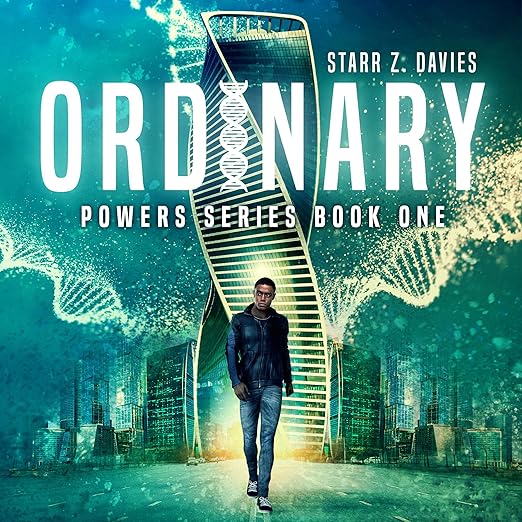
The powerless protagonist in a world of superpowers is a premise that has been worked hard in YA fiction, but Starr Z. Davies brings something genuinely unsettling to it. Ordinary – book one of the Powers Trilogy – is not merely a story about someone who is different in a world that prizes conformity. It’s a story about institutional betrayal, the ethics of sacrifice, and what it costs to be a person of principle when the institution holding you has no principles at all. Nathaniel Ascher’s narration gives the book an urgency that keeps the pages, or rather the chapters, turning at a clip. The 4.5-star rating from 79 listeners understates, I think, how accomplished this series opener is.
About the Audiobook
In Davies’s world, the near-extinction of humanity has left a society rebuilt entirely around superpowers. Your ability determines your education, your employment, your social standing. Seventeen-year-old Ugene has no power – a condition so rare and stigmatised that it makes him effectively unemployable. When the Paragon biotech corporation offers him a place as a test subject, ostensibly to help solve a growing crisis of power regression across the population, Ugene agrees. What he finds inside Paragon is something far darker: sealed exits, test subjects suffering catastrophic injuries, and disappearances nobody will explain.
The novel borrows from dystopian classics – the sealed facility, the institutional lie, the protagonist who must choose between self-preservation and collective responsibility – but Davies deploys these elements with confidence and pace. The character of Ugene is particularly well-drawn: his lack of powers has forced him into problem-solving and observation rather than physical response, and those qualities make him a genuinely useful protagonist in a way that powerless characters in other stories sometimes aren’t. The moral escalation of the final act lands with real weight. At ten and a half hours, it’s a substantial listen that earns its length.
The Narration
Nathaniel Ascher brings Ugene’s interiority to life with a performance that never tips into melodrama despite the material’s escalating intensity. He captures the specific quality of a teenager who has had to be sharper and more self-reliant than his peers simply to survive, without making Ugene seem preternaturally mature or detached. The world-building scenes – explanations of powers, the Paragon facility’s systems – are delivered with enough clarity that the listener can track the logic without feeling lectured. This is disciplined, effective narration for a genre that sometimes attracts more theatrical approaches than the material requires.
What Readers Say
At 4.5 stars from 79 ratings, Ordinary has a dedicated following. Sian, reviewing from the UK, calls it “one of those books that I genuinely struggled to put down” and praises the “morally grey woman in power” as a favourite trope well-executed. Kirsty Barrett notes that “the characters are all real,” which is the highest compliment you can pay a dystopian novel in a genre that sometimes sacrifices character for world-building. The reviewer Anie provides a detailed breakdown of the world’s premise and concludes: “so intense!” – which is precisely what it is. The one note of caution from C. Rowlands concerns whether Ugene’s lack of powers will eventually be revealed as a concealed super-power; it’s a reasonable question that the trilogy eventually answers in a more interesting way than the obvious.
Who Should Listen?
Ideal for teenagers and adults who enjoy dystopian science fiction with a strong ethical core. Fans of Divergent, The Testing, and Elly Blake’s Frostblood trilogy will find themselves in familiar territory, but Davies’s institutional focus and morally complex supporting cast give Ordinary a distinctive flavour. The cliffhanger ending commits fully to its darkness, so be prepared to have book two queued up before you finish.
Listen to Ordinary on Audible UK – find it via this link. Also available on Kobo, Scribd, and Storytel.