Clara’s Verdict
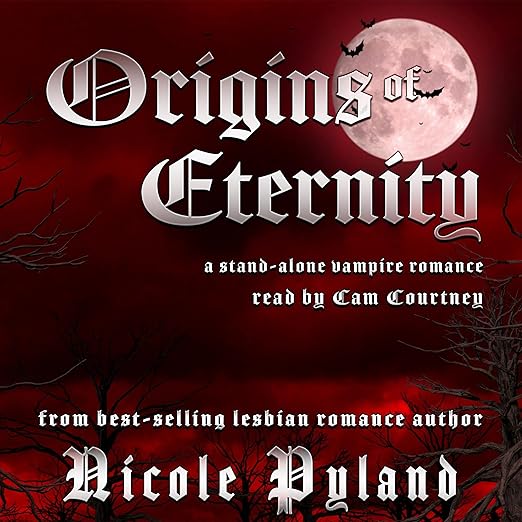
Nicole Pyland has built a substantial and loyal following in sapphic romance over the past several years, and Origins of Eternity demonstrates both why that following exists and where this particular book falls slightly short of her strongest work. The premise is genuinely interesting – a centuries-old vampire leaving a toxic long-term relationship to find something real – and at ten and a half hours the book gives that premise real room to breathe. Rated 4.4 from 129 listeners, it is a solid entry in the paranormal romance genre. My reservations are structural rather than fundamental: the decision to use multiple points of view dilutes some of the central romance’s intensity, and readers who came specifically for the Iro and Arwen dynamic may find themselves impatient with the detours.
That said, the central emotional architecture of the book – a vampire as survivor rather than predator, navigating the aftermath of a centuries-long relationship that has slowly become controlling and violent – is more thoughtful than the genre standard. Pyland takes the psychological dimension of Iro’s departure from Cassia seriously, which elevates the story beyond its supernatural surface.
About the Audiobook
Iro Black is a vampire who has spent three centuries with Cassia, the woman who turned her. The relationship has curdled over the long years: Cassia still kills, still feeds on humans, still controls and manipulates; Iro has moved in a different direction entirely, giving up violence years ago and building something that looks, from the outside, like an ordinary business life. When Iro relocates from Paris to Washington DC, she meets Arwen Lam at a bar, and the story that follows is as much about the aftermath of leaving an abusive partnership as it is about falling into a new relationship. That dynamic is genuinely refreshing: Iro is not a predator in search of a victim, but a survivor learning what it means to be free.
The complication is that Cassia has not accepted the ending of their relationship, and her attempts to destroy Iro’s new happiness give the plot its external tension and its darker passages. Pyland handles Cassia with more complexity than straight villainy – there are moments where you understand, if you do not sympathise with, how a three-century attachment could make someone incapable of letting go. The world-building around vampire society, rules, and history is consistent and detailed enough to support a longer series without feeling underdeveloped in this first entry.
There is a secondary strand in the novel that is worth noting: the friendship between Arwen and her best friend Zara, which provides the book with some of its lighter and more emotionally straightforward moments. Zara’s uncomplicated delight in Arwen’s new romance acts as a tonal counterweight to the threat from Cassia, and Pyland handles the friendship dynamics with the same warmth she brings to her best contemporary work. It is a reminder that the paranormal scaffolding here is in service of character relationships rather than the other way around.
The Narration
Cam Courtney handles the multiple perspectives with real professionalism, distinguishing between the various character voices clearly and consistently without resorting to exaggerated vocal characterisation. The pacing through the romantic scenes is well-judged – unhurried enough to let the emotional moments land, without lingering so long that the tension drains away. The darker sequences involving Cassia are read with appropriate menace and control. At over ten hours, Courtney sustains the tone consistently throughout, which is a significant achievement in a narrative that moves between warmth, threat, and the particular register of immortal beings remembering things that happened centuries ago.
What Readers Say
With 129 ratings at 4.4 stars, the response is broadly positive. The most consistent note of caution – raised by reviewer CJ, who gave it four stars – is that the multiple points of view dilute the central romance. “I wish it was more about Iro and Arwen,” CJ wrote, adding that the blurb does not prepare you for a four-POV structure. Fans of Pyland’s other work found it enjoyable but not among her strongest entries; new readers coming to the book cold tend to rate it more highly, without the comparison point of her best novels. The vampire mythology is consistent and carefully constructed, and the central relationship arc – despite the competition from the other viewpoints – delivers a satisfying conclusion.
Who Should Listen?
Readers of sapphic paranormal romance who enjoy slow-burn dynamics and emotionally complex protagonists will find plenty here to engage with. The book works particularly well if you approach it as a story about leaving and beginning to heal as much as about falling in love – the departure from Cassia is, in some ways, the more interesting narrative than the romance with Arwen. If you are a Pyland reader who has enjoyed her contemporary work and want to see what she does with supernatural elements, this is a confident entry into that territory. Available on Audible UK.