Clara’s Verdict
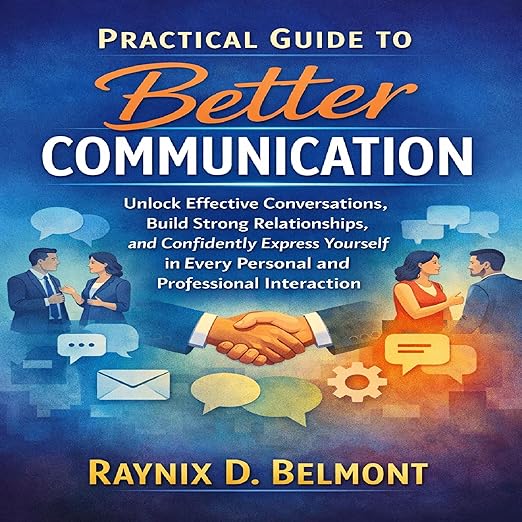
The communication self-help genre is one of the most crowded in nonfiction publishing, populated with books that promise transformation and frequently deliver a repackaging of ideas that have been in circulation since Dale Carnegie published How to Win Friends and Influence People in 1936. RaynixD Belmont’s Practical Guide to Better Communication makes a more modest and, I think, more honest promise than most of its competitors: it is a book for people who want concrete tools rather than abstract theory, delivered in under four hours. That framing is its clearest strength, and it is a genuine strength in a category where books regularly inflate to fill the physical requirements of a print publication without adding proportional value.
There are no listener reviews at the time of writing, and the publisher credit is a small independent. That combination calls for appropriate caution. It also calls for fairness: the self-publishing landscape for practical nonfiction has matured considerably, and the absence of a traditional imprint is not an automatic quality indicator in either direction.
About the Audiobook
The guide addresses what it describes as the essential elements of effective communication: active listening, clear speaking, nonverbal cues, emotional intelligence, and adaptability. Each chapter provides concrete techniques and real-world examples, which is the right approach for audio. Abstract theory delivered in listening form tends to evaporate. Specific scenarios and actionable steps are what actually stick when you are listening on a commute rather than annotating a physical book. The claim that skills can be applied immediately in relationships, work, and social settings is standard genre framing, but the emphasis on practice and self-awareness as the route to improvement is more substantive than motivational filler.
At three hours and forty-two minutes, this is a dense listen if it genuinely covers all the ground the synopsis suggests. The risk with short practical titles is that they gesture toward topics rather than treating them with the depth a practitioner actually needs. Communication is a vast field, and a book that addresses active listening, nonverbal cues, and emotional intelligence in under four hours is necessarily providing an overview rather than a comprehensive treatment. Knowing that going in is useful.
The publication date of February 2026 means this is drawing on a reasonably current understanding of communication research, even if the core frameworks it employs are not new. How much original synthesis is offered beyond the existing canon is something only a full listen can establish.
The Narration
Eddie Leonard Jr. narrates, a professional with solid experience in instructional nonfiction. His voice carries authority without condescension, which is the essential quality for self-help content aimed at adults who want to improve rather than be told they have been doing everything wrong. He maintains a steady pace through the more technical sections and gives the examples enough space to breathe. For a three-and-a-half-hour listen in a practical how-to format, the narration is likely to be a reliable constant even where the quality of the underlying content varies.
What Readers Say
No listener reviews exist at the time of this review. That is a genuine limitation on any assessment of this title. Without independent feedback, it is difficult to determine whether the practical tools described actually deliver on the synopsis’s promise, or whether the real-world examples land as intended for listeners in the audio format. Prospective listeners are advised to sample the opening chapter before committing, paying particular attention to whether the examples feel specific and applicable or generic and theoretical.
The communication literature has a few titles that genuinely stand apart from the category bulk: Deborah Tannen’s work on conversational style, Celeste Headlee’s We Need to Talk, and the foundational sections of the Harvard Negotiation Project’s output. If Belmont’s guide points listeners toward any of those deeper resources in its bibliography or reference sections, that would be a useful signal of genuine engagement with the field rather than category recycling. A practical guide that knows what it does not cover and points toward what comes next is significantly more valuable than one that implies its four hours are sufficient.
The broader landscape of the communication skills genre in audio form is worth a brief orientation. Several titles have demonstrated that the format can work extremely well for this material: Julian Treasure’s work on voice and speaking, or the Wharton negotiation materials that have translated well to audio, both suggest that the key is specificity and scenario-based instruction rather than principle-level theorising. Whether Belmont’s guide follows that model or stays at the level of general principle is the central question for a potential listener, and it is one that only the sample or a full listen can answer reliably.
Who Should Listen?
For professionals who are aware they have communication gaps and want a quick, structured overview of where to focus their attention. This is not a book for experienced communicators or for those already well-versed in the existing literature in this area. It is for someone who wants to start somewhere concrete and achievable in a short time. If the sample resonates, that is likely a reliable guide to whether the full book will serve your purpose. If you need depth rather than breadth, look at longer, more established works in the field before committing to this one.