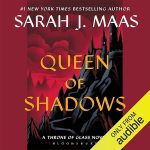
Clara’s Verdict
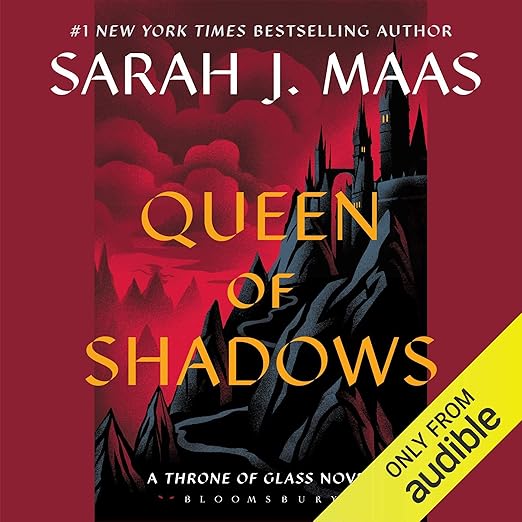
I spent a considerable portion of my late editing career watching fantasy novels arrive on my desk with series ambitions that their opening volumes had not quite earned. Sarah J. Maas is not that kind of writer. By the time you reach Queen of Shadows – the fourth book in the Throne of Glass series – you are so deep inside the world of Erilea, so invested in Celaena Sardothien’s transformation into Aelin Galathynius, that the book’s scale feels not like indulgence but like necessity. This is fantasy that has genuinely earned its size.
The Goodreads Choice Award for Best Young Adult Fantasy in 2015 gives some indication of the book’s reception at the time of publication. More than a decade on, Queen of Shadows holds a 4.8 rating from 149 Audible UK listeners, which is an exceptionally strong signal for a series instalment that runs to nearly 21 hours of audio. Some readers in these reviews describe it as the best of the series so far; others, more honestly, call it a setting-up book. Both assessments are correct and compatible: this is a book that does a great deal of structural work for what follows, and is nevertheless deeply satisfying on its own terms.
About the Audiobook
Queen of Shadows is the fourth book in the Throne of Glass series and was published in September 2015 by Audible Studios. At 20 hours and 43 minutes, it is substantial even by the generous standards of its series. The synopsis positions it as a pivotal transition: Celaena has fully embraced her identity as Aelin Galathynius, the lost Queen of Terrasen, and returns to the empire not as an assassin for hire but as someone with a kingdom to reclaim and people to save. There is a cousin to rescue, a friend in an unspeakable prison, and a tyrant king whose grip on the enslaved people of Terrasen must be broken.
Maas structures this book in multiple points of view – a technique she has used throughout the series, but which becomes more complex here as the ensemble grows. Manon Blackbeak and her Thirteen, the iron-teethed Ironteeth witch captain, gets substantial space in this volume and is consistently cited by readers as a highlight: a villain-coded character rendered with such three-dimensional specificity that she functions as a protagonist in her own right. The question of what constitutes monstrousness – the series’ central moral inquiry – is nowhere more fully explored than in Manon’s sections.
The Wyvern-riders, the political machinations of Adarlan, and the slowly assembling alliance of characters who will eventually stand against the king are given room to breathe here in ways that the earlier, more propulsive volumes did not always allow. This is why some readers call it a filler book and why others call it the best of the series: it depends entirely on whether you are reading for plot momentum or for character depth.
The Narration
Elizabeth Evans narrates, and this performance is one of the genuine assets of the Audible version. Evans has a range and expressiveness that serves Maas’s ensemble particularly well: she differentiates the cast cleanly – Aelin’s controlled fire, Rowan’s guarded intensity, Manon’s predatory precision, Lysandra’s layered calculation – without ever losing the thread of who is speaking. Over twenty hours the performance sustains its energy and investment without flagging. Evans has narrated the full Throne of Glass series, and the familiarity she has built with these characters is audible in every chapter. She is the voice most readers now associate with Celaena and Aelin, and it is difficult to imagine the series without her.
What Readers Say
The 4.8-star average from 149 listeners places this among the highest-rated audiobooks in the fantasy catalogue. Siobhan Davis, reviewing in 2016, called it the best of the series so far and praised the pacing and world expansion. A reviewer known as Bex described it as bloodthirsty as its murderous characters, praising the representation of truly bad-ass women with convincing vulnerability. The review from Tori, written in Australia in January 2026, captures the series’ maturation precisely: darker, larger, and more confident, the story begins to feel truly epic rather than simply large. The most honest review comes from Emmak89, who called it a filler book and then admitted it was a damn big and enjoyable one – which is a fair assessment of what Maas is doing structurally.
Who Should Listen?
This is exclusively for readers already in the Throne of Glass series. Coming in at book four without the accumulated context of the first three volumes is not impossible, but you will lose the emotional weight of Celaena’s transformation, the significance of the character relationships, and the full force of the world-building. If you have read Throne of Glass, Crown of Midnight, and Heir of Fire, this is the inevitable next step and a strong one. If you are entirely new to Maas and want an entry point, the first book in the series is the correct place to start, not here.