Clara’s Verdict
Pride and Prejudice variations are their own cottage industry at this point, and the quality is wildly uneven. Some handle the source material with reverence and produce something that feels like careful period fan fiction. Others take genuine creative risks with the characters and setting, and occasionally produce something that genuinely extends Austen’s world rather than merely inhabiting it. Room for Improvement by Jessie Lewis is the latter kind. Part of the “Inspired by Austen” series, it brings a real wit to the material – trusting the reader to find Darcy and Elizabeth funny as well as romantic – and the Brighton seaside setting gives the variation a spatial logic that sidesteps the Netherfield-Pemberley circuit without feeling forced or arbitrary.
Rated 4.5 from 633 listeners at launch, this has found a substantial and enthusiastic audience, and the response makes sense: this is a variation that respects the source without being enslaved to it, and that balance is harder to achieve than it looks.
About the Audiobook
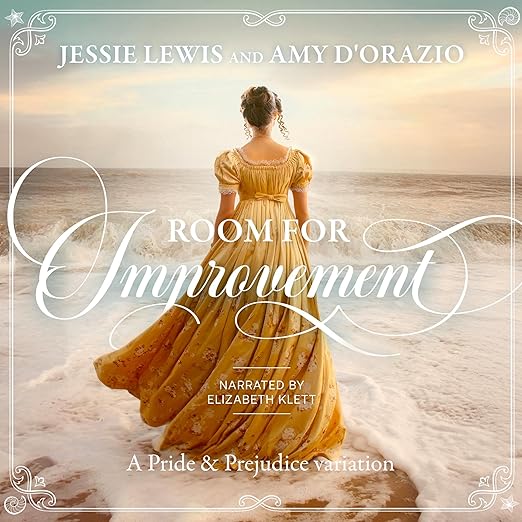
Running just over eight hours and released in March 2026, Room for Improvement picks up the Darcy and Elizabeth story with an inventive setup: Elizabeth inherits a crumbling seaside mansion in Brighton, which she plans to restore. Before she can begin, it’s rented – against her wishes, before it’s remotely habitable – by Viscount Saye, who arrives to stay with his cousin Mr. Darcy. Darcy, his pride still smarting from Elizabeth’s rejection in Kent and his cousin’s pointed suggestion that heartache has made him stout, is hoping the seaside will do him good. When his new landlady turns out to be the woman who refused him, the situation becomes both acutely uncomfortable and – for the reader – enormously entertaining.
Lewis uses the dilapidated property as a running metaphor with genuine consistency and invention. Every structural crisis in the house corresponds to a crisis or breakthrough in the relationship; the fresh plaster can’t cover the cracks any more than Darcy’s renewed pride can cover his feelings. It’s a neatly constructed conceit and Lewis develops it with confidence throughout, never letting it tip into forced symbolism. The secondary characters – Viscount Saye, Georgiana, Lydia – are used generously and given their own story threads that add texture without overwhelming the central romance. The comedy is sharp, the angst is genuine, and the stolen kisses are earned rather than dropped in for pacing.
Lewis also demonstrates a real understanding of why the original novel continues to work so powerfully: it is not the plot mechanics – the misunderstandings, the miscommunications, the social pressures that keep Darcy and Elizabeth apart – but the underlying recognition that both characters are dealing with genuine pride in themselves that needs to be genuinely humbled. Brighton and its crumbling mansion provide a new set of circumstances for that process, but the emotional logic is Austen’s own, respected and extended rather than replaced.
The Narration
Elizabeth Klett narrates, and she’s a veteran of the Austen variation space who brings the specific skills the genre requires. Her work is clean, well-differentiated between a substantial cast of characters, and consistently paced across eight hours. She handles the comic sequences with a dry lightness that respects the source material without imitating it – the joke lands without needing to be underlined. The more emotionally charged exchanges between Darcy and Elizabeth have a genuine tension that builds naturally across the book’s progression. For a romantic audiobook, the quality of the narration in the key emotional scenes carries enormous weight, and Klett reliably delivers where it matters.
What Readers Say
The response has been emphatic across the board. “A dream of a book,” wrote one reviewer, praising the humour, the genuine stakes, and particularly Darcy’s confession of love as told to his rival – which she describes as worth reading the book for alone. Another who described herself as a devoted Jessie Lewis reader called this one “sparkling”: a doubting Lizzy and a doubting, brooding, remorseful Darcy navigating multiple obstacles and misunderstandings while their cousins and siblings create constructive mayhem. The Georgiana-Lydia subplot has been specifically praised as “unexpected and very funny,” suggesting Lewis has found ways to use the secondary cast that go beyond their roles in the original. Highly recommended by everyone who’s read it; no dissenting voices in the reviews collected so far.
Who Should Listen?
Austen devotees who enjoy variations that honour the source while taking genuine creative risks will be in their element here. Particularly recommended for listeners who want wit alongside romance – this is not a book that sacrifices either the comedy for the passion or the passion for the comedy, but holds both in balance throughout. The seaside setting and the renovation backdrop make it particularly pleasant summer listening, though it works in any season. Also strongly recommended for fans of Jessie Lewis’s previous work, which this meets and in several respects exceeds.
Listen to Room for Improvement on Audible UK – also available on Kobo, Scribd, and Storytel.