Clara’s Verdict
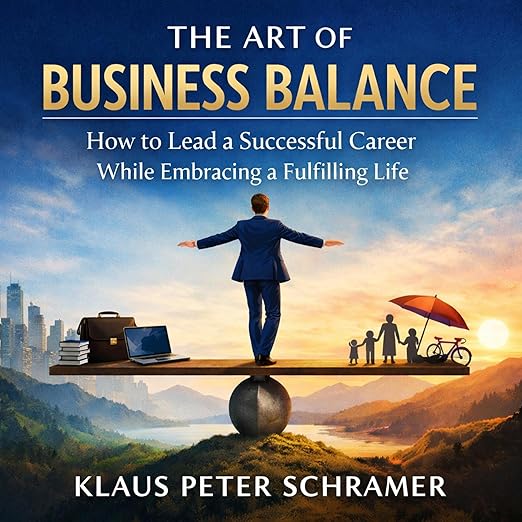
The Art of Business Balance arrives as a brief, earnest guide to the problem that occupies much of professional life: how to pursue ambition without surrendering health, relationships, and the texture of daily living in the process. At 1 hour and 23 minutes, it is a short listen, and the ambition is correspondingly modest. Klaus Peter Schramer is not attempting anything as sweeping as Oliver Burkeman’s Four Thousand Weeks or Cal Newport’s Deep Work. What he offers is a concise framework for thinking about burnout, boundary-setting, and what he calls sustainable habits.
This is a self-published title with no listener ratings at time of writing, released in March 2026. The absence of ratings means we should treat it as an unknown quantity and review it honestly on its own stated terms.
About the Audiobook
Published on 13 March 2026 and running for 1 hour and 23 minutes, this is Schramer’s guide to building what the synopsis describes as a life that feels meaningful, calm, and fulfilling without sacrificing professional ambition. The structure is promise-led: the book itemises what you will learn across its course, from creating balance that adapts to real life rather than rigid schedules, to building emotional resilience in high-pressure environments, to avoiding burnout and sustaining motivation over time.
The book’s central claim, that balance is not a fixed state but a dynamic practice that must be rebuilt continuously as circumstances change, is more sophisticated than its packaging might suggest. Schramer is not arguing for a perfect work-life equilibrium; he is arguing for an ongoing practice of recalibration that keeps ambition from consuming everything else in its path.
The framing is sensible and the coverage is broad. Schramer addresses boundary-setting, energy management, relationship strengthening, and leadership clarity. The audience is explicitly wide, described as professionals, entrepreneurs, leaders, or anyone feeling pulled between ambition and wellbeing. At under 90 minutes, the treatment of each topic is necessarily brief, which means this functions better as an orientation to these ideas than as a detailed manual. Think of it as a starting point rather than a destination. Someone who reads Newport or Burkeman afterwards will find this was a reasonable warm-up, and someone who never goes further will at least have a coherent framework for thinking about the problem.
The fact that this is self-published does not in itself determine quality, but it does mean there has been no editorial process beyond the author’s own judgement. New listeners may want to sample a chapter before committing, which Audible’s listening sample feature makes possible.
The Narration
Genevra Lupa Catalano narrates with clarity and a measured pace that suits the instructional register of the material. Her delivery is professional and warm without being overly performative, which is the appropriate choice for self-help content of this kind. Listeners who find overly theatrical narration distracting in non-fiction will find her approach easy to follow. The short runtime means there is no fatigue to contend with.
The match between narrator and material is adequate rather than exceptional. Catalano reads the text competently, but a short self-help title with no narrative arc or character work offers limited scope for a narrator to do anything memorable. She performs what is asked of her efficiently and clearly.
What Readers Say
There are no listener reviews at the time of writing. This is a newly released self-published title, and the absence of ratings is neither a positive nor a negative signal at this early stage. What it does mean is that the usual social proof is absent, and prospective listeners will need to make their decision based on the synopsis and their own sense of whether they need what the book offers.
There is also the question of who this book is primarily for. The language of the synopsis suggests a broad professional audience, but in practice the advice it contains will land most usefully with people who are already experiencing the friction of overcommitment rather than those who are merely anticipating it. A person in the middle of genuine burnout does not need convincing that balance matters; they need practical tools for beginning to reclaim space, and that is where this book’s brevity may actually be a virtue rather than a limitation.
Given the brevity of the runtime and the low barrier to entry, the risk of the investment is modest. If the framing of burnout and sustainable ambition resonates with your current situation, the 83-minute listen represents a reasonable exploratory commitment. Return here in a few months once listener reviews have accumulated, and this assessment may be supplemented by direct audience response.
Who Should Listen?
This will suit professionals currently navigating genuine burnout, or those who want a brief, structured primer on work-life integration before exploring the topic in more depth. It is not a replacement for longer, more rigorous treatments of the subject. If you have already read Burkeman’s work, Newport, or Jenny Blake’s Pivot, you will find this covers familiar ground at shallower depth. For listeners entirely new to these ideas who want a quick orientation before deciding whether to invest in longer reading, it may serve as a useful entry point. Sample before purchasing if possible.
The Art of Business Balance is available on Audible UK. Listen on Audible UK