Clara’s Verdict
A villain’s origin story is a difficult thing to pull off, and The Ballad of Songbirds and Snakes is Suzanne Collins at her most quietly audacious, asking us to spend hundreds of pages inside the young mind of the man who becomes the great tyrant of the Hunger Games. It should not work as well as it does.
The gamble is that we watch Coriolanus Snow while he is still, arguably, a person, ambitious, proud, fallen on hard times, and capable of feeling. Collins refuses easy sympathy and refuses easy condemnation, letting us see the small choices and self-justifications that harden, over time, into something monstrous. It is a chilly, intelligent book about how a certain kind of ruin is chosen rather than fated.
It is longer and more reflective than the original trilogy, and readers hoping for the relentless propulsion of the Games themselves may need to recalibrate. Stay patient and the reward is real: a portrait of power and its costs that deepens everything you thought you knew about Panem.
About the Audiobook
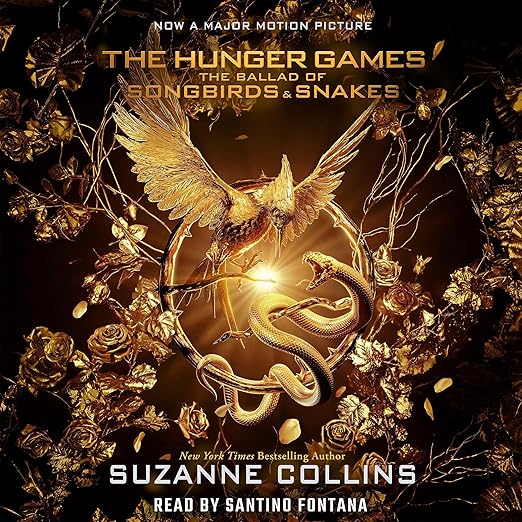
The Ballad of Songbirds and Snakes returns to the world of the Hunger Games, this time as an origin story. It is the morning of the reaping that will begin the tenth annual Games. In the Capitol, the eighteen-year-old Coriolanus Snow is preparing for his one shot at glory as a mentor, with the once-mighty house of Snow fallen on hard times and its fortunes resting on the slender hope that he can outcharm, outwit and outmanoeuvre his classmates to mentor the winning tribute.
The odds are against him. He is handed the humiliating assignment of mentoring the female tribute from District 12, considered the lowest of the low, and their fates become completely intertwined. Every choice he makes could bring favour or failure, triumph or ruin. Inside the arena it is a fight to the death, while outside it Coriolanus finds himself beginning to feel for his doomed tribute, and having to weigh his need to follow the rules against his sheer determination to survive at any cost. It is a story about ambition, control and the making of a tyrant.
What Collins is really examining is the machinery of power and the moment a person decides who they will become. By setting the story in the shabby, early days of the Games, long before the polished spectacle of the original trilogy, she lets us watch cruelty being rationalised in real time. Coriolanus is never quite a monster here, which is what makes the book so unnerving, and the doomed bond with his District 12 tribute keeps genuine feeling in play even as his choices curdle. It is a study of how ambition and fear can quietly hollow a person out.
The Narration
Santino Fontana narrates this edition across sixteen hours and sixteen minutes, and it is a performance of considerable control. Snow is a slippery narrator, self-flattering and self-deceiving, and Fontana threads that needle beautifully, giving us a young man who sounds reasonable, even sympathetic, precisely when we should trust him least.
Over sixteen hours that restraint pays dividends. Fontana keeps the Capitol’s chilly poise while letting genuine feeling flicker underneath, and he handles the songs and set pieces without overplaying them. It is a long listen for a reflective book, but the narration sustains the tension, and it makes the slow tightening of Snow’s character audible in a way the page cannot quite manage.
Sustaining a novel this long from inside such an untrustworthy head is no small feat, and Fontana manages it by trusting the material rather than editorialising. He lets Snow sound plausible, even likeable, so that we feel the pull of his reasoning before we recoil from it, which is far more chilling than any villainous flourish. Across sixteen hours he keeps the Capitol’s brittle poise intact, handles the songs without strain, and paces the slow, dreadful hardening of his narrator so that the ending feels less like a twist than an inevitability.
What Readers Say
Across 71 ratings the audiobook averages 4.5 stars, and reviewers who love the original trilogy have largely embraced it. Several call it a compelling and notably dark prequel, praising the way Collins builds out the history of Panem and the civil war that shaped it, and one described being hooked despite an initial scepticism about spending a whole book with Snow.
The measured four-star responses are honest about the shift in pace and tone, with one reader admitting that curiosity about the war and about Snow’s psychology was what carried them in. Others single out the world building and the depth Collins grants her future villain, noting the small hints and connections that enrich the original saga. It is thoughtful, engaged praise from an audience that plainly cares about this world.
Who Should Listen?
This is essential listening for anyone invested in the Hunger Games, and a rewarding, standalone entry point for readers drawn to morally complex character studies. Newcomers can follow it without having read the trilogy, though longtime fans will get the most from its echoes and foreshadowings. Be ready for a slower, more contemplative experience than the Games themselves.
If a chilling, intelligent origin story sounds like your kind of long listen, this one repays the hours, and you can Listen to The Ballad of Songbirds and Snakes on Audible to settle into it.