Clara’s Verdict
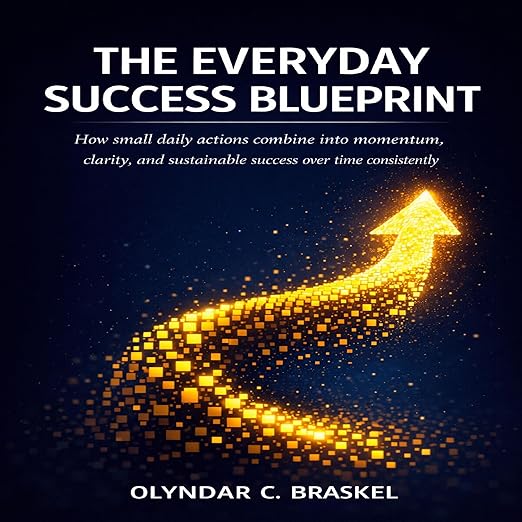
The habits-and-systems corner of the personal development audiobook market is among the most crowded areas on the platform, and any new entry has to justify its presence alongside established titles with deeper evidential bases and larger audiences. The Everyday Success Blueprint by Olyndar C. Braskel, self-published in March 2026 and running to just over three hours, does not attempt to compete on the level of research depth or proprietary framework. It aims at clarity, accessibility, and the kind of practical orientation that gives someone new to this territory a coherent starting point, and within those deliberately modest parameters it delivers what it promises.
That modesty of ambition is itself a form of honesty that the personal development space does not always practice. This is an introduction to habits-based thinking, clearly structured and practically oriented, and approaching it as anything more ambitious will lead to a mismatch between expectation and delivery.
About the Audiobook
Braskel’s central argument is that success is built through the repeated, intentional execution of ordinary daily actions rather than through exceptional talent, fortuitous timing, or dramatic life overhauls. This is not a novel theoretical contribution, and Braskel does not claim that it is. What he offers instead is a clear, operationally focused synthesis that specifically addresses the gap between understanding the principle and beginning to act on it, which is the practical problem that most readers of the habits literature have actually encountered. The gap between knowing and doing is where this book operates.
The framework covers five interrelated areas. Morning structure addresses how to design the opening hour of the day to create momentum rather than dissipate energy before anything significant has happened. Energy management treats attention as a finite resource to be allocated deliberately rather than assuming willpower is available on demand. The section on procrastination and self-doubt is the most practically valuable of the five: Braskel does not present these as simple matters of decision, but offers specific techniques for disaggregating large tasks into components small enough that starting them becomes genuinely low-cost, and for interrupting the avoidance loop before it becomes entrenched as a habit in its own right. The focus section addresses digital hygiene and environmental design with useful specificity. Recovery from setbacks, the fifth and final area, is where the book distinguishes itself most clearly from purely aspirational self-help by treating failure explicitly as data to be processed rather than a problem to be prevented or a sign of fundamental inadequacy.
The title promises a blueprint and the audiobook delivers something closer to a well-considered sketch: a clear outline requiring the listener to fill in the specific detail according to their own circumstances, goals, and current position. Whether that is a strength or a limitation depends entirely on what you came for. Those wanting a ready-made system to adopt wholesale will be frustrated. Those wanting a set of organising principles they can adapt intelligently will find genuine value. The absence of extended case studies keeps the runtime tight but also limits the reader’s ability to see the principles tested against concrete real-world examples.
The Narration
Robyn Green reads with a calm, encouraging presence that suits the material without tipping into the saccharine register that sometimes affects narrators working in this genre. She handles the more abstract passages on mindset and identity without losing practically oriented listeners in the process, and maintains an energy level throughout that makes three hours feel like two. The production from Tori Slamon is clean and professional. Green’s delivery has the quality of someone who genuinely believes what she is reading without performing that belief as a motivational technique, which is a genuinely fine line in this genre and she navigates it with care and consistency.
What Readers Say
No Audible UK listener reviews have been posted at the time of writing, reflecting both the March 2026 release date and the limited marketing reach of an independently produced title. Sampling before purchasing is particularly advisable here: whether this adds meaningful value relative to what you have already absorbed from the broader habits literature is something only you can assess accurately from your current position in the territory.
Who Should Listen?
Those relatively new to the personal development space who want a structured, accessible introduction to habits-based thinking before committing significant time to longer, more evidentially dense titles. Also potentially useful for listeners who have read more ambitious books in this area and found them difficult to translate into practical daily action, and who want a simpler operational framework as a workable starting point. Not aimed at people who already have a functioning system they are happy with: this is orientation rather than optimisation, and it performs best when approached on exactly those terms. At three hours, the cost of discovering it is not the right fit for your stage is genuinely low.