Clara’s Verdict
I was perhaps eleven when I first encountered The Happy Prince, read aloud by a teacher who did not warn us it was going to end that way. The classroom went very quiet. That is the particular power of Wilde’s fairy tales: they arrive dressed in the language of enchantment and beauty and moral simplicity, and then they do something that children understand precisely because they have not yet learned to protect themselves from it the way adults have. I came back to this Puffin Classics edition on a slow Sunday afternoon, expecting something comfortable and nostalgic. What I got was something that still stings in the way it always has, and something that is even richer when you listen with the full weight of Wilde’s biography in mind.
He wrote these stories for his children. He also, unmistakably, wrote them from somewhere much darker than a nursery, from a place that knew very precisely what it felt like to be beautiful and valued and visible, and then not to be any of those things at all.
The Other Side of Wilde
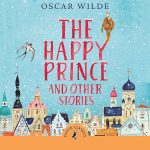
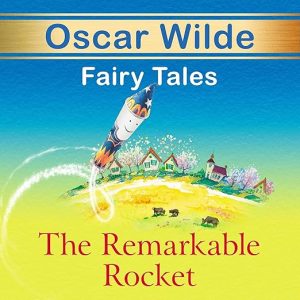
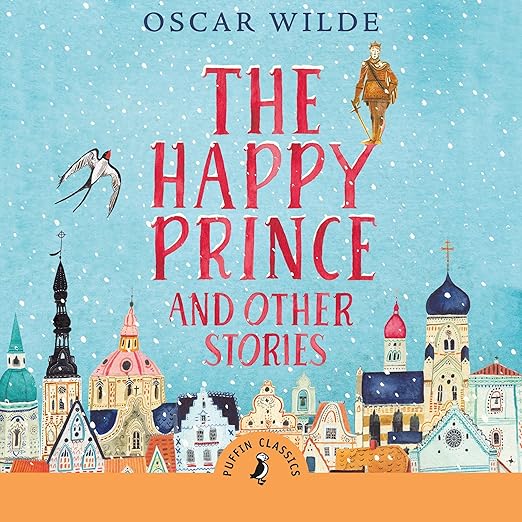
Published by Puffin as part of the Timeless Classics series, this unabridged edition runs three hours and six minutes and was released in 2009. The collection gathers Wilde’s most celebrated short fiction: The Happy Prince, The Selfish Giant, The Devoted Friend, The Remarkable Rocket, and The Star-Child. Each story operates on two levels simultaneously, and Wilde never condescends to readers of either level. They are simultaneously stories for children and stories about adult moral failure, self-deception, and the specific ways that beauty and goodness come apart in a world that values the wrong things.
The Happy Prince, which gives the collection its title, tells of a gilded statue of a once-happy prince who enlists a migrating swallow to strip himself of his gold and jewels, distributing them to the poor of the city below, until both swallow and prince are destroyed by the winter they have chosen to endure together. The Selfish Giant is a story of exclusion and grace that arrives at its final image with devastating quietness; it is not a comfortable story despite its apparent simplicity. The Star-Child follows a beautiful boy who rejects his mother and pays for it across a journey that is more folk tale than fairy tale in its moral architecture, darker and less forgiving than the others.
What makes these stories remarkable, and what gives them an unusual quality as audiobook listening, is that Wilde’s prose rhythms are designed to be heard. He came from an oral tradition of Irish storytelling, and the sentences are built for the ear. The rise and fall of his cadences, the slight formality of his diction, the way he uses repetition as both a structural device and an emotional accumulation; all of this becomes considerably more apparent in audio than on the page. Listening to Wilde is not the same as reading him, in the best possible way.
John Moffatt and the Art of Restraint
John Moffatt reads the collection, and this is precisely the right voice for these particular stories. Moffatt has a warmth that does not tip into sentimentality, and a clarity of diction that allows Wilde’s language to do its work without interference or embellishment. He understands that these stories should be delivered at the pace of someone telling them aloud rather than performing them for effect, and that distinction matters enormously here. There is a particular restraint in his handling of the final pages of The Happy Prince that makes the ending land as it should: quietly, without announcement, with the full weight of its implications carried by the prose rather than by the performance. This is a narrator who trusts the text, which is the highest form of respect a narrator can pay a writer.
What Readers Say
The audiobook carries a rating of 4.4, with a small number of listeners reflecting the format’s 2009 vintage. Edoardo Albert, reviewing in the UK, wrote beautifully about the contrast between the Wilde who could wound with wit and the Wilde who wrote stories of purest innocence, calling these tales the other side of the man entirely. R. Burnett recalled the emotional power of The Happy Prince from childhood and found the other stories written in a romantic style that suited their author, noting that endings sometimes arrived unexpectedly. DougB connected the stories directly to Wilde’s biography, reading The Happy Prince as a projection of the author’s own experience of isolation and the suppression of his true self in a society that would ultimately destroy him for it. One reviewer noted that the sadness of the stories gave a ten-year-old nightmares, which is worth noting if you are selecting this for younger children. These are tales that respect the reader’s capacity for difficult feelings rather than protecting them from it.
Who Should Listen?
This collection is for adults who want to return to Wilde’s fairy tales with the full context of his life in mind, for older children and young adults who are ready for stories that take sorrow seriously, and for anyone who loves prose that rewards the ear as much as the eye. At just over three hours, it fits comfortably into a Sunday afternoon. It is also an excellent choice for listening with older children, with the understanding that some conversations may follow. Wilde’s wit, which dominates his comedies and his aphorisms, is largely absent here. This is a quieter, more exposed version of the writer, and for that reason, one of the most revealing.