Clara’s Verdict
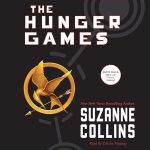
I was about eleven when a neighbour’s daughter left a battered paperback copy of The Hunger Games on our kitchen table after a summer visit. I read it in a single afternoon, which had not happened to me since the Narnia years. That physical memory has stayed with me, so coming to Tatiana Maslany’s 2018 special edition recording was a slightly strange experience: I knew every turn of the plot, every character beat, and still the narration made it feel urgent in a way that caught me off guard. Maslany does something precise and quite difficult: she does not perform Katniss, she inhabits her.
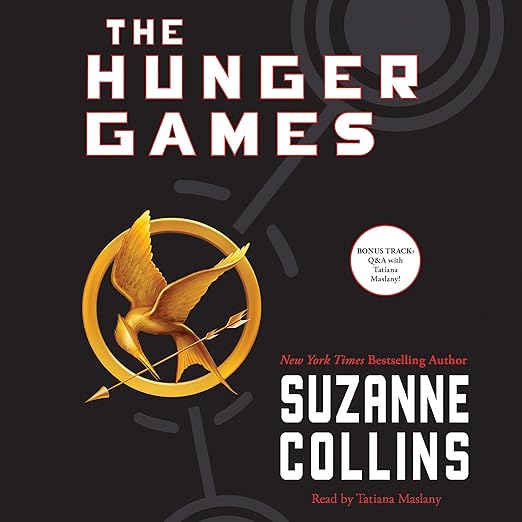
The Hunger Games is the first book in Suzanne Collins’s trilogy, originally published in 2008 and read here in a special Scholastic Audio edition that includes a bonus Q&A track with the narrator. That this recording, made a decade after the original publication, has become the definitive audio edition for many listeners says something about how much the right narrator can give a canonical text renewed life.
Panem and the Grammar of Survival
The premise is well known but deserves clear articulation. Panem is a post-apocalyptic North America divided into twelve districts held in submission by the Capitol, a gleaming urban centre that maintains its control through spectacle, economic dependency, and annual ritual violence. The Hunger Games themselves are a compulsory televised event: each district sends one boy and one girl between the ages of twelve and eighteen to fight to the death on live television. When sixteen-year-old Katniss Everdeen volunteers to take her younger sister Prim’s place, she enters a system designed at every level to destroy her.
What has always made The Hunger Games more than a survival thriller is Collins’s unflinching use of the premise as social and political commentary. The Capitol’s entertainment complex, the compulsory spectatorship of children killing children as a mechanism of social control, the way the districts have been made to internalise their own oppression: these elements land differently for adult readers than they did in childhood. Jo, reviewing from Poland, made exactly this point: a childhood re-reader described the adult encounter as not fun, but scary, “because you can see so many similarities between the universe of the Hunger Games and the real world.” That is Collins’s achievement.
The PDF companion available in the Audible library alongside the audio is worth noting, though the novel itself is complete without reference to it.
Maslany’s Katniss
Tatiana Maslany is probably best known internationally for her Emmy Award-winning performance in Orphan Black, a role that required her to play multiple distinct, fully realised characters within the same scenes. That background makes her a particularly resonant choice for Katniss, a narrator who is constantly performing for Capitol cameras while simultaneously trying to remain true to an interior self that the cameras are never meant to see. Maslany understands the gap between the Katniss that Panem watches and the Katniss who thinks in first person for the reader, and she plays both registers simultaneously without either overwhelming the other.
Her Katniss is not softened. She is sharp, practical, and often unkind in ways that the character requires and that a more cautious narrator might have smoothed. The romantic ambivalence toward Peeta is present in every scene they share, not imposed retrospectively but genuinely embedded in the texture of how Maslany reads those exchanges. For a first-person narrative this intimate, the narrator is the book. Maslany makes a very strong case.
What Readers Say
Eighty-eight Audible UK reviews at 4.7 stars represents a robust endorsement. UK reviewers praised both the source material and the production, with several noting the novel rewards adult re-reading for its social commentary in ways that childhood readings necessarily skip. Meghan Thompson’s enthusiastic review of Jaxon Knopf’s performance appears to be a case of cross-listing confusion with the Harry Potter full-cast series, but her evident passion for the character’s emotional complexity speaks to what Maslany’s narration achieves. Frances, reviewing as far back as 2013, could not stop: “take a day off, you’ll need it.” The Italian reviewer Cristina Roccia noted that Maslany’s English is comprehensible even for non-native speakers, which is a genuine practical endorsement.
The Bonus Track and What It Adds
One element of this special edition that separates it from other audio versions of the novel is the bonus Q&A track with Tatiana Maslany, included at the end of the recording. It is not a lengthy conversation, but it offers a brief, useful glimpse into how an actor of Maslany’s calibre approaches literary narration as distinct from performance. Her reflections on Katniss’s interiority, and on the particular challenge of voicing a character who is simultaneously performing for a television audience and telling the truth to the reader, are illuminating. Whether you listen to it immediately after finishing the novel or return to it separately, it earns its place in the edition.
Who Should Listen?
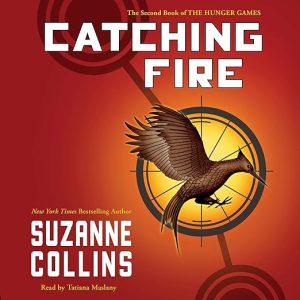
This is an excellent starting point for younger listeners encountering the story for the first time and an equally rewarding revisit for adults who read Collins in the original print run. Maslany’s narration gives you genuine reason to return even if you know the story well. The novel works for family listening with older children and teenagers, though the violence is not softened and the thematic content is genuinely dark. Start here and continue with Catching Fire and Mockingjay. The trilogy rewards completion.