Clara’s Verdict
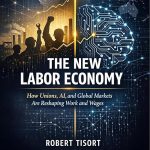
The timing of The New Labor Economy is hard to fault. In early 2026, the intersection of AI-driven automation, post-pandemic remote work patterns, global supply chain restructuring, and resurgent trade union activity has produced a labour market that feels genuinely unprecedented, or at least unprecedented to anyone who has not spent time studying the structural upheavals of the 1970s and early 1980s. Robert Tisort sets out to explain what is actually happening and why, and for a ninety-minute listen, he covers the terrain with surprising breadth.
The limitation is one of depth. At under an hour and a half, The New Labor Economy is definitively a primer, and some of the more complex dynamics it touches on, such as the relationship between collective bargaining strength and technological displacement, deserve considerably more than the space they receive. But as an orientation to the forces shaping work in this decade, it is coherent, accessible, and free of the jargon that makes so much economics writing inaccessible to the general reader.
The epistemic honesty about uncertainty is one of the book’s more valuable qualities. Tisort does not pretend to know how AI will reshape specific job categories over the next decade, because nobody does. That restraint in the face of forecasting pressure is rarer than it should be in this genre and adds to rather than detracts from the book’s credibility as a guide to navigating genuine uncertainty.
About the Audiobook
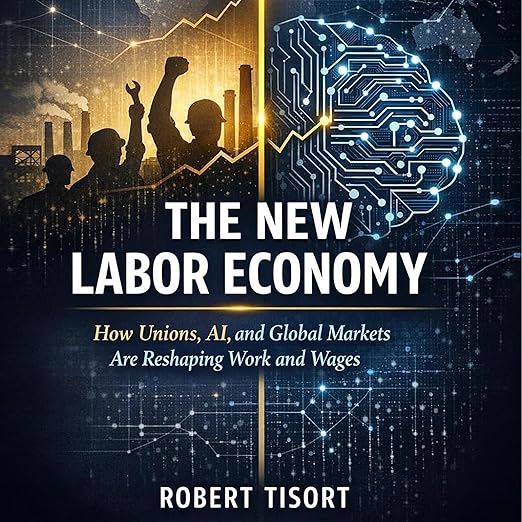
Published in March 2026 by Robert Tisort, the book takes a broad-angle view of workplace transformation across several interconnected domains: the resurgence of organised labour in the US and UK, the role of artificial intelligence in reshaping bargaining power and job categories, global labour arbitrage and the policy levers available to governments managing cross-border competition for workers, and the strategic question of skill specialisation in a market that rewards specific expertise over general competence.
One of the book’s more useful moves is its explicit attention to multiple audience positions. It addresses workers seeking career resilience, business leaders managing talent strategy, and policymakers thinking about regulatory frameworks. This breadth occasionally produces a slightly unfocused quality, since advice useful to an HR director is not always useful to the person who reports to that director. But Tisort is self-aware enough about this to keep the register human rather than defaulting to management-speak.
The economic theory is translated into plain English without being oversimplified, and there is a genuinely useful section on why wage growth and productivity growth have decoupled in so many economies over recent decades, and what the emerging labour landscape suggests about whether that decoupling will persist. That question has real consequences for workers’ decisions about skill development and career positioning, and the book addresses it with appropriate seriousness rather than treating it as a rhetorical framing device.
The section on skill specialisation is particularly relevant for UK listeners navigating a labour market that has been disrupted simultaneously by Brexit-related changes to worker mobility and the broader technological shifts affecting every sector. Tisort’s framework for thinking about which skills command lasting premium and which are most vulnerable to automation or offshoring is applicable across national contexts, and the UK examples he draws on give it an additional layer of local relevance.
The remote work and geographic arbitrage sections are well-timed. The pandemic-era experiments with distributed work have now produced enough data to permit serious analysis, and Tisort draws on that material to make a case about which patterns are genuinely structural and which were temporary accommodations that employers have since reversed. That analysis is one of the more substantive contributions the book makes to a conversation that has been dominated by anecdote and ideology.
The Narration
Rory Young delivers a clean, professional performance in a register suited to business and economics content: authoritative but not pompous, clear at speed, and comfortable with the domain vocabulary. He does not add interpretive colour, but the material does not require it. This is explanatory writing, and clarity is the primary virtue. Young provides it consistently across the ninety-minute runtime, making the listening experience efficient even when the content is particularly dense.
What Readers Say
No Audible ratings have been recorded for this title at time of publication. The March 2026 release date means the book is still finding its audience, and business economics titles often accumulate reviews more slowly than genre fiction. It will be worth revisiting the listing in three to six months for a clearer picture of how it is landing with practitioners versus general listeners, as those two audiences are likely to respond very differently to the same content.
Who Should Listen?
This works well for professionals navigating career uncertainty who want an economic framework for understanding the pressures they are experiencing, rather than purely motivational or skills-based content. Business leaders thinking about talent strategy in a disrupted environment will find useful orientation, if not detailed prescription. Those with strong existing knowledge of labour economics will find it lightweight, but as an accessible introduction for a generalist audience, it does what it sets out to do in a sensible amount of time. Listen on Audible UK