Clara’s Verdict
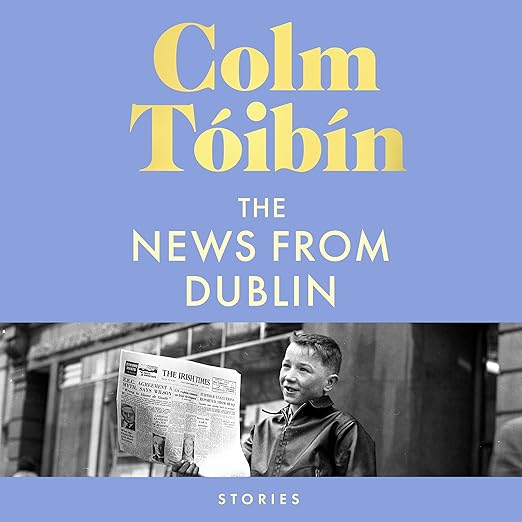
I listened to the first two stories of The News from Dublin on a Sunday afternoon when the light had gone flat and the city felt curiously quiet. It was exactly the right conditions for Colm Toibin: grey, still, a little melancholy, and genuinely attentive. These stories demand attention in the specific way that very precise writing always does. They are not showy. They do not announce themselves. They accumulate, and by the time the final story ends, you realise something has been accomplished in you that you cannot quite name.
Toibin has been perfecting this register for decades, and The News from Dublin, published by Picador in March 2026, is among his finest work in short form. Running for just over 8 hours across the full collection, it is the kind of audiobook I would recommend to anyone who wants to understand what literary fiction can do when it operates at full stretch and trusts its reader enough to leave things unsaid.
About the Audiobook
The collection gathers stories that share a preoccupation with displacement: people living far from where they began, carrying the weight of other lives and other selves at a great distance from the places that formed them. A woman in Galway learning of her son’s death in the First World War. An Irishman in Barcelona seeking the shelter of anonymity after committing crimes whose nature Toibin characteristically withholds from us. A man who travels from Enniscorthy to Dublin to implore the Minister for Health for a special favour. An undocumented worker in San Francisco who has lived an illegal life for thirty years and must now leave his child and his adopted home behind. Three sisters in Argentina deciding to return to Catalonia.
The geography is deliberately wide, spanning Ireland, Spain, Argentina, and the United States, but the emotional register is remarkably consistent across the stories. This is, as one listener described it, a sepia-toned collection, shaped by retrospection and the particular sadness of lives that have moved irrevocably beyond their own origins. Toibin is famous for his restraint; he is the great cartographer of what is not said, the thoughts characters struggle to find words for. The Guardian called these tales of quiet power, and the Financial Times described them as stories that astonish and delight. Both descriptions are apt, though quiet power is perhaps the more useful one for listeners deciding whether this collection is for them.
The stories are not equal in length or weight. Some are vignettes, complete in ten minutes; others unfold over longer stretches and carry more narrative structure. The final story, which one reader found long and rambling, is in fact the most ambitious formally, and its inconclusive quality is a feature of Toibin’s method rather than a failure of craft. He does not provide resolution because the situations he describes do not resolve. They simply continue, off the page, in lives the reader will not follow.
The Narration
Derbhle Crotty is a superb choice for this material. Her voice carries the particular quality of Irish literary performance at its best: understated but deeply inhabited, with a natural feel for the cadences of Toibin’s prose. She does not sentimentalise, which is exactly what these stories require. The effect is of someone reading to you privately, with genuine care and without theatrical mediation. Crotty handles the range of geographical settings and character perspectives with confidence, and the 8-hour runtime passes without the narration ever becoming monotonous. The intimacy she brings to the diary-like quality of certain stories is one of the finest examples of literary audio performance I have encountered recently.
What Readers Say
The collection holds a 4.2 average across 13 Audible listeners. One listener, writing shortly after release, called the collection gorgeous and quietly devastating, noting the way Toibin maps the space between people with a restraint that feels particularly and painfully Irish. Another gave it five stars and praised its unhurried, attentive pace, the clarity of setting and character, and what they described as a gentle sense of retrospection that gives the collection coherence. A third, more ambivalent reader, gave it three stars and found some stories, particularly the final one, long and rambling. That division of response is typical for Toibin in short form: his register rewards patience, and not every reader comes to these stories prepared to slow down sufficiently to let them work.
Who Should Listen?
The News from Dublin is for readers of literary short fiction who are either already familiar with Toibin’s novels, particularly Brooklyn and Long Island, or who have found the mode of quiet, character-driven storytelling deeply satisfying in writers like Alice Munro, William Trevor, or Claire Keegan. Those expecting plot-driven narrative arcs or emotional catharsis will find the collection frustrating. Derbhle Crotty’s narration makes it a particularly strong choice for audio, and the 8-hour runtime works well across a week of commutes or a quiet weekend with the time to give each story the attention it earns.