Clara’s Verdict
I first read The Secret Garden in a battered school copy with half the pages threatening to come loose, and I have been attached to it ever since in the way one remains attached to books encountered at precisely the right moment of childhood. Frances Hodgson Burnett published it in 1911, and it has accumulated more film and stage adaptations than almost any other children’s novel of its era, which is itself a form of testimony to the durability of its central ideas. The story of Mary Lennox, ill-tempered and lonely, arriving at Misselthwaite Manor and discovering a locked garden that transforms three children’s lives, is one of those narratives that seems to know something fundamental about how restoration works: slowly, through attention, through the act of tending something outside yourself.
What makes the novel endure beyond its initial period appeal is also what makes it slightly unusual in the canon of children’s literature: it is genuinely interested in the mechanics of how miserable people become less miserable. The process is shown rather than simply announced. Mary does not wake up one morning transformed by a narrative convenience; she changes through accumulation, through the small daily choices of paying attention to something outside herself, through the unexpected experience of being needed. That psychological specificity, rare enough in adult literary fiction and rarer still in children’s books of the Edwardian period, is what gives the story its continuing relevance.
The novel’s enduring power comes from its emotional precision. Burnett is not writing a simple story about a garden growing back. She is writing about the relationship between what we attend to and what we become. Mary’s transformation from sour and dismissive to genuinely curious and connected is mapped onto the garden’s revival with a care that goes well beyond allegorical convenience. Colin’s recovery follows the same logic. Dickon Sowerby, who can charm animals and make things grow, is one of the great minor characters in children’s literature: not because he is complex, but because he represents the uncomplicated alternative to the various forms of indoor misery that surround him.
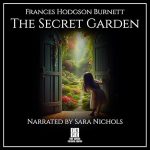
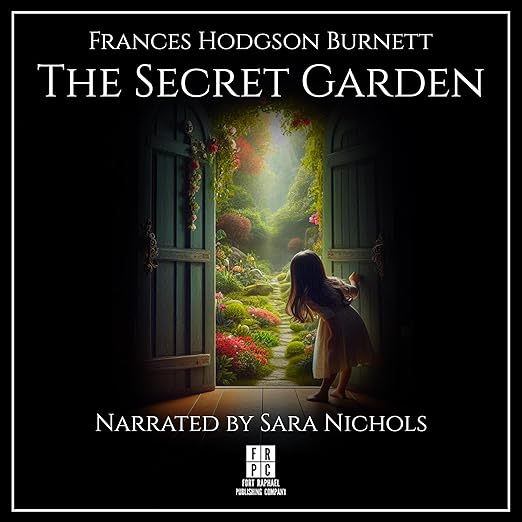
This SoundCraft Audiobooks production, released in June 2025, offers the complete and unabridged text narrated by Sara Nichols. The combination of a beloved classic and a faithful unabridged recording makes it a reliable choice for family listening, school contexts, and adult listeners revisiting the book after decades away from it.
About the Audiobook
This edition runs for 8 hours and 38 minutes and carries a rating of 4.3 from 221 listeners. The text is presented in its original unabridged format. Sara Nichols narrates. The review pool includes responses from multiple markets including the UK, the US, and Italy; some of the Italian-language reviews relate to print editions of the text rather than the audiobook, and these should be disregarded when evaluating the audio experience specifically. The most directly audio-relevant review noted that Nichols is a little slow and a little boring but acceptable, which is a calibration worth having before purchasing.
The Narration
Sara Nichols approaches the material with appropriate care and measured delivery. The Yorkshire dialect passages, which feature significantly in Dickon’s characterisation and in the speech of the housekeeper Mrs Medlock, present a genuine challenge: too broad an accent reads as caricature; too neutral loses the social specificity that Burnett built deliberately into the class dynamics of the novel. Nichols achieves functional competence in this regard rather than distinction. Her pacing is deliberate throughout, which suits the novel’s contemplative register but may feel unhurried to listeners accustomed to faster-paced contemporary fiction narration. For shared listening with younger children, however, that measured delivery is generally an advantage rather than a liability.
The unabridged format is particularly valuable for this text because Burnett’s pacing is itself structural rather than merely comfortable. The long middle section, in which the garden is tended week by week and the children’s characters shift gradually rather than suddenly, is where the novel does its most important work. Abridged versions of The Secret Garden tend to cut precisely the passages that make the emotional resolution feel earned, and listeners who have only encountered shortened adaptations may find the full text more affecting than they expected.
What Readers Say
The UK-based audio reviewer doubletrouble gave four stars and noted the recording is good for helping students understand the Yorkshire accent, with a measured caveat about the pace. Lindsay Herrera in the US gave five stars and found it ideal for a child with double vision who needed accessible audio access to a school text. The overall 4.3 rating across 221 reviews, with the qualification that some of those reviews address print editions rather than audio, reflects a text whose quality carries the production rather than the other way round. The Secret Garden survives narration more readily than most books because the prose itself has a voice.
Who Should Listen?
Families with children aged roughly 8 to 12 will find this a strong choice for long journeys or evening listening. Adult listeners revisiting the book will find the unabridged format faithful to the text they remember. Those studying English literature or language at secondary level will benefit from the Yorkshire dialect sequences. Listeners who need fast-paced narration to sustain engagement should sample Nichols’s delivery before committing; the measured pacing is either soothing or soporific depending on your listening habits. Listen on Audible UK