Clara’s Verdict
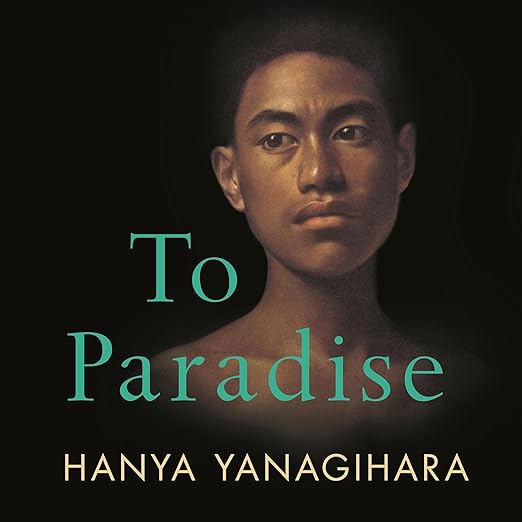
After A Little Life, anything Hanya Yanagihara published was going to be measured against a book that many readers consider one of the most devastating novels of the twenty-first century. To Paradise is a different kind of ambition: wider, cooler, more structurally audacious, and less concerned with the extremity of individual suffering than with the systems – political, social, domestic – that determine what suffering looks like across historical time. It is not A Little Life. Readers who approach it expecting the same emotional register will be surprised and possibly frustrated. It is, in its own terms, an extraordinary novel, and BD Wong’s nearly twenty-nine-hour narration is one of the finest audio performances I have encountered in the past several years.
About the Audiobook
The novel spans three centuries and three distinct versions of America, with recurring names – David, Charles, Edward, William – suggesting lineage or reincarnation or thematic echo, though Yanagihara is careful not to resolve exactly which. This structural ambiguity is deliberate: the novel is interested in what certain patterns of desire and vulnerability look like across radically different social conditions, not in tracing a single continuous bloodline.
In 1893, New York is part of the Free States, where same-sex marriage is not only legal but socially unremarkable. A wealthy young man named David is expected to make an advantageous match arranged by his protective grandfather. Instead he finds himself drawn to a charismatic, mysterious stranger of uncertain means – a choice that carries entirely different risks than its surface romanticism suggests. The prose here has the quality of a very accomplished historical novel: slow, observant, attentive to social texture and the specific anxieties of a particular class at a particular historical moment.
The 1993 section moves to the AIDS epidemic: a young Hawaiian man in Manhattan, living with his much older and considerably wealthier partner, carrying secrets from a troubled childhood that he has no adequate language for. This is where Yanagihara’s emotional intelligence is most apparent – the careful calibration of what is not said, the way loss operates as atmospheric pressure throughout rather than as event, the specific quality of grief in communities for whom grief had become structural.
The 2093 section is the longest, the most demanding, and ultimately the most ambitious: a totalitarian America reshaped by successive plagues and governed by the kind of benevolent authoritarianism that always presents itself as temporary necessity. A powerful scientist’s damaged granddaughter attempts to navigate daily life in a surveilled, controlled society while investigating what happened to her husband. The parallels to our own moment are unmistakable and carefully constructed rather than polemical. One UK reviewer described the book as “large and complex and bleak and brilliant,” which is the most accurate short summary available.
The Narration
BD Wong is a remarkable choice. An actor of considerable range, Wong modulates between the three eras with precision – the measured, formal cadences of 1893, the anxious interiority of 1993, and the controlled, watchful register of 2093 are distinctly rendered without ever feeling performed. The novel’s emotional restraint – which is a deliberate structural choice rather than coldness or distance – is preserved rather than compensated for: Wong trusts the writing, which is exactly the right instinct. At nearly twenty-nine hours, this is a sustained performance of genuine accomplishment. Some passages in the 2093 section, particularly the longer meditative sequences, are demanding in ways that reward rather than frustrate sustained attention.
What Readers Say
UK listeners who have read A Little Life approach To Paradise with calibrated expectations and a willingness to be surprised. “I took a while to get into it, but it was definitely worth sticking with,” wrote one reader who had previously called A Little Life the best book she’d ever read. Another called the novel “complex but compelling,” noting that it unfolds slowly “but is utterly compelling” – a fair description of Yanagihara’s method across both her major novels. A third gave five stars and described the book as “large and complex and bleak and brilliant” simultaneously, which captures the paradox at the heart of the reading experience. The most mixed response comes from a reader who found the three-section structure unclear initially – a genuine structural challenge that the audiobook format can amplify when the tonal shift between sections is not immediately legible.
Who Should Listen?
Readers who loved A Little Life and want more of Yanagihara’s emotional intelligence deployed at larger canvas and greater structural complexity. Fans of literary speculative fiction – particularly work that uses alternate history and dystopian projection as lenses for examining the present – will find the 2093 section especially rewarding. This also works for readers of ambitious historical fiction who are comfortable with the kind of novel that accumulates meaning over distance and asks more questions than it resolves. Do not start here if you haven’t read Yanagihara before – A Little Life first, then this. Allow yourself time and patience; this is not a book that rewards impatience, and it returns the patience generously.
Listen to To Paradise on Audible UK – narrated by BD Wong, running 28 hours and 46 minutes.