Clara’s Verdict
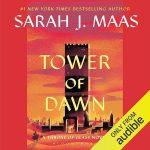
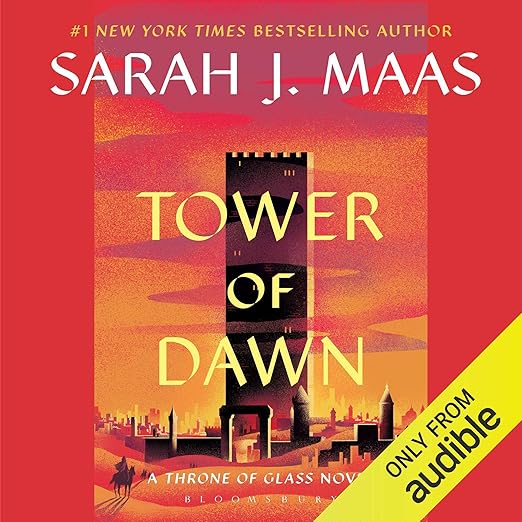
Tower of Dawn arrived in 2017 with a particular reputation problem: it was the sixth book in the Throne of Glass series, but it followed its main characters sideways rather than forward, tracing what Chaol Westfall was doing while Aelin Galathynius’s war continued elsewhere. A significant portion of the readership approached it with reluctance — Chaol had not always been the most beloved character — and were, according to the reviews, comprehensively won over. Carrying a 4.6 rating from 106 Audible UK listeners, it is now widely regarded, with some justice, as the series’ finest entry.
I listened to it over three evenings, and I would gently suggest that this is exactly the right pacing. Tower of Dawn is not a novel that benefits from being rushed. Its emotional architecture is built slowly and deliberately, and the cumulative effect of watching a character dismantle and rebuild himself — physically, emotionally, and morally — requires time to land properly.
About the Audiobook
Chaol Westfall, former Captain of the Guard at the Adarlan court, arrives in Antica — the southern continent’s imperial city — in a wheelchair, his body broken by events at the end of the previous book. His mission is political: to persuade the Khagan, ruler of the southern empire, to commit his forces to the war against Erawan. His personal need is more urgent: the Torre Cesme, a legendary order of healers based in Antica, may be his only chance of physical recovery.
What Maas does with this set-up is more ambitious than it first appears. Antica is rendered as a fully imagined civilisation with its own history, politics, religion, and internal tensions — not simply a backdrop for Chaol’s recovery, but a world that has its own claims on the narrative. The political intrigue at the Khagan’s court is complex and satisfying. And the Torre Cesme itself, through the character of healer Yrene Towers, provides the counterweight to Chaol’s physical limitation: someone who must overcome her own resistance to treating a man from the country responsible for destroying much of what she knew.
The relationship that develops between Chaol and Yrene is the book’s emotional centre, and it is handled with considerably more patience than Maas’s earlier romances in the series. The slow build, the genuine obstacles, the way their healing of each other is literal and metaphorical simultaneously — it adds up to something that surprised me in its emotional weight.
The Narration
Elizabeth Evans narrates, and her performance is among the best in the Throne of Glass audio catalogue. She brings to Chaol’s chapters a weight and restraint that avoids the self-pity that could easily dominate a character in his position, giving him dignity without minimising what he is going through. Yrene’s chapters are rendered with a different energy — sharper, more guarded, gradually and believably softening. Evans handles the ensemble’s considerable range of characters with clarity and confidence, keeping the Khagan’s court properly distinct from the world listeners know from the first five books.
What Readers Say
The reviews for Tower of Dawn share an almost universal quality of surprise: readers who expected to find this a lesser entry discovered something that felt, to several of them, like Maas at her best. Tara, five stars, calls it “breathtaking and deeply moving” and praises the way “healing, growth, and hope can be just as powerful as war and magic.” Sophie Elaina, reviewing on publication day, describes it as potentially Maas’s best-executed book to date. Even the four-star review from Shelnito carries the instruction: “Don’t skip it. It’s a brilliant read.” The minority opinion from the US — acknowledging the complex structural situation of a book set apart from its main sequence — tends to rate it lower, but UK readers have been consistently enthusiastic.
Who Should Listen?
Tower of Dawn is essential listening for anyone making their way through the Throne of Glass series. Do not be tempted to skip it on the basis that Chaol is not your favourite character — that instinct, if the reviews are any guide, will be corrected by the time you reach the final chapters. If you are new to the series, start with Throne of Glass and proceed in order. Elizabeth Evans’s narration is among the reasons the series works as well in audio as it does in print. Listen on Audible UK for Elizabeth Evans’s full, nuanced performance.