Clara’s Verdict
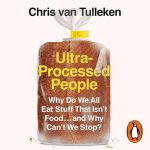
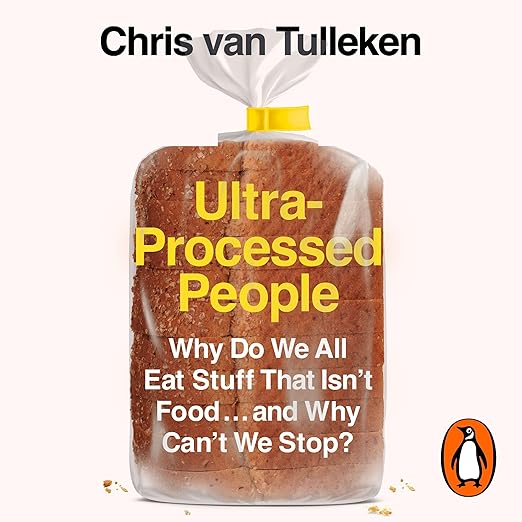
I was halfway through Ultra-Processed People during a Saturday morning commute when I paused to look at the label on the coffee I had just bought from the station kiosk. Chris van Tulleken has written the kind of book that does something genuinely inconvenient: it changes how you see ordinary things. Not through moral lecturing, not through horror statistics deployed for maximum anxiety, but through steady, well-evidenced, almost cheerful scientific investigation that arrives at some rather alarming conclusions about the food that makes up the majority of most British diets. This is the Number One Sunday Times bestseller, Fortnum and Mason’s Debut Food Book of the Year 2024, a Times and Sunday Times Science Book of the Year, and shortlisted for Waterstones Book of the Year 2023. The acclaim is deserved.
About the Audiobook
Published by Penguin Audio on 27 April 2023, Ultra-Processed People runs for 12 hours and 10 minutes. Van Tulleken’s central argument is clear and specific: ultra-processed foods are industrially engineered to override our natural satiety signals, they are designed and marketed to be addictive, and the resulting public health crisis cannot be solved through willpower or individual choice because the food environment itself is the structural problem. He supports this through personal experiment – van Tulleken ate a UPF diet and documented the physiological and psychological consequences on himself – and through sustained engagement with food scientists, manufacturers, public health researchers, and the documentary evidence of how the food industry has shaped both legislation and cultural norms around eating.
This Audible edition includes a genuinely valuable addition that the print version cannot offer: bonus conversations between van Tulleken and his brother Dr Xand van Tulleken at the end of each part of the book, in which they discuss and extend what you have just heard. These feel natural rather than tacked on, and they add a dimension of dialogue and reflection that enriches the experience considerably. The book holds 4.6 out of 5 from 6 listeners on Audible UK – a small sample that reflects the book’s primary readership through the print edition rather than any limitation of the audio.
The Narration
Van Tulleken reads his own book, and it is the right choice. His voice carries the credibility of the clinician-researcher without the dryness that often afflicts academic self-narration. He sounds genuinely engaged with his subject: occasionally exasperated, occasionally darkly amused, and consistently clear. The conversational sections with his brother are especially successful in audio form – they have a natural documentary quality that a professional narrator could not replicate, and that quality matters because the book is, in significant part, a personal investigation conducted by a person you are spending twelve hours with. The self-narration does not feel like an economy; it feels like the essential choice for this material.
What Readers Say
Dimitar Zhekov (5 stars): “One of those rare books that changes how you shop, cook and eat – without shouting or shaming. The author blends clear science with witty, very human storytelling to explain what ultra-processed food is, why we eat so much of it, and how it affects our bodies and minds. It’s rigorous yet highly readable.”
J. Drew (5 stars): “A powerful polemic about what the food we are putting in our body is causing us harm. Ultra-processed foods make up as much as 60% of our diets in the UK.”
Stephen D (5 stars): “The author explains that the obesity crisis has not been caused by the usual suspects of salt, sugar, fat, lack of exercise. It sets out to explain why in an easy to understand and engaging way.”
It is worth noting that the audio edition of Ultra-Processed People is substantively different from the print version in one meaningful way. The conversations between van Tulleken and his brother Xand at the end of each major section were created specifically for the audio release. They are not a tacked-on addition but a genuine expansion of the argument, with the two brothers discussing implications and complications that the main text raises but does not always follow to their conclusions. This makes the audio edition the fuller version of the book, not merely a reading of the print version, and it is one of the stronger cases I can think of for the audio format adding genuine value to the reading experience rather than simply serving as an alternative delivery mechanism.
Who Should Listen?
Strongly recommended for anyone who eats, which is to say everyone. The book is equally relevant whether you consider yourself health-conscious or not – van Tulleken’s point is that UPF is pervasive precisely because it appears throughout products marketed as healthy. Those expecting a diet guide or a clean-eating manifesto will find something more complex and more useful: a structural critique of how the food industry operates and why public health responses have consistently failed. The audio format works particularly well here because of the bonus conversations with his brother and because van Tulleken’s voice carries genuine authority and warmth. One of the more consequential books of recent years, and a case where the author narrating his own work is not a compromise but an enhancement.