Clara’s Verdict
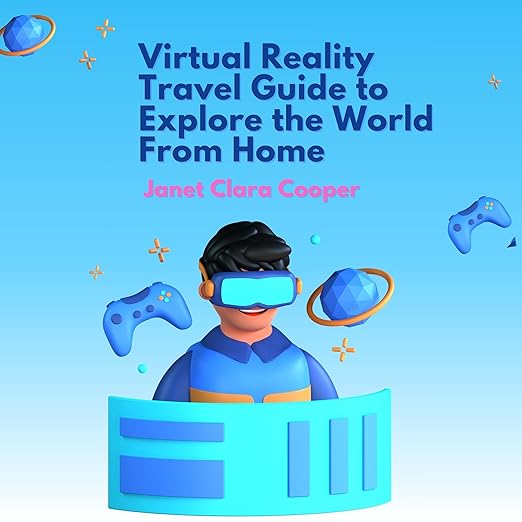
Virtual reality travel occupies an interesting position at the moment: not quite mainstream, but no longer the province of expensive early adopters willing to strap on bulky headsets in the name of technological optimism. The hardware has become more accessible, the content libraries have grown substantially, and the use case for people who cannot or do not want to travel physically has become genuinely compelling for a wider range of people than the gaming community that dominated early VR adoption. Janet Clara Cooper’s guide arrives at a reasonable moment in this trajectory, offering a beginner’s orientation for a technology that is finally finding a broad audience.
At just over an hour, this is a starting point rather than a comprehensive technical manual, and it sets its scope honestly and without apology. For listeners who have been curious about VR travel but do not know where to begin, it provides a useful and accessible framework.
About the Audiobook
The guide opens by addressing the fundamental question of what VR travel actually is and how it differs from watching a 360-degree video on a flat screen, a distinction that matters considerably for calibrating expectations. This is a more important point than it might initially seem: many people’s scepticism about VR travel is based on experiences with flat-screen 360 video rather than true head-tracked, immersive VR, and they are different enough experiences that the distinction is load-bearing.
Cooper then moves through the practical decision-making: how to choose appropriate hardware given the range of headsets currently available at different price points, which platforms and applications offer the most compelling travel experiences, and how to integrate VR exploration into daily life in ways that are sustainable rather than a novelty that fades after a fortnight. This last point is given more attention than similar guides typically provide, and it is the more valuable section for anyone seriously considering the investment.
The book frames VR travel across several use cases: leisure and relaxation, educational experience of historical sites and cultural landmarks, and the particular value proposition for listeners who face physical or financial barriers to conventional travel. This last application is the book’s most thoughtful angle. Cooper makes a genuinely persuasive case for VR travel as democratising rather than merely convenient, extending meaningful access to experiences that geography, health, or financial constraint would otherwise put out of reach. There is also practical guidance on combining VR travel with learning objectives: language immersion, cultural preparation before physical trips, and deepening engagement with destinations you have already visited.
The Narration
Myriam Berger, who also narrates Cooper’s Unplugged Clarity in this collection, brings the same warm, clearly-paced delivery to this material. The technical content, hardware specifications, platform comparisons, and application recommendations, requires a narrator who can make terminology feel accessible rather than alienating, and Berger manages this without dumbing down. For a short, informational listen, the performance is well-calibrated. The only inherent limitation is that audio cannot substitute for the visual demonstrations that would make certain hardware comparisons more concrete, but that is a format constraint rather than a performance failing, and Berger compensates with careful verbal description throughout.
What Readers Say
As a newly published title released in March 2026, this guide has not yet accumulated listener reviews on Audible UK. The subject has a growing and engaged audience, particularly among the disability and accessibility communities that have found VR travel genuinely transformative, and among sustainability-minded travellers who want to reduce their carbon footprint without entirely giving up the experience of encountering unfamiliar places. The accessible framing should help it find readers beyond the already-converted technology enthusiasts.
It is worth addressing one potential objection to VR travel as a concept, since Cooper herself engages with it honestly: that the experience is a pale substitute for actual travel and risks encouraging people to mistake digital representation for genuine cultural encounter. Cooper’s response is that VR travel is not positioned as a replacement for physical travel where that is possible, but as an addition to the range of ways people can engage with places and cultures. Used as preparation for a physical trip, as accessible entertainment for those who cannot travel, or as a way of encountering places that are too fragile, too remote, or too expensive to visit physically, it serves purposes with genuine cultural and educational value rather than merely simulating the tourist experience at lower cost. That is a case worth taking seriously.
Who Should Listen?
Travellers who have been curious about VR but have not known where to begin, technology enthusiasts looking for compelling non-gaming applications for VR hardware, and anyone interested in accessible or sustainable travel will find this a useful short listen. It is not a replacement for dedicated technology journalism if you want granular hardware comparisons, but as a conceptual framework and starting point for exploration, it serves its purpose clearly and practically. Under seventy minutes, it rewards a single focused listen rather than background playing, since the platform and app recommendations benefit from being noted down as you go.