Clara’s Verdict
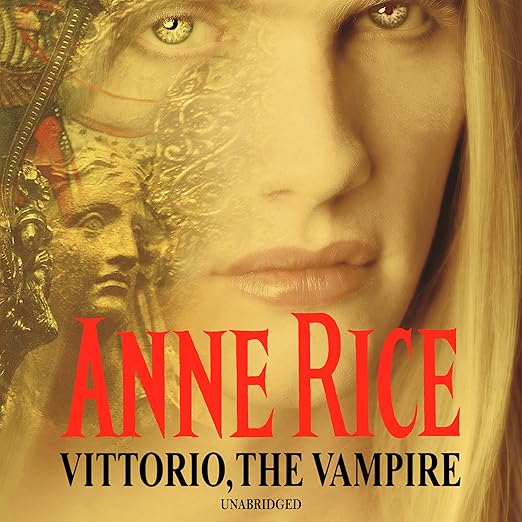
Anne Rice wrote Vittorio the Vampire in 1999, at a moment when her powers were fully engaged and the vampire as literary vehicle still felt rich with possibility. Coming at you after the sprawl of the main Vampire Chronicles, it’s a deliberately contained story – a novella, really, in scope if not in page count – and its restraint is precisely what gives it such elegance. Rice strips away the philosophical grandeur of Lestat and Louis and returns to something older, more mythic, and unexpectedly moving. The result is one of her most underrated works.
This is Book 2 of the New Tales of the Vampires series, a companion series to the Chronicles that allowed Rice to explore the mythology through new eyes and new centuries. Vittorio gives her the Italian Renaissance, and she seizes it with both hands.
About the Audiobook
Sixteen-year-old Vittorio di Raniari is the sole survivor of a massacre at his father’s Tuscan palazzo – a brutal opening that sets the tone for a story that never lets cruelty and beauty exist far apart from one another. Escaping to the Florence of Cosimo de Medici, Vittorio seeks vengeance but instead finds himself entangled with a court of vampires who are unlike anything the Chronicles’ readers have encountered before. They attend Mass. They are bound by their own theological anguish. They are, in their strange way, devout – and they are utterly terrifying.
Rice uses the Renaissance setting not merely as backdrop but as argument: this is a world where the sacred and the profane are genuinely in conversation, where beauty in art and violence in life coexist without irony. The angels and demons of the narrative are not metaphors – they are participants. Vittorio’s love story, played out against frescoes and marble and political intrigue, is genuinely tragic in the classical sense. Rice earned every note of it.
The Narration
Jonathan Marosz gives a performance that serves the material well. His reading captures the solemnity of the narrator’s voice – Vittorio speaks from memory, with the measured cadence of someone who has been carrying his story for centuries – without tipping into portentousness. The Italian names and Renaissance period detail are handled confidently, and Marosz finds the right register for Rice’s more lyrical passages without overselling them. At seven hours, the audiobook moves at a pace that suits both the historical setting and the emotional weight of the story.
What Readers Say
Vittorio the Vampire holds a 4.3 rating from 709 listeners on Audible – a score that reflects genuine appreciation rather than mere fandom. UK reviewer Eva praised “Anne Rice’s descriptions and images” as “so well written and vivid” and noted the story was “easy to follow by listening to it as an audiobook.” LindaMM, re-reading the full vampire canon, described Vittorio as “so little damaged in comparison to Armand” and the novel as “a soft simple tale” that “sparkles as a perfect, unique gem.” Azariah’s only complaint was that the story ended too quickly – having consumed it within a day. One reader found it disappointing compared to Rice’s larger works, which is a fair point: this is a chamber piece, not a cathedral.
Who Should Listen?
Essential for Anne Rice devotees working through the Vampire Chronicles universe, but also an excellent entry point for listeners new to her vampire fiction – the self-contained narrative and Renaissance setting make it more accessible than the series proper. Recommended for anyone drawn to literary gothic fiction, historical atmosphere, and love stories that don’t flinch from their tragic implications.
Listen on Audible UK: Get Vittorio the Vampire on Audible UK. Also available on Kobo, Scribd, and Storytel.