Clara’s Verdict
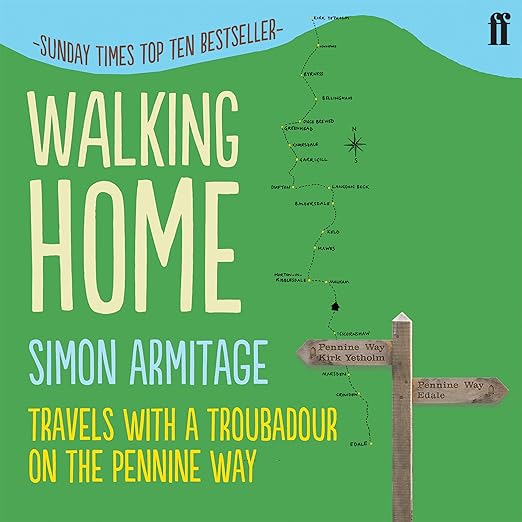
I tend to be suspicious of walking books. There are rather a lot of them, and many share a template: challenging route, various hardships, personal revelation, gratitude for the natural world. Simon Armitage does something considerably more interesting in Walking Home. He walks the Pennine Way backwards – south, towards Yorkshire and his birthplace – without any money, supporting himself through poetry readings in village halls and pubs and people’s living rooms. The combination of travelogue, nature writing, and something approaching a parable about the economics of poetry is quietly unlike anything else in the genre.
About the Audiobook
Published by Faber & Faber in April 2013 and running at 8 hours and 54 minutes, Walking Home covers Armitage’s 256-mile journey along the Pennine Way in summer 2010. He walked from Kirk Yetholm on the Scottish border towards his home village in Yorkshire – against the conventional direction – and the decision to walk home rather than away from it gives the journey an emotional shape that most walking memoirs lack.
The book is many things simultaneously: a nature memoir with a poet’s eye for precise description, a social document of northern England’s rural interior with its community halls and church rooms and unfailingly hospitable strangers, and a meditation on what it means to give poetry readings in places where the pool table is still in use and the sheep are audible outside. Armitage is funny, occasionally self-deprecating to the point of self-parody, and genuinely observant. His descriptions of landscape are not merely pretty – they carry the weight of someone who grew up in these hills and is returning to them with the complicated feelings that implies.
The nature writing is grounded, droll, and free from the sentimentality that sometimes afflicts the genre. The people he meets along the way are rendered with affection and specificity.
The Narration
Armitage reads the audiobook himself, and hearing it in his voice – warm, drily funny, with the particular rhythms of someone who has spent a lifetime attending to the sounds of language – is considerably better than reading it silently would be. One listener describes feeling “like you’re walking right alongside him,” sensing him “maybe a bit bedraggled, probably a bit lost at times, but oddly content.” That is exactly right. The narration has the quality of the best radio travel writing: unhurried, observant, and quietly compelling. At nearly nine hours, it rewards an attentive listen.
What Readers Say
The audiobook carries a rating of 4.6 out of 5. Zoe Langley-Wathen writes at length about the pleasure of the audio version specifically, noting that “the lilt of Simon Armitage’s voice makes you feel like you’re walking right alongside him.” Stephanie Jane from Literary Flits appreciated his “fantastic turn of phrase when describing the landscapes” and found his approach to the walk “refreshingly different.” Doug L. Williams is simply enthusiastic: “If you like Simon’s voice you will love this. It’s a great book that is even better when listened to.”
Who Should Listen?
Natural territory for readers who enjoy nature writing and travel memoir – particularly those with an interest in the north of England and its landscape. Poetry readers who know Armitage’s work will find it essential, but it is equally accessible to those coming to him for the first time through this book. It is also a fine choice for anyone who appreciates writing that takes its time and trusts the reader to keep pace. The northern English countryside in summer, rendered in a poet’s prose, is a particular pleasure on a grey afternoon.
Listen on Audible UK – get your copy here.