Clara’s Verdict
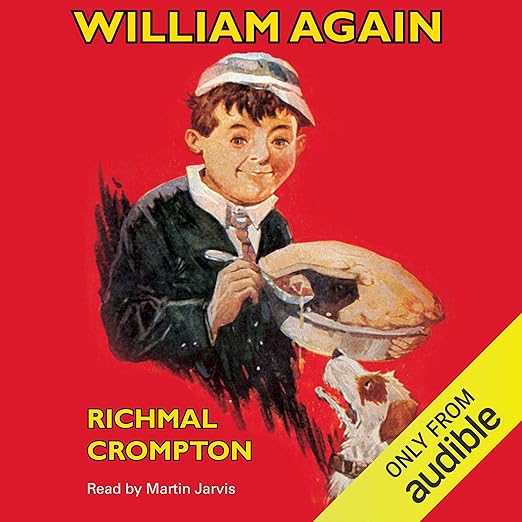
Richmal Crompton’s William Brown is one of English literature’s great comic creations: a perpetually eleven-year-old boy of absolutely incorrigible disposition, magnificent self-confidence, and a talent for catastrophe that borders on the supernatural. The Just William stories were first published in the 1920s and have remained in continuous print ever since – a record that speaks not just to their entertainment value but to something deeper, some essential truth about childhood and the gap between intention and consequence that every generation recognises afresh.
Martin Jarvis, who has been reading these stories for decades, has made William’s voice as familiar and as beloved as the original prose. This is the gold standard of nostalgic British audio comedy, and I say that with complete sincerity and without reservation.
About the Audiobook
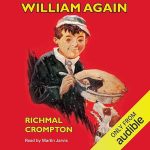
William Again collects fourteen adventures featuring the incorrigible William and the Outlaws – his gang of equally chaotic friends – including “The Great Detective,” “William the Reformer,” “William Sells the Twins,” and the gloriously titled “William Gets Wrecked.” Each story is self-contained and follows an essentially invariable structure: William forms an ambitious and well-intentioned plan; the plan interacts catastrophically with the adult world around him; order is eventually restored; William is blamed; and absolutely nothing is learned by anyone. This is comedy through repetition and recognition, and Crompton executes it with a precision that never becomes mechanical.
What makes the stories remarkable – and what generations of readers have repeatedly noted – is that Crompton, despite writing primarily for adults in the early years, captured the interior life of childhood with almost anthropological accuracy. William’s logic is always internally consistent; it is the world that consistently fails to understand him. He is never malicious, rarely selfish in the conventional sense, and almost always convinced that he is acting in the general good. The fact that his definition of the general good bears so little resemblance to anyone else’s is the engine that drives every story.
The class-conscious, inter-war English village setting has acquired its own kind of period charm, but the emotional core remains entirely legible to contemporary readers. William’s relationship with authority – respectful in theory, catastrophically undermining in practice – is timeless.
The Narration
Martin Jarvis is simply the definitive voice for these stories. His William is not a child’s impersonation but something more precise and more honest: the voice of a boy who is absolutely convinced he is right, delivered with perfect comic timing and an immaculate sense of the stories’ rhythm. He has been performing the William books for long enough that many listeners treat his voice as essentially inseparable from the text itself. At just over six hours, this is an ideal length – enough for a proper listening session without exhausting the material. The production note acknowledges a vintage recording transfer; audio quality may not meet modern technical standards. The performance more than compensates for this.
What Readers Say
The audiobook carries a 4.6-star average from 304 listeners – an excellent rating for a vintage recording. Listeners write of sharing the stories with grandchildren and grandparents simultaneously; of rediscovering books loved in childhood with genuine pleasure; of a ten-year-old granddaughter who cannot keep the book out of her hand. Several reviewers note that the earlier William stories were originally written for adult readers and that the jokes – dense, fast, and rather sophisticated – land differently once you understand the intended audience. As one reviewer observed: “How Richmal Crompton got inside the head of a well-meaning but disastrously unlucky boy is one of the wonders of literature.” That is not an overstatement.
Who Should Listen?
It is worth noting what Crompton was actually doing with the William books that makes them so durable. She was, among other things, writing a precise and rather affectionate satire of English middle-class life in the inter-war period – the village fetes, the earnest societies, the pompous adult characters who exist primarily to be undermined by an eleven-year-old who has not yet learned to take them seriously. This social dimension gives the stories a richness that simple children’s adventure stories rarely achieve. William is not just funny; he is funny because the world around him is slightly absurd, and he is the only one honest enough to notice.
The William books work for ages eight and upwards, though younger children may need slightly more patience with the period references and the more elaborate comic set-pieces. They are, frankly, ideal family listening – funny enough to entertain adults genuinely rather than indulgently, accessible enough to delight children who enjoy mischief and chaos. For anyone who grew up with the books and hasn’t revisited them in years, Martin Jarvis’s audio editions are one of the best reasons I know to return. A staple of British children’s literature that has earned every year of its century in print.
Listen to William Again on Audible UK – classic British comedy that rewards every generation that discovers it.