Ask a devoted listener why they abandoned an audiobook at the halfway mark and the answer is rarely the writing. It is the voice. I spend much of my week with listener ratings and reviews, and one pattern holds across every genre we cover at myaudiobook.co.uk: the narrator moves the needle at least as much as the story does. A middling book becomes a favourite in the right hands. A masterpiece becomes unbearable in the wrong ones. This essay is an attempt to explain why.
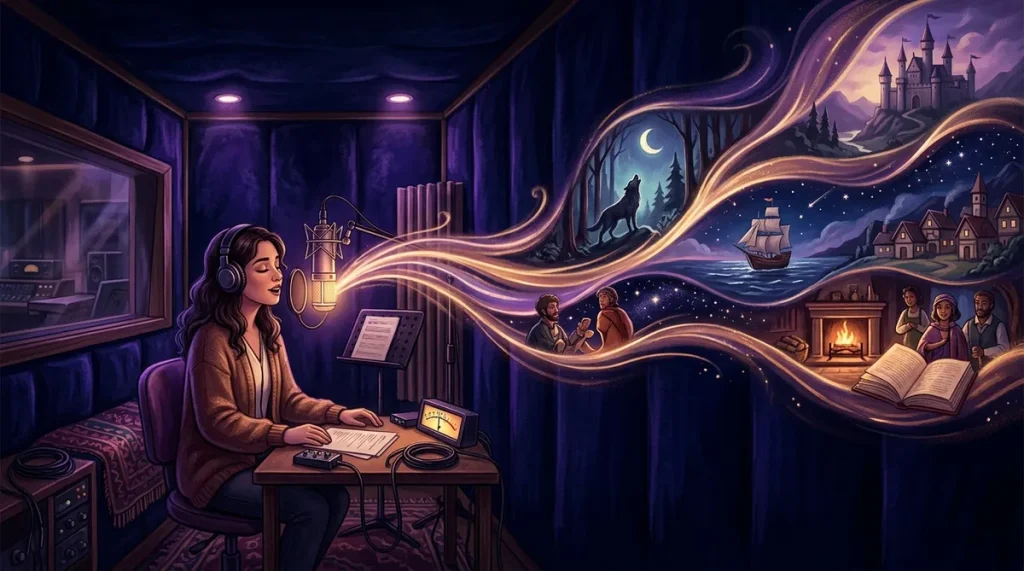
The explanation is simple. In print, you cast the book yourself. You decide how the detective sounds, how fast the argument crackles, where the sarcasm sits. In audio, someone else makes every one of those decisions for you, sentence by sentence, for ten or twenty or thirty hours. Pace, accent, irony, warmth, menace: each is an interpretive choice, made once and then lived with. A narrator is far closer to a stage actor than to someone reading aloud, except that the stage is your head.
A narrator does not read a book to you. A narrator performs it for you, one listener at a time.
A familiar story made new: Hugh Laurie and Harry Potter
There is no sterner test of a narrator’s power than a story everyone already knows. Hugh Laurie’s reading of Harry Potter and the Philosopher’s Stone takes a book many listeners could quote from memory and makes it feel newly told: on our records it holds 4.8 stars across its 8 hours and 41 minutes. Consider what that number is measuring. The plot surprises no one. The characters are folklore. The text is a constant, so the enthusiasm can only attach to the one remaining variable: the performance. When everything else is fixed, the voice is the difference.
When the author is the voice: David Attenborough
Memoir is the genre where narration matters most, because authenticity cannot be faked. Life on Air, David Attenborough’s account of his broadcasting life, is read by the man himself across 19 hours and 23 minutes, and it holds 4.7 stars with our listeners. No actor, however gifted, could deliver those stories with quite the same authority, because the voice is not imitating a life. It is the life. An author narrated memoir turns anecdote into company, which is precisely what a long listen is for.
The counterpoint on the same shelf
Yet the counterpoint sits close by. All Creatures Great and Small is read not by James Herriot but by Christopher Timothy, and at 4.9 stars it is one of the best loved recordings we cover. The lesson is not that authors always narrate best, but that the right voice, whoever it belongs to, is the one that makes the material sound true.
Two voices, one village: the Thursday Murder Club handover
Nothing exposes the narrator’s share of the work like a series that changes voice midstream. Richard Osman’s Thursday Murder Club books began on audio with Lesley Manville, whose reading of The Man Who Died Twice rates 4.7 on our records, before Fiona Shaw took over for The Bullet That Missed and The Last Devil to Die, both also rated 4.7. Two exceptional performers, two genuinely different books in the ear: each brings her own rhythm and colour to the same village and the same four friends, and listeners who followed the handover will tell you the characters themselves seem to shift slightly with the voice. Same author, same world, different music. That is how much of an audiobook lives in its narration.
What a great narrator actually does
Strip away the mystique and the craft resolves into a handful of disciplines, each harder than it sounds:
- Pacing: knowing when to press forward and when to let a line sit in silence
- Character separation: keeping dozens of voices distinct across many hours without sliding into caricature
- Emotional restraint: trusting the text instead of performing feelings at the listener
- Consistency: making a character sound the same in hour one and hour thirty
- Invisibility: the paradox that the finest performances stop you noticing the performer at all
The credit under the title
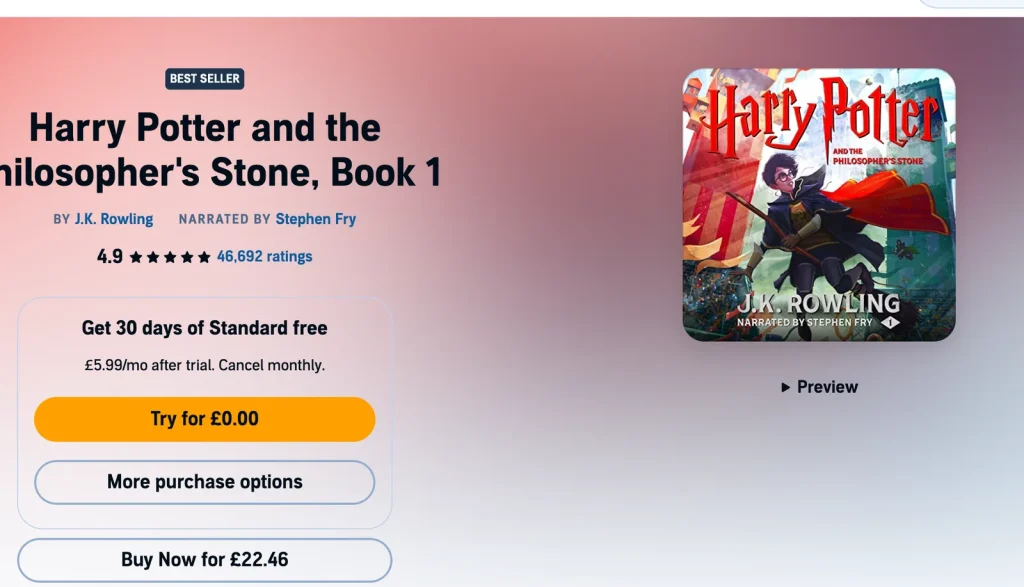
If the performance carries this much of the experience, the performer deserves equal billing, and the retailers quietly agree. Open a product page on Audible UK and the narrator is named directly beneath the title, alongside the series line and the star rating: part of the book’s identity, not a technical footnote. Stephen Fry’s recording of the same Philosopher’s Stone sits there with 4.9 stars beside his name, proof that credit and score attach to a recording, never merely to a book. Listeners worked this out long ago. Audible’s review form asks for two marks, Story rated separately from Performance, as plain an admission as the format will ever make that narration is judged as a craft in its own right.
Follow the voice, not just the author
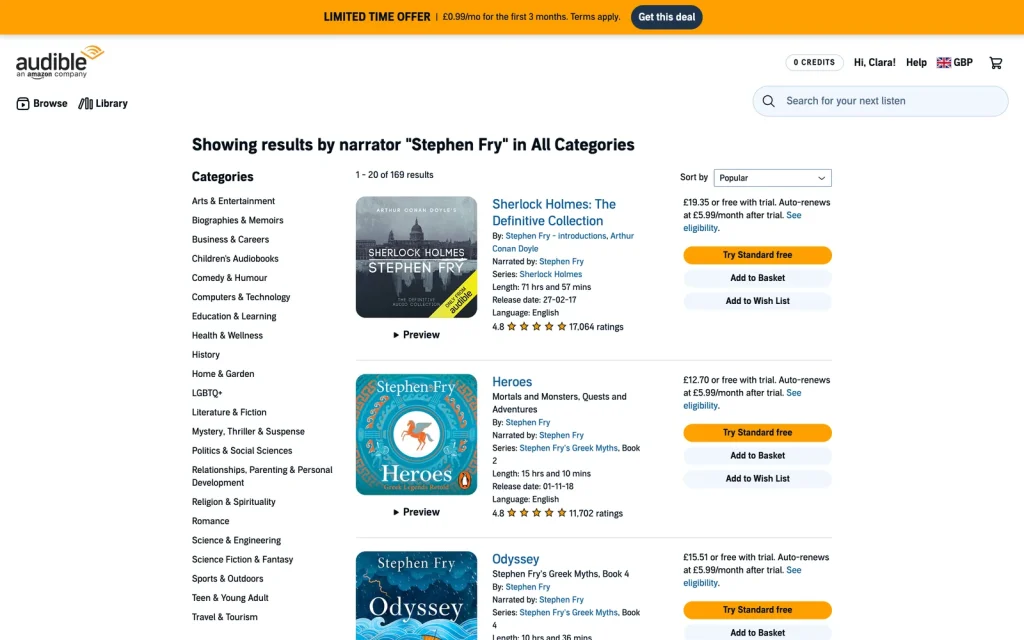
Once you start reading that credit, a better habit follows: treating narrators the way you treat authors, as names worth following. Audible UK lets you search by narrator, and the results page says so plainly: “Showing results by narrator”. Look up Stephen Fry and a parallel career unfolds, from his Sherlock Holmes collection to Heroes and the Odyssey, one trusted voice threading through detective fiction, myth and epic. A voice you already trust is the single best predictor of a happy listen, making the back catalogue the most underused discovery tool in the format.
How to choose with your ears
All of which points to one practical rule: never buy an audiobook on the strength of the book alone. Play the sample, every time. Within a minute you will know whether a voice belongs in your head for the next ten hours. When a beloved novel exists in more than one recording, as the Philosopher’s Stone now does, sample both before you commit a credit. And if you are new to all this, my guide to choosing your first audiobook begins exactly where this essay ends: with your ears rather than your eyes.
It is worth knowing how much invisible labour sits behind a voice that sounds effortless. I have traced that hidden process in how audiobooks are recorded, and once you know what a proof listener does, no smooth hour sounds quite so simple again. To test the narrator theory tonight, you can try Audible UK free for 30 days, download something read by a voice you have never met, and listen to what a great one does with the first page. You will never think of it as just reading again.