Clara’s Verdict
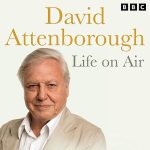
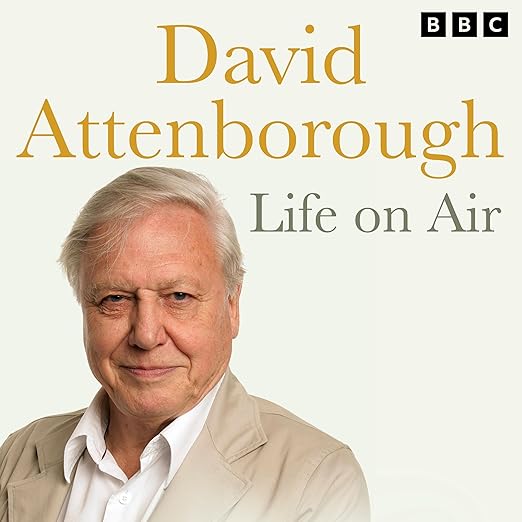
There are certain voices so familiar they occupy a different category of listening. When David Attenborough speaks, something slightly different happens in the brain – a settling, a slowing down, a readiness to pay attention to whatever comes next. Life on Air exploits this in the best possible way, because what it delivers is not another nature documentary but something considerably stranger and more revealing: the account of a man who shaped British broadcasting from the inside and then walked away from institutional power to go and film lizards in Madagascar.
I listened to much of this late at night, and it felt exactly right. There is something about Attenborough’s self-narration that is perfectly calibrated for those hours – unhurried, full of genuine wonder, and structurally honest about the compromises that a long career in public broadcasting inevitably involves. This is not a book written to secure a legacy; it reads like a man simply accounting for what happened, and trusting the events to speak for themselves.
About the Audiobook
Published by BBC Digital Audio in 2010, Life on Air spans Attenborough’s career from his first days at the BBC as a trainee producer through his influential tenure as Controller of BBC2 – during which he introduced colour television to Britain and commissioned programmes that defined the channel’s character – and on through the decades of wildlife filming that built his public identity. The book is structured around the series he made, which gives it a natural episodic quality, but the more interesting thread is the internal BBC life: the politics, the decisions about what to commission, the encounters with figures including Montgomery, Anthony Eden, Benjamin Britten, and the Queen.
Attenborough writes about the natural world with the specificity of a naturalist and the narrative instinct of a broadcaster – the sections covering Zoo Quest, the filming of rare species in New Guinea, Borneo, Paraguay, and the Australian outback, are as absorbing as any of the programmes they document. The memoir ends at Life in Cold Blood (2008), which means the subsequent decades of his explicitly climate-focused work are not covered here. Listeners expecting a complete account of his environmental advocacy will need to supplement this with his later books. What this volume covers, it covers with characteristic precision and wit.
What is perhaps most striking about Life on Air in retrospect is the decision it documents at its centre: Attenborough’s choice to give up the Controller of BBC2 role – a position of real institutional power, one in which he had genuine creative influence over the direction of the channel – in order to return to field work. The memoir examines this decision without dramatising it unduly, presenting it as a clear-eyed assessment of what kind of work he wanted to do with the rest of his career. For readers who know Attenborough primarily through his later environmental advocacy, understanding the BBC institutional story that preceded it provides essential context for how his public authority was built.
The Narration
Attenborough narrates his own memoir, and this is the only way it could work. His prose is clean and specific – he writes about animals and places the way a good documentary makes you see them – and his reading carries the same quality. One reviewer noted that “his writing style is exactly like his personality: often funny, interested, charming and unpretentious.” At 19 hours and 23 minutes, this is a long listen, but the pace never drags. Attenborough has a naturalist’s sense of when to move on and a broadcaster’s understanding of when a detail earns its place. One honest note: the hardback edition contains several sections of photography that do not translate to audio. The listening experience is complete without them, but it is worth knowing they exist if you find yourself wanting visual reference.
What Readers Say
The 834 Audible UK listeners give this a 4.7 rating, which at that volume is a strong signal. One listener described it as “packed to the tunnels with anecdotes and information all interesting and unusual.” Another highlighted the book’s unexpected emphasis on his BBC executive career rather than his nature work: “His brave decision to give up the role as head of BBC2 to wade through swamps and jungles is erudite, charming, entertaining and informative.” A third reviewer, who noted having met Attenborough personally, confirmed that the writing personality matches the man: “often funny, interested, charming and unpretentious.” One 4-star review came from a listener who had purchased a print edition for an elderly mother and found the font too small – a reminder to verify format before gifting, and an oblique advertisement for the audio version.
Who Should Listen?
Essential for anyone who has spent time with Attenborough’s television work and wants to understand the person and decisions behind it. Also worthwhile for readers interested in BBC history, British broadcasting culture, or the development of nature documentary as a form. Those who come primarily for natural history will find it in abundance alongside the institutional story. The self-narration is a genuine gift – there is no substitute for hearing this particular voice tell this particular story.