Clara’s Verdict
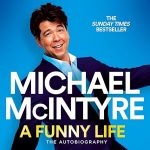
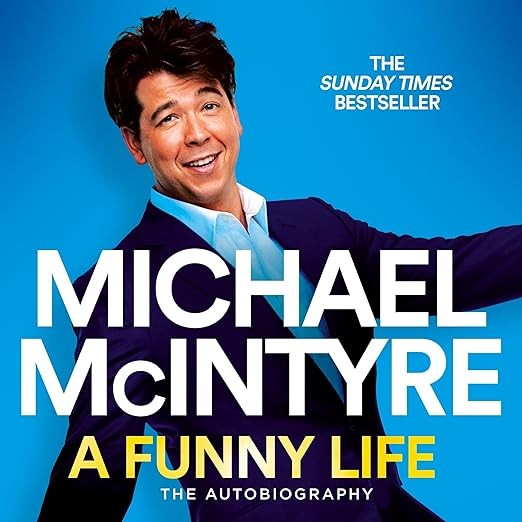
I listened to A Funny Life during a long drive back from a weekend away, and it was exactly right for that context: loud laughter in a car, occasional moments of genuine warmth, and McIntyre’s voice doing what it does on stage, which is to make the slightly absurd circumstances of a famous life feel accessible and relatable to everyone who has ever slightly misjudged a social situation or spectacularly underestimated how unprepared they were for something. Michael McIntyre is Britain’s best-selling comedian, and he knows exactly what he is doing here. This is the second volume of his autobiography, picking up where his first book ended: at the 2006 Royal Variety Performance, the breakthrough moment that changed everything.
About the Audiobook
Where the first autobiography traced the road to that breakthrough, A Funny Life covers the bewildered, exhilarating, frequently disastrous experience of arriving at the top and discovering that you have almost no idea how to stay there. McIntyre is disarmingly honest about his failures: the panel shows that went wrong, the chat show hosting he was demonstrably not suited to, the talent judging role that did not fit, the television formats that seemed like good ideas until they were not. He is also consistently funny about his wife Kitty, who appears throughout as the sensible centre of gravity against which McIntyre’s more chaotic instincts play out. Kitty emerges as one of the more entertaining supporting characters in recent memoir.
McIntyre reads the book himself, which is non-negotiable for a comedian of this kind. The timing, the emphasis, the places where he speeds up and slows down, the small theatrical asides — none of these can be transferred to another voice. The audiobook is, in this sense, the primary format rather than a secondary adaptation of the print edition, and the difference between the two versions is not slight. The episode with the falling trousers in front of three policemen is the kind of story McIntyre tells in the book and presumably on stage: mortifying in the moment, perfectly shaped for retelling, and funnier in his own voice than it would be in anyone else’s.
The Narration
McIntyre’s self-narration is an asset so significant that it effectively constitutes a different product from the print edition. He does not simply read the text; he performs it, with the small adjustments and spontaneous-seeming asides that characterise his live work. One reviewer noted that after reading the first autobiography years earlier in print, they specifically sought out the audio for the second — a testimony to how much the self-narration adds, and a recommendation in itself. This is a comedian reading his own life at the top of his powers; the result is an eight and a half hour stand-up set with a narrative spine, moving between the genuinely funny and the occasionally touching with the ease of someone who has been making audiences do both for two decades.
What Readers Say
TechGenius called it “a sterling book” that “made me laugh throughout.” Belinda Wright noted laughing out loud several times. The most detailed review comes from a listener who had previously read the first book in print and found it “very funny”: “He taps into so many people’s lives that we could all have him over for dinner.” Debbie described it as “funny heartfelt.” Alison Wane called it simply “hilarious.” Across two Audible ratings, it holds a 4.6 average — a small sample that almost certainly underrepresents the actual response, given the book’s substantial print readership and McIntyre’s considerable UK fanbase.
Who Should Listen?
Anyone who finds McIntyre funny on stage or television will find this audiobook a completely satisfying eight and a half hours. His voice, his timing, and his willingness to be embarrassed on the record all translate exceptionally well to audio. Those who do not find his register funny are unlikely to be converted by the autobiography, and that is fair enough. It is also worth noting that this is a second volume: listening to or reading Life and Laughing first is not strictly necessary — the narrative works independently — but it provides the context for the breakthrough moment that A Funny Life picks up from, and that context adds to the satisfaction of following the subsequent story. Either way, McIntyre in audio is substantially better than McIntyre on the page.