Clara’s Verdict
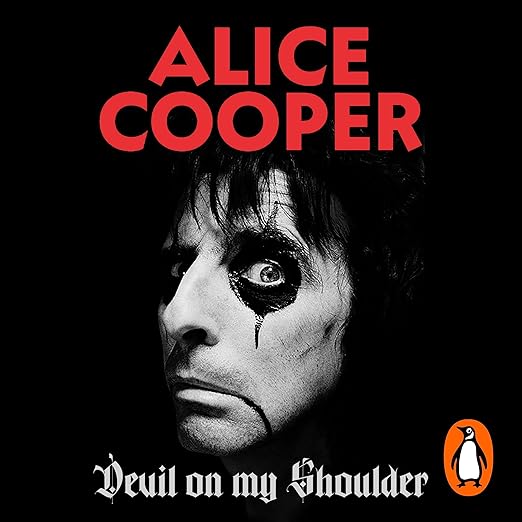
Alice Cooper is one of those figures the British music press has always found slightly difficult to categorise. Too theatrical for the punks, too American for the glam crowd, too Christian for the shock-rock faithful who thought he meant it literally. Devil on My Shoulder, his long-awaited definitive autobiography published by Penguin Audio in October 2026, promises to resolve that ambiguity at last, told entirely from the inside. And the framing is perfectly chosen: angel on one shoulder, devil on the other, with Vincent Damon Furnier and his alter ego existing in uneasy cohabitation for sixty years of one of rock music’s more genuinely strange careers.
As a pre-publication title, this review draws on the publisher’s description and contextual knowledge of Cooper’s career. What is already clear from the synopsis is that this is a memoir willing to confront the period when the two Alices became, in the publisher’s words, “schizophrenically, almost fatally intertwined.” The alcoholism, the psychological unravelling, and the recovery that produced a deeply religious sober man who still straps on a snake and sings about schools being out forever. That is not cognitive dissonance; it is a genuine story, and it deserves the telling.
About the Audiobook
Released by Ebury Digital under the Penguin imprint in October 2026, Devil on My Shoulder covers a career that began in the 1960s and shows no signs of concluding. The cast of characters alone is extraordinary. Salvador Dali, John Lennon, Groucho Marx, Vincent Price, Frank Sinatra, Bette Davis, Jimi Hendrix, Gerald Ford, Andy Warhol, and Tiger Woods all appear in what the publisher describes as “witty, intimate anecdotes.” But Cooper’s value as a memoirist is not merely in the celebrity proximity. He is, by all accounts, an acute observer of dysfunction: addiction, excess, and the particular madness of the music industry at its most unhinged. He has the credibility of someone who lived through all of it rather than observed from a safe distance.
The dual perspective the book promises is genuinely unusual in the memoir genre. The sober Christian man and the Godfather of Shock Rock narrate the same life from two distinct vantage points. Most rock autobiographies flatten the conflict into a redemption arc. Cooper’s framing suggests something more honest and more uncomfortable than that: the devil does not disappear when the angel takes up residence. Both of them are still there, taking turns. The structure of the book appears designed to honour that ongoing tension rather than resolve it artificially, and that ambition alone sets it apart from the standard celebrity memoir.
At the time of writing, the duration has not been confirmed. Given the scope of Cooper’s career and the complexity of the material, a substantial runtime seems likely, and the Penguin Audio production values should ensure that the final product is technically well-executed.
The Narration
No narrator has been confirmed at the time of writing. Given the material, self-narration would be the obvious choice: Cooper’s speaking voice, his timing, and his particular way of landing a story are well-documented across decades of interviews. If Penguin has gone that route, it will almost certainly be the right call. A hired narrator reading Alice Cooper’s memories of drinking with Groucho Marx risks a certain tonal mismatch that self-narration would simply dissolve. This review will be updated once narrator information is confirmed ahead of the October 2026 release date.
What Readers Say
As a forthcoming title with a release date of 8 October 2026, no listener reviews are available at the time of writing. The publisher’s early material is strong, and the appetite for a proper Cooper memoir, comprehensive, honest, and spanning the full sixty-year arc, has been evident for years among fans who found previous accounts either too reverential or too partial. This is one to watch closely as publication approaches.
Who Should Listen?
Rock music fans who want more than a greatest-hits nostalgia tour will find this compelling. So will listeners interested in addiction memoirs that do not reduce the complexity of recovery to a single conversion moment, and anyone fascinated by the psychology of performers who inhabit character so completely that the character threatens to subsume them. Less suited to listeners expecting a conventional celebrity autobiography in the anecdote-and-tour-dates mould. Cooper’s story is stranger and more uncomfortable than that, and the book seems determined not to smooth those edges.