Clara’s Verdict
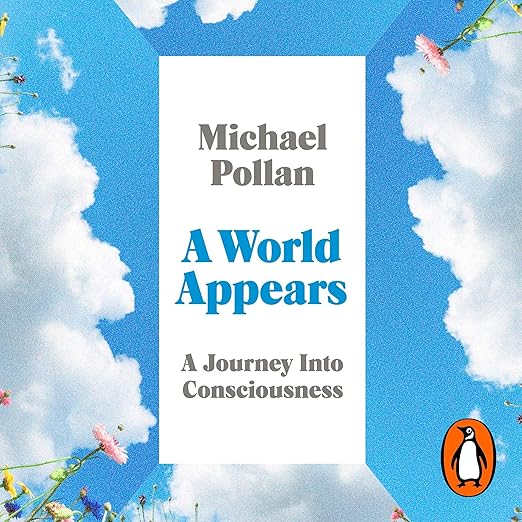
I spent most of a long train journey from London to Edinburgh with A World Appears, and by the time I reached Carlisle I had stopped looking out the window entirely. Michael Pollan has always been a writer whose curiosity is more interesting than his conclusions, and here that quality is at full, almost uncomfortably generous stretch. The question of consciousness, how three pounds of grey matter generate a subjective point of view, an inner life with feelings, memories, and the sensation of being someone, is arguably the most profound problem in all of science, and Pollan approaches it with the same restless, personal intelligence he brought to the food system in The Omnivore’s Dilemma and to psychedelics in How to Change Your Mind.
Published by Allen Lane in February 2026, A World Appears has gathered 4.5 stars from 190 ratings in under six weeks, which is a strong response for a work of this intellectual seriousness. The press reception, which the synopsis quotes, supports that signal: the Financial Times calls it “big, generous, illuminating and beautifully written”; the Guardian finds it “fabulous and mind-expanding”; the Sunday Times calls it “razor-sharp, reassuringly sceptical, sensitive and grounded.” These are not polite blurbs. They are descriptions of a book that is doing something real.
About the Audiobook
The early 1990s, as Pollan establishes in the book’s opening, marked the birth of a formal science of consciousness, founded on the assumption that subjective experience could ultimately be explained in terms of brain activity. That project is now faltering. Wilder ideas, including panpsychism, the view that consciousness is a fundamental feature of reality rather than an emergent product of complex neural activity, are receiving serious academic attention from philosophers and neuroscientists who would previously have dismissed them. Pollan wants to understand why, and his method is characteristically personal: he does not lecture from a position of settled expertise but accompanies the reader through his own investigation.
The journey takes him from neuroscience laboratories in Seattle through philosophy departments and extended conversations with Buddhist monks, ending in a cave in the mountains of New Mexico. The conclusion he reaches, that explaining consciousness may be less urgent than learning to practise it in everyday life, is not the resolution scientists are looking for but is, he argues, the one that the evidence and the experience of the investigation keep pointing towards. The audiobook runs to 8 hours and 51 minutes.
The Narration
Pollan narrates his own book, and this is entirely the right decision. He is not a professional audiobook narrator, and there are moments where a trained voice actor might move through the more technically demanding passages with greater fluency. But what Pollan brings instead is something that cannot be manufactured: intellectual ownership. When he says he was surprised by something a philosopher told him, you believe him. When he expresses genuine uncertainty, it sounds like the real uncertainty of a writer in the middle of a difficult problem rather than a rhetorical device designed to create intimacy. For a book built around personal intellectual journey rather than authoritative exposition, this quality of present-tense engagement is worth more than polished performance technique.
One reviewer noted, with affection, that Pollan seems to have a mushroom habit to support, which is a joking reference to his previous book on psychedelics and their relationship to consciousness. That continuity of intellectual concern gives A World Appears the feeling of a serious long-term project rather than an opportunistic subject change.
What Readers Say
Essential for all who are interested in the hard problem (5 stars, Felix FitzRoy): “Essential reading – a brilliant book on a difficult but fascinating topic – understandable without losing depth and subtlety.”
Toward a new view of Reality (5 stars, Dave Rowsell): “A brilliant book, and a real contribution to the emerging new paradigm of life. We need more like this.”
Of course you have to buy the next Michael Pollan book (5 stars, Peter): “He packs his books with such amazing research. This is an amazing book for anyone with the idea that the brain is a computer. Turns out, consciousness is a much more amazing, complicated, and tactile thing.”
Who Should Listen?
This audiobook is for listeners with a serious interest in the philosophy of mind, the hard problem of consciousness, or the question of what it means to be a subject in an objective world. You do not need a science background: Pollan is writing for the intelligent general reader and explains every technical concept as he introduces it. Prior familiarity with How to Change Your Mind is helpful context for understanding Pollan’s ongoing intellectual project and provides a bridge to this book’s concerns, but it is not required. A World Appears is one of the most substantive works of popular science to have appeared in the first months of 2026, and it demands and repays sustained attention in a way that makes the self-narrated format all the more appropriate.