Clara’s Verdict
Cat Sebastian has built her reputation on historical romance of considerable intelligence and emotional depth – she writes characters whose interiority is as carefully rendered as their external circumstances, and she does not flinch from making those circumstances genuinely difficult. After Hours at Dooryard Books is set in 1968 New York, in a gay bookshop in Greenwich Village, and it is both a love story and something rather larger: a meditation on community, belonging, grief, and the possibility of hope in the middle of profound societal upheaval. The comparison one reviewer reached for – Armistead Maupin’s Tales of the City – is not inapt, and it is a high standard to be measured against.
Joel Leslie’s narration is exceptional. This is one of the finest romance audiobooks I’ve encountered this year, and I do not say that carelessly.
About the Audiobook
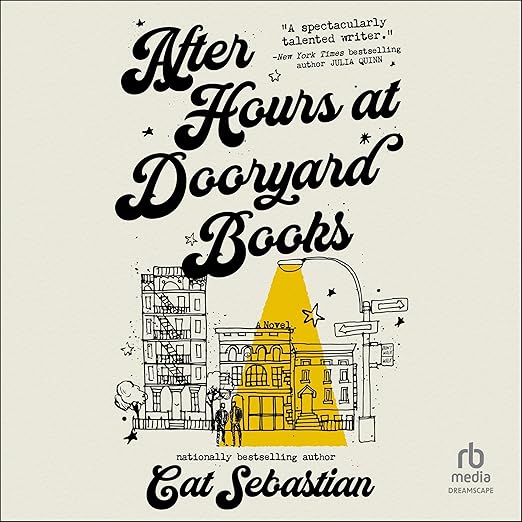
Patrick runs Dooryard Books in the East Village, sells rare books to collectors, and sleeps his way through the gay literary community with practiced ease. He is doing fine, he insists – the news might be keeping him up at night (Vietnam, the assassinations, the general sensation that the world is tilting off its axis) but he is managing. His equilibrium is disrupted when he takes in a mysterious drifter called Nathaniel, who is clearly hiding something and equally clearly not planning to stay, and when his best friend and her newborn move into the flat upstairs.
Sebastian populates the novel with a community that feels genuinely inhabited rather than assembled for narrative convenience: radicalised teenagers who are, upsettingly, right about everything; a grieving folk musician and her infant daughter, who will only sleep if Nathaniel holds her; a network of activists and agitators who are under FBI surveillance or shortly will be. The political backdrop – 1968, the year that felt like the world breaking open – is not decorative. The novel is in constant, thoughtful conversation with its historical moment, and several readers have noted, with some discomfort, how contemporary its concerns feel.
At its heart this is a love story about two people who have both, for different reasons, decided they don’t deserve the community they have accidentally found themselves in. Sebastian’s particular genius is making their journey towards believing otherwise feel utterly and painfully earned rather than merely wished for.
The Narration
Joel Leslie narrates, and his performance is outstanding. He captures Patrick’s particular combination of warmth, deflection, and unacknowledged vulnerability with remarkable precision, and his handling of the ensemble cast – multiple voices, multiple registers, the folk singer’s grief, the teenagers’ righteous certainty, Nathaniel’s carefully maintained evasiveness – is technically accomplished and emotionally alive throughout. At nine hours and three minutes, this is a listen that rewards unhurried, attentive engagement. Leslie earns every minute of it, and the Dreamscape Media production is excellent.
What Readers Say
The audiobook holds a 4.6-star average from 609 listeners – an excellent score for a historical romance with genuine literary ambitions. Reviews describe it as “gorgeous,” “lovely,” “filled with the bittersweetness of grief – for those we’ve lost, for the things we’ve let happen, for the world we can’t control and the people we can’t help. But still hopeful.” One listener called it their favourite book of 2025, noting: “Not big or flashy, just a story of normal lives living ordinarily in extraordinary times.” Several readers comment on the resonances between 1968 and the present – the sense that Sebastian has written a historical novel that is also unmistakably about now. The consensus: this lures you in gently and holds you completely until the final page.
Who Should Listen?
It is worth saying something about Cat Sebastian’s particular skill with grief, because it is central to this novel in a way that the romance framing does not entirely convey. Both Patrick and Nathaniel are carrying losses – of people, of versions of themselves, of the futures they had imagined – and Sebastian does not tidy those losses away in the service of the happy ending. The ending is earned precisely because the characters have been honest about what they have lost and what they are asking of each other. This is what separates her best work from competent genre fiction.
Historical romance readers who want real substance alongside their happy endings. Fans of LGBTQ+ fiction set in twentieth-century America – Armistead Maupin, Edmund White, the literary tradition of bearing witness to queer life in hostile times. Anyone who appreciated the recent wave of cosy, community-centred romance fiction but wants something with more historical texture and emotional weight. This is a sophisticated novel that uses the romance framework beautifully without being constrained by it. The 1968 setting and its resonances make it particularly rewarding for readers who like fiction that does more than one thing at once – which is, if I’m honest, what all the best fiction does.
Listen to After Hours at Dooryard Books on Audible UK – a beautifully crafted story of community, love, and finding your place in the world.