Clara’s Verdict
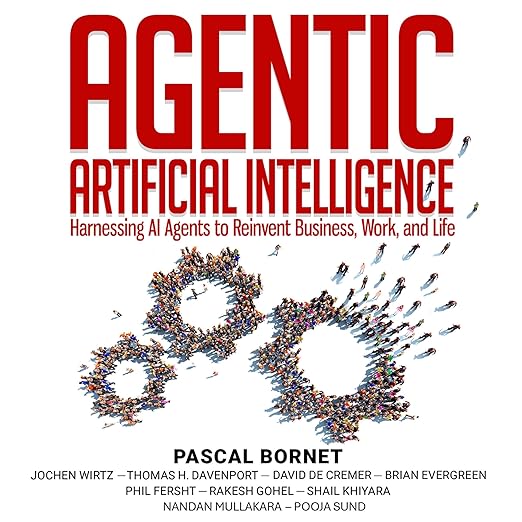
The volume of business books about artificial intelligence published in the past two years has been extraordinary, and the quality has been correspondingly uneven. Most fall into one of two failure modes: either breathlessly optimistic to the point of uselessness – the world is changing, everything is different, act now – or so hedged with appropriate caveats that they offer nothing actionable to the reader who actually needs to make decisions. Pascal Bornet’s Agentic Artificial Intelligence largely avoids both traps. It is a serious, practically-oriented guide written by people who have implemented this technology across real organisations, and that lived experience gives it a credibility that purely theoretical treatments cannot manufacture. Rated 4.4 from 407 listeners – a substantial and meaningful sample – it has found a genuinely receptive audience.
The book’s single most valuable quality is its honesty about failure as well as success. Bornet and his co-authors have seen agentic AI implementations go wrong, and they write about what went wrong in ways that help the reader avoid the same outcomes. That kind of evenhandedness is rarer in a field dominated by advocates than it should be.
About the Audiobook
Published in March 2025 and running nearly fifteen hours, this is a comprehensive guide to what the authors call the Agent Economy: the emerging landscape in which AI systems that can plan, act autonomously, adapt based on outcomes, and coordinate with each other are transforming the way organisations operate and compete. The book’s framing is explicitly strategic rather than technical – Bornet is not teaching you to build an AI agent, but to lead an organisation through the transition that agentic AI is driving.
The content is organised around the core questions any leader needs to answer: how to identify high-value opportunities for agentic AI within your specific context; how to build and deploy agents that actually work; what new business models and revenue opportunities the Agent Economy opens; and what skills and mindset changes are required when humans and AI systems work alongside each other on genuinely complex tasks. Throughout, the authors balance the transformative potential of the technology against the very real implementation challenges – governance, accountability, quality control, the management of AI systems that make consequential decisions autonomously.
The case studies, drawn from the authors’ consulting work across global enterprises and early-stage startups, provide concrete illustrations of both successful implementations and instructive failures. Some reviewers have noted that these could profitably be explored in greater depth – this is a fair criticism, and reflects the tension between breadth and depth that any comprehensive guide faces. A companion PDF is included in the Audible library. The framing question – not whether agentic AI will transform your industry, but how you will lead that transformation with purpose and integrity – is the right question for this moment, and Bornet approaches it with the seriousness it deserves.
The section on what the authors call the new mindset required to lead in the Agent Economy is, I think, the most original contribution the book makes. Most AI business literature focuses on technology adoption or workflow transformation; relatively few engage seriously with the question of what it means to manage a team that includes AI agents with genuine autonomy – agents that can take consequential actions, make decisions, and generate outputs that will be attributed to human organisations. Bornet addresses this with appropriate seriousness, acknowledging that the psychological and cultural adjustments required are often harder than the technical ones.
The Narration
Rory Young narrates, handling technically dense material with the clarity it requires across nearly fifteen demanding hours. The balance between accessible explanation and appropriate complexity is well-maintained throughout: Young keeps the jargon-heavy sections from becoming robotic, and brings a natural storytelling quality to the case study material that makes the longer analytical passages more bearable. At fifteen hours, maintaining consistent pace and energy across substantial instructional content is a genuine challenge, and Young manages it without audible strain.
What Readers Say
The response across 407 listeners has been broadly positive with some well-placed qualifications that are worth noting. One reviewer called it “an excellent book” for a thorough, non-surface-level introduction that engages honestly with both opportunities and challenges. Another praised the accessibility to non-technical readers – Bornet, like the best explainers of complex topics, does not condescend but also does not assume background knowledge that most of his audience doesn’t have. The most useful critical note, from a reviewer in the UK, is that the writing style reflects the authors’ consulting background – polished, structured, occasionally thin on granular implementation detail where specificity would help most. This is fair. The consensus is that this is one of the more trustworthy books in a field crowded with overpromising.
Who Should Listen?
Business leaders, senior managers, and entrepreneurs who need to understand agentic AI at a strategic level – not to build the systems themselves, but to make informed decisions about where and how to deploy them, and to lead organisations through the transition without being either naive about the risks or so cautious that they cede ground to less careful competitors. Also well-suited to people in digital transformation, automation, or technology consulting who want a frameworks-based approach to advising clients. The non-technical framing makes it genuinely accessible to non-engineers. If you are responsible for your organisation’s AI strategy – or if your organisation does not yet have one and you think it should – fifteen hours with this book is a worthwhile investment.
Listen to Agentic Artificial Intelligence on Audible UK – also available on Kobo, Scribd, and Storytel.