Clara’s Verdict
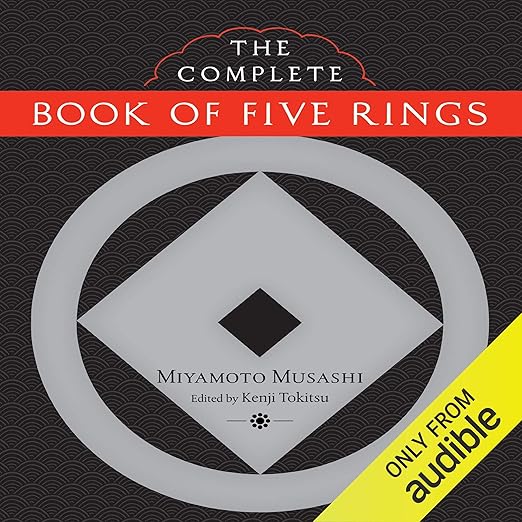
Miyamoto Musashi fought over sixty sword duels – many of them to the death – before retiring in his fifties to a cave on the island of Kyushu and spending the final years of his life writing down everything he had learned about strategy, discipline, and the cultivation of mastery. The Book of Five Rings, completed in 1645, is the result: a treatise that has been read by samurai, business leaders, military strategists, and philosophers for nearly four centuries without losing its edge. This edition, translated and extensively annotated by martial arts scholar Kenji Tokitsu and narrated by Brian Nishii for Audible Studios, is the most rigorous and contextually rich audio version of this material I have encountered. At just over five hours, it is more substantial than that duration might initially suggest.
About the Audiobook
What distinguishes this edition decisively from simpler translations is the comprehensiveness of Tokitsu’s scholarly framing. The Book of Five Rings itself runs to roughly fifty pages in most print editions – a document of concentrated power and famous difficulty without context. For the uninitiated, its instructions on sword technique can seem impossibly remote; for those who understand the philosophical system beneath the technical surface, it is one of the most profound texts on the nature of competitive excellence ever written. Tokitsu, who has spent the greater part of his professional life researching Musashi, provides that system.
His edition includes four additional Musashi texts that are rarely heard alongside the Five Rings: The Mirror of the Way of Strategy, written when Musashi was in his twenties and still developing his thinking; Thirty-five Instructions on Strategy and Forty-two Instructions on Strategy, which served as direct precursors to and dry runs for the Five Rings; and The Way to Be Followed Alone, Musashi’s final written work, completed just days before his death. Heard in sequence, these texts constitute a comprehensive view of a philosophical project developed and refined over an entire lifetime. The evolution of Musashi’s thinking – from the confident, somewhat combative young duelist to the serene, death-contemplating master – is itself one of the most compelling narratives in the intellectual history of martial arts.
Tokitsu’s annotations place Musashi’s thought in careful historical and philosophical context: the Warring States period, the Tokugawa consolidation, the changing social position of the samurai class, and the relationships between Musashi’s strategic principles and Buddhist, Shinto, and Confucian philosophical traditions that would have been his inheritance. The result is a text that can be engaged with at multiple levels simultaneously. Application to modern contexts – leadership, competition, business, self-cultivation – is left largely to the listener, which is the right approach: Musashi’s principles are robust enough to make their own case without needing a consultant’s translation.
The Narration
Brian Nishii is an excellent and culturally appropriate choice for this material. His voice carries appropriate gravity without straying into affected profundity, and his pronunciation of Japanese proper names and technical terminology is accurate – a detail that matters considerably when dealing with source material this culturally and historically specific. The pacing is deliberate throughout, suited to text that genuinely rewards slow, attentive listening rather than passive consumption. Nishii gives both Musashi’s aphoristic, sometimes gnomic declarations and Tokitsu’s more analytical commentary their proper weight, and manages the transitions between the two voices cleanly.
What Readers Say
The audiobook holds a 4.7-star rating from 489 listeners – a strong result for philosophical non-fiction of this nature. UK reviewers consistently emphasise the particular value of Tokitsu’s scholarly apparatus: one called it “the best translation with comments section,” noting that Tokitsu’s expertise in martial arts is essential to the interpretive work. Another praised the depth of contextual framing while noting that some shorter, simpler translations might serve first-time readers better as an initial encounter with the material. A third reviewer made the case with characteristic directness: “A real-life samurai philosopher who had at least 63 sword duels to the death… wrote down his philosophies. What the hell are you waiting for?” The one 4.0-star outlier found Tokitsu’s approach more painstaking than some shorter translations in conveying the immediate gist – a legitimate preference for a different kind of engagement.
Who Should Listen?
The Complete Book of Five Rings is essential listening for anyone seriously interested in strategy, whether in business, competitive sport, martial arts, or philosophy of action and excellence. It rewards listeners willing to engage with a text that does not make its modern relevance explicit – Musashi’s principles are articulated in the language and context of sixteenth-century Japan, and the act of translating them to contemporary life is the reader’s own work to do. That work is part of the value. Those who have read Sun Tzu’s The Art of War will find familiar territory and considerably deeper analysis. Those coming to Musashi for the first time will find something genuinely unlike anything else in the strategic canon – older, more personal, more concerned with the interior conditions of mastery than with tactical systems alone.
Listen on Audible UK: Get The Complete Book of Five Rings on Audible UK. Also available on Kobo, Scribd, and Storytel.