Clara’s Verdict
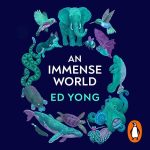
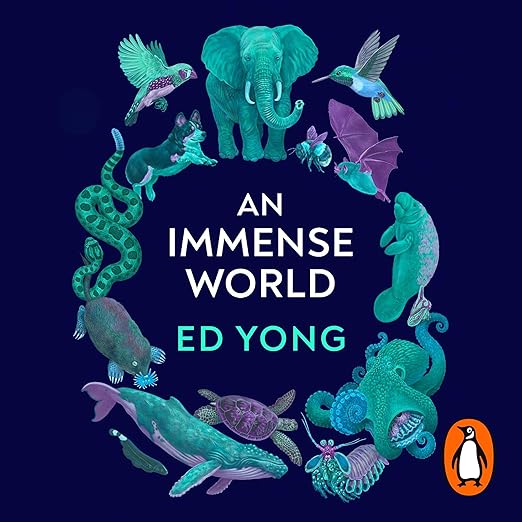
Ed Yong’s An Immense World is the kind of science writing that makes you permanently rearrange the way you perceive your immediate surroundings. After reading it, you will notice a dog’s nose in a different way, a bat’s silhouette differently, even the behaviour of a bumblebee in a garden with fresh eyes. Yong – a Pulitzer Prize-winning science journalist, author of the acclaimed I Contain Multitudes – has written an exploration of animal sensory worlds: the umwelt, as the biologist Jakob von Uexküll called it, the self-centred universe each species inhabits. Mantis shrimp with sixteen colour-detecting cones. Scorpions that may see with their entire bodies. Knifefish that navigate by electrical field. The natural world, it turns out, is stranger and richer than our own senses allow us to grasp – and Yong reads his own book with the infectious enthusiasm of someone who spent years being astonished.
About the Audiobook
The book proceeds through the senses: vision, sound, vibration, electric and magnetic fields, smell, taste. For each sensory modality, Yong takes us into the specific biology of multiple species, drawing on cutting-edge research to explain not just what animals can detect but how their nervous systems process that information – and how fundamentally different the resulting experience of the world must be from our own. This is not easy material to communicate accessibly, but Yong has a gift for analogy and a journalist’s instinct for the specific detail that makes the abstract vivid.
The book’s most important argument is ethical: in an era of mass extinction, our ability to imagine ourselves into other species’ perceptual worlds may be the imaginative foundation required for genuine conservation. If we cannot begin to appreciate what a cetacean experiences when it is exposed to naval sonar, we cannot fully understand what we are destroying. Yong makes this case without abandoning scientific rigour, and without preaching. The final sections of the book, dealing with the human disruption of animal sensory environments through noise and light pollution, are genuinely disturbing in the best way.
At just over fourteen hours, this is a substantial listen. Published June 2022 by Penguin Audio.
The Narration
Yong reads his own work, and the decision is wholly vindicated. His voice carries the genuine enthusiasm of someone who has been regularly astonished by his research – he sounds delighted, which is contagious. His pace is slightly quick, which suits the material: science writing that drags feels like a lecture, and Yong’s briskness keeps the listener moving through ideas. The density of footnotes in the print edition translates less well to audio form – several reviewers noted this – but Yong integrates the most important contextual information smoothly enough that the flow is maintained.
The book’s scope is also notably democratic: Yong gives as much attention to creatures we rarely think of – the pit vipers that see in infrared, the duck-billed platypus that hunts by electroreception, the star-nosed mole that experiences its environment primarily through its extraordinary snout – as to the charismatic megafauna that dominate most popular science writing. This inclusiveness is both scientifically valuable and narratively satisfying: each chapter opens up a new way of thinking about what it means to inhabit a body in a world full of information we cannot access.
What Readers Say
UK listeners rate it 4.7 out of 5 from 5 reviews. One declared it “the best book I have ever read – life changing,” going so far as to buy five copies as gifts. Another described it as “scrupulously and robustly evidence-based, but written in a very accessible way.” A third said it was “like having a really smart friend happily telling you everything they know about animals” – high praise, and an accurate description of Yong’s authorial voice. A more critical reviewer found the footnote-heavy structure occasionally disruptive to audio flow, but still rated it four stars and described it as “fascinating and ambitious.” The consensus is that this is one of the finest popular science books of recent years.
Who Should Listen?
For anyone with a genuine interest in the natural world, animal cognition, evolution or ecology, this audiobook is essential. It is also ideal for listeners who liked I Contain Multitudes, Entangled Life by Merlin Sheldrake, or David Attenborough’s more scientifically demanding written work. Even listeners with no particular background in biology will find this approachable, because Yong consistently builds from the familiar to the extraordinary. Listen to An Immense World on Audible UK and prepare to see everything differently.