Clara’s Verdict
Few book projects are as gleefully odd as The Science of Discworld, and the fourth volume, Judgement Day, may be my favourite kind of oddity. It braids a genuine Terry Pratchett Discworld story together with real, rigorous popular science, and then dares to point the whole apparatus at the biggest questions we have. I came away entertained and, more unexpectedly, made to think.
The trick that makes it work is tone. The fiction is warm and funny, the science is delivered with the confidence of people who actually do it for a living, and the two halves talk to each other rather than politely taking turns. If you like your ideas served with a wink, this is a rare treat.
It is only fair to say this is not a book to have on in the background. It asks for your attention, especially in the science chapters, and it rewards listeners who are happy to sit with a little uncertainty rather than demanding tidy answers.
About the Audiobook
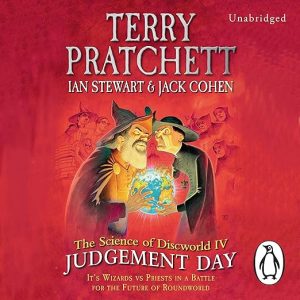
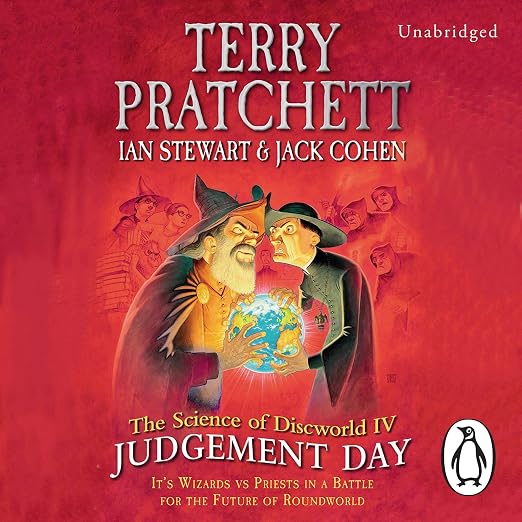
Judgement Day is the fourth book in the Science of Discworld series, and this time it takes on the really big questions. A brand new Terry Pratchett Discworld story is annotated with very large footnotes, the interleaving chapters, by mathematician Ian Stewart and biologist Jack Cohen, producing a mind-mangling combination of fiction, cutting-edge science and philosophy.
Marjorie Daw is a librarian who takes her job, and indeed the truth of words, very seriously. She does not know it, but her world and ours, Roundworld, is in serious trouble. On Discworld, a colossal row is brewing. The Wizards of Unseen University feel responsible for Roundworld, having brought it into existence by bungling an experiment, but legal action is now being taken against them by the Omnians, who say the Wizards’ god-like meddling makes a mockery of their religion.
As the finest legal brains in Discworld gird their loins for battle, and as the Great Big Thing in the High Energy Magic Laboratory is switched on, Marjorie Daw finds herself thrown across the multiverse and dropped into the middle of the whole explosive affair. Around that story, the science chapters roam across quantum gravity, evolutionary design, dark matter and the question of how you might invent a better mousetrap. God, the universe and frankly everything else all come under cheerful, curious investigation.
The Narration
Michael Fenton Stevens narrates, and at twelve hours and fifteen minutes this is a substantial listen with a great deal of ground to cover. That length is well spent, because the book alternates between comic Discworld storytelling and dense, idea-packed science, and both modes need room to breathe.
The challenge for any narrator here is the constant gear-change. One moment you are among wizards and zombies and Pratchett’s trademark comic timing, the next you are following a careful argument about physics or evolution. A reading of this material has to keep the jokes crisp while giving the science the clarity and patience it deserves, so that a listener without a technical background can follow the thread and still enjoy the ride. The generous running time means neither side is rushed, and the alternating structure gives your ear a natural rhythm of story and explanation, story and explanation, all the way to the end.
What Readers Say
With an average of 4.5 stars across 737 ratings, this fourth volume has clearly found a devoted audience. Long-standing fans of the series welcomed it warmly, one describing the ongoing saga of science and Discworld as a great combination of entertainment and genuine, proper science. Another reader with a background in chemistry and physics praised the treatment of the science as excellent, while gently noting it could stretch a listener without some grounding in the subject.
The book’s central theme, the tug of war between science and religious belief, drew the most comment. Several readers found it thought-provoking and were glad it made them reason things through for themselves. A few felt its view of religion was a touch naive, yet the same reviewers were quick to add that the authors remain respectful of the beliefs they question. It is, by common agreement, a book that provokes actual thinking rather than settling anything, which is rather the point.
Who Should Listen?
This is a listen for the curious. If you love Terry Pratchett’s Discworld and you also enjoy popular science that does not talk down to you, Judgement Day sits right at the meeting point of those pleasures. It suits listeners who like big ideas, playful footnotes and a debate that respects both sides, and who do not mind a little intellectual heavy lifting along the way.
Newcomers can enjoy it, though a little comfort with school-level science will smooth the path, as one reader kindly pointed out. If that describes you, pour something warm, give it your full attention and Listen to The Science of Discworld IV: Judgement Day on Audible for a listen that is as funny as it is genuinely stretching.