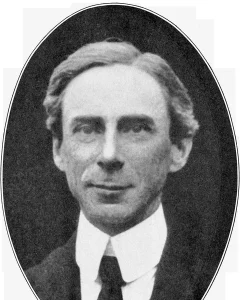
Orphaned before his fifth birthday, Bertrand Arthur William Russell, third Earl Russell, was raised at Pembroke Lodge by the widow of a Prime Minister and spent the rest of his long life dismantling the certainties he had been handed. He was born in 1872, escaped that hothouse in 1890 on a scholarship to Trinity College, Cambridge, and graduated three years later.
There he found G. E. Moore and Alfred North Whitehead, and with them helped lead the revolt against British idealism that reshaped philosophy in English. With Whitehead he wrote Principia Mathematica, the vast attempt to ground all mathematics in logic; his essay On Denoting is still taught as a model of how the discipline argues. Frege preceded him, Wittgenstein followed him, and analytic philosophy took the shape it holds today.
He was also a public nuisance in the best sense: a pacifist gaoled during the First World War, an anti-imperialist who chaired the India League, a late and furious campaigner for nuclear disarmament. The Nobel Prize in Literature came in 1950, awarded for writing that championed humanitarian ideals and freedom of thought. He died in 1970, aged ninety-seven.


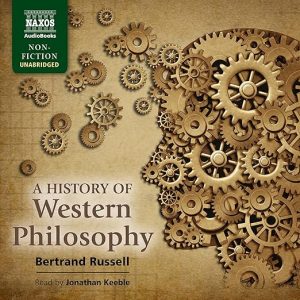 38 hours and 3 minutes