Clara’s Verdict
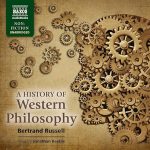
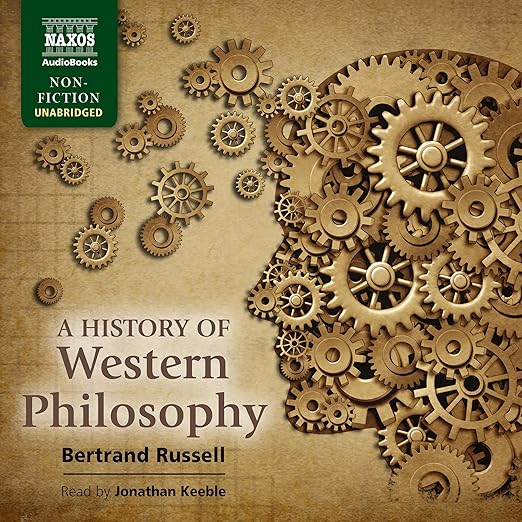
Bertrand Russell’s A History of Western Philosophy was published in 1945 and has never been out of print. It remains, eighty years on, the most readable single-volume account of its subject in the English language – and that’s not faint praise. Russell is funny, opinionated, and occasionally scathing in ways that contemporary academics rarely permit themselves to be, and the result is a history of ideas that reads rather more like an extended conversation with a brilliant, exasperating dinner companion than a textbook.
Jonathan Keeble narrates the Naxos AudioBooks recording, and at thirty-eight hours, this is a serious commitment. It is also, I think, one of the genuinely rewarding long listens available in the intellectual non-fiction catalogue. Philosophy presented as living argument, as a story with heroes and villains and wrong turns and moments of genuine illumination – this is what Russell understood and most of his successors have failed to replicate.
About the Audiobook
Russell covers the full sweep of Western philosophical thought from the pre-Socratics through to the early twentieth century, placing each thinker within their historical and cultural context. He is particularly acute on the relationship between philosophy and political power – his treatment of the medieval period, where theological constraints shaped what could be thought and said, is especially illuminating. His accounts of Plato, Aristotle, Descartes, Hume, Kant, and the empiricist tradition are models of clear exposition. He is also, refreshingly, willing to say when he thinks a philosopher got things wrong, and his reasons for saying so are usually compelling.
The book is not exhaustive – Russell himself acknowledged that it was designed to be readable rather than comprehensive. But it is an extraordinary intellectual performance: the work of a man at the height of his powers, writing for the general reader with the assumption that general readers can handle difficult ideas when they’re presented with sufficient care.
The Narration
Jonathan Keeble is ideally suited to this material. He has a naturally authoritative voice that carries weight without condescension, and his pacing through Russell’s more demanding arguments is carefully managed. The text requires a narrator who can modulate between Russell’s more lyrical passages and his more analytical ones without losing the thread of either, and Keeble handles this with skill. Thirty-eight hours is a long recording, but there’s no sense of fatigue in the performance – Keeble maintains consistent engagement throughout.
What Readers Say
The audiobook holds a 4.7 rating. “Ant Mart” on Audible UK called it “a must read if you have any interest in philosophy at all,” praising Russell’s explanatory clarity. John Pritchard described Russell as “an intelligent, engaging and entertaining man” whose work reads like listening to “an amusing and well-educated after-dinner speaker.” San Patch, an engineering graduate who approached the book for its difficulty, said he wished he’d discovered it sooner. One reviewer read the text as a young man in the early 1950s and found that returning to it decades later proved “fascinating” – a rare testimony to genuine durability.
Who Should Listen?
Essential for anyone with a curiosity about where Western ideas came from and how they developed. It’s a particularly good choice for listeners who have encountered individual philosophers – Plato in sixth form, Nietzsche in their twenties – but have never had the opportunity to see them placed in relation to one another. It’s also a rewarding listen for the simply curious: Russell’s wit and clarity make demanding material genuinely enjoyable. Give yourself the thirty-eight hours; they’ll be well spent.
Listen on Audible UK: Get A History of Western Philosophy on Audible UK. Also available on Kobo, Scribd, and Storytel.