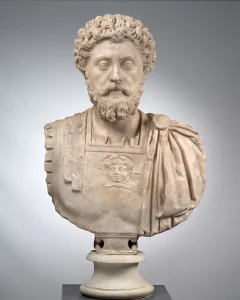
Marcus Aurelius (121 to 180 AD) was Roman emperor from 161 until his death and, far more unusually for a man in that job, a serious Stoic philosopher. He was the last of the rulers remembered as the Five Good Emperors and the last emperor of the Pax Romana, the long stretch of relative peace and stability the Roman Empire enjoyed. His father died when he was three, leaving him to be raised by his mother and grandfather; he was adopted into the imperial succession, tutored in Greek and Latin by scholars including Herodes Atticus and Marcus Cornelius Fronto, and married to the emperor Antoninus’s daughter Faustina.
His reign was anything but serene: war in the East against a revitalised Parthian Empire, the grinding Marcomannic Wars against the Marcomanni, Quadi and Iazyges, and the Antonine Plague, which killed millions across the empire. He ruled first alongside his adoptive brother Lucius Verus and was succeeded by his son Commodus; his column and equestrian statue still stand in Rome.


 5 hours and 9 minutes