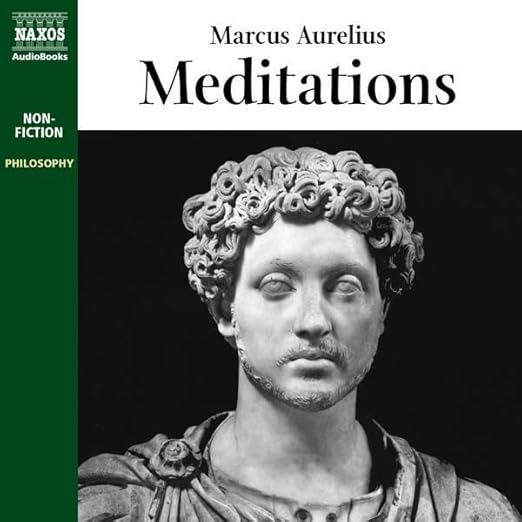
Clara’s Verdict
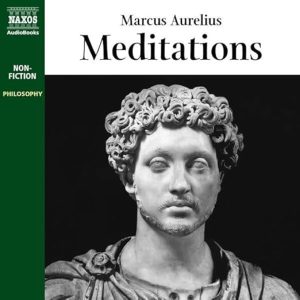
There is a particular kind of hubris involved in reviewing the Meditations of Marcus Aurelius – a text that has been in continuous use since the sixteenth century and has survived considerably more rigorous scrutiny than anything I might offer. What I can say, having listened to this Naxos edition read by Duncan Steen, is that the audiobook format suits this particular book unusually well, perhaps better than any other classical text I can think of. The Meditations were never written for publication – they are private notes to self, a Roman emperor working through Stoic philosophy in real time – and hearing them read aloud restores something of their original quality: a voice addressing itself, thinking aloud, correcting and returning. At 5 hours and 9 minutes, this is a compact but genuinely affecting listen.
About the Audiobook
Marcus Aurelius wrote his notes between approximately 161 and 180 CE, during a reign defined by perpetual military campaigning, bubonic plague, and the administrative weight of governing the largest empire in the ancient world. The themes that preoccupied him are striking in their contemporary relevance: duty, forgiveness, the brotherhood of humanity, strength in adversity, the proper relationship between reason and circumstance, and the question of how to face death without either denial or despair. The Naxos edition uses George Long’s translation revised by Duncan Steen – a version that updates the most archaic formulations whilst retaining the stateliness the text requires and has always had.
The Meditations have no argument in the conventional sense. They circle and return, repeat insights in different formulations, apply philosophical principles to specific frustrations and failures. This quality, which can frustrate readers looking for a linear argument, is part of what makes the audiobook format so effective: the listen becomes something like a sustained meditation in itself, and the Stoic insights – that we control only our own judgements, that externals are indifferent, that death is nothing to fear – accumulate through repetition into something more than the sum of their individual statements.
It is also worth noting the specific quality of Marcus Aurelius’s Stoicism compared to more familiar practitioners of the philosophy. He was not writing for publication or posterity – these notes were never intended to be read by anyone other than himself – and that private quality gives the text a directness that more composed philosophical works lack. When Marcus reminds himself not to waste time on uncontrollable externals, or to act well without seeking recognition, he is actively struggling with the same tendencies he criticises, not lecturing from a position of achieved wisdom. That struggle is part of what makes the text useful rather than merely admirable.
The Narration
Duncan Steen’s reading is measured and authoritative – exactly appropriate for a text that rewards careful listening rather than pace. He does not attempt to dramatise material that is essentially philosophical monologue, which is the right and only reasonable decision; a theatrical reading would impose a falseness on these private notes that would undermine everything. The translation, which Steen helped to prepare, sits in the middle register between archaic formality and modern accessibility. One reviewer found the residual archaic language occasionally tedious, which is a legitimate response – but for this listener, the slight elevation of register serves the reflective quality of the material well.
What Readers Say
Rated 4.3 out of 5, the reviews capture the full range of responses to Stoic philosophy. One reviewer uses the book as “an I Ching that actually says useful things” – a description that captures both its wisdom and its occasionally oracular quality. Another praises it as creating “a personal connection with an epoch of time, long since finished.” A more sceptical reviewer found the language difficult for today’s younger reader, which the revised translation here largely addresses. The book’s survival for nearly two thousand years remains the most compelling endorsement it could possibly receive.
Who Should Listen?
Anyone interested in Stoic philosophy, in classical thought, or in the practical question of how to live well under sustained pressure. The Meditations are genuinely useful in a way that most philosophy is not – they are not abstract but applied, concerned throughout with the question of how to behave well when the world actively does not cooperate. The audiobook format is particularly well-suited to daily commutes, long walks, or any situation where the mind is partly occupied and partly free. At just over five hours, it can be listened to in fragments without losing the thread. Listen on Audible UK: get Meditations on Audible UK. The audiobook also functions well as an introduction to Stoic philosophy for listeners who want to understand the original primary source before moving on to modern interpretations and applications. Available on Audible UK and Kobo. Ryan Holiday’s The Obstacle Is the Way and Donald Robertson’s How to Think Like a Roman Emperor are useful modern companions if the Meditations leave you wanting more Stoic practice in contemporary form.