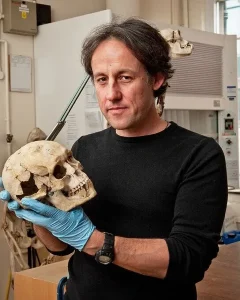
Radiocarbon dating rarely makes headlines, yet it has quietly overturned a great deal of what we thought we knew about our own species. Tom Higham has spent his career at the centre of that upheaval.
A specialist in scientific archaeology, he directed the Oxford Radiocarbon Accelerator Unit until 2021, after two decades based at the University of Oxford, and is now Professor of Scientific Archaeology in the Department of Evolutionary Anthropology at the University of Vienna. His work uses accelerator mass spectrometry to put reliable dates on Palaeolithic sites, which sounds narrowly technical until you consider what hangs on the answers.
Higham’s research concerns the emergence of Homo sapiens and our overlap with the other humans who shared Eurasia, above all the Neanderthals and the Denisovans, the latter identified only recently from fragments of bone in a Siberian cave. Dating tells us whether those populations met, for how long, and where. He writes as a working scientist rather than a populariser, candid about false starts, contaminated samples and results that had to be withdrawn, and that honesty is a large part of his appeal.

 9 hours and 4 minutes