Clara’s Verdict
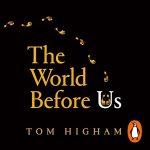
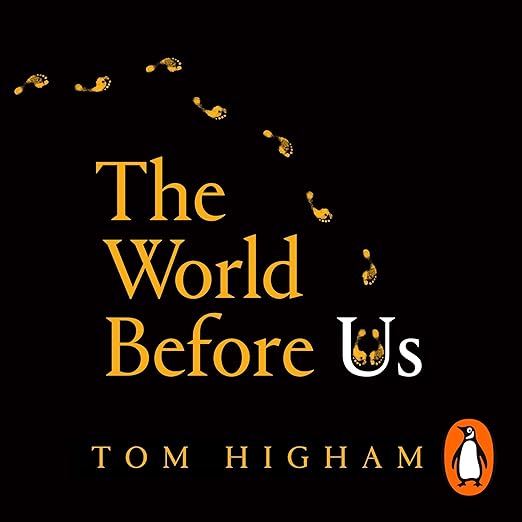
Fifty thousand years ago, we were not alone. That fact – simple to state, extraordinary to sit with – is the animating idea behind The World Before Us, Oxford Professor Tom Higham’s account of the scientific discoveries that have, in the past few decades, fundamentally changed our understanding of human prehistory. Narrated by John Sackville with appropriate gravitas, this is a book that manages the difficult trick of being both rigorously scientific and genuinely readable. I listen to a great deal of popular science, and the best of it – this book qualifies – makes you feel that you are in the presence of someone who cannot quite believe how fascinating their own field is. Higham is that person.
The Denisovans alone – an entire species of human, identified from a fragment of finger bone and a couple of teeth, whose genetic legacy lives on in modern populations across Asia and Oceania – would be enough material for a remarkable book. Higham gives us that, and much else besides.
About the Audiobook
The starting point is a question that seems almost absurd in its implications: until very recently, we thought we were the only humans who had ever lived. We were wrong. The Neanderthals we knew about, more or less. But the Denisovans – identified only in 2010 from fragmentary remains found in a Siberian cave – were an entirely unknown branch of the human family tree, one that interbred with both Neanderthals and our own ancestors and whose genetic inheritance persists in people alive today.
Higham, one of the world’s leading experts in radiocarbon dating, uses the Denisovan story as a way into a broader account of how science has transformed our understanding of human prehistory. The methodological innovations he describes – improvements in radiocarbon dating precision, the extraction and analysis of ancient DNA from fragmentary remains – are not merely technical achievements; they are detective stories, and Higham tells them as such.
The book covers the full cast of our ancient relatives: Neanderthals, Homo floresiensis (the “Hobbits” of Flores), Homo luzonensis (discovered in the Philippines as recently as 2019), and the Denisovans. It examines where these species overlapped, how they interacted, and how their genetic legacy shapes the people alive today. At 9 hours and 4 minutes, it is a substantial but never exhausting listen, accompanied by a PDF with additional reference material.
The Narration
John Sackville brings a measured, authoritative quality to the material that suits its scientific register without making it feel dry. He handles the technical vocabulary – radiocarbon calibration curves, haplogroup distributions, stratigraphic sequencing – with confidence and clarity, never losing the listener in jargon but never oversimplifying either. The pacing is well-judged: slower and more reflective during the methodological explanations, livelier when Higham is describing a particular discovery or a moment of breakthrough. A reliable and polished performance.
What Readers Say
With 291 ratings and a 4.6 average, this is one of the most consistently well-reviewed popular science audiobooks in its field. Readers describe it as “one of the very best and currently most up-to-date books on the subject” and as something they were unable to leave the room without finishing. A volcanologist at the University of Leeds called it “the best [book on human migration] that puts it all together.” Reviewers who are not scientists report finding it accessible and compelling; scientists praise its accuracy and currency. The main criticism from some is that it focuses more on the science of discovery than on the lived experience of these ancient humans – a fair observation, though arguably exactly what Higham set out to do.
Who Should Listen?
Ideal for anyone with an interest in human evolution, archaeology, or the history of science. If you have ever wondered where the Neanderthals went, or how we know anything at all about people who lived 50,000 years ago, this book provides the most current and compelling answers available. Accessible enough for non-specialists, rigorous enough to satisfy those with a scientific background.
Listen to The World Before Us on Audible UK – the most compelling account of human prehistory currently available in audio.