Clara’s Verdict
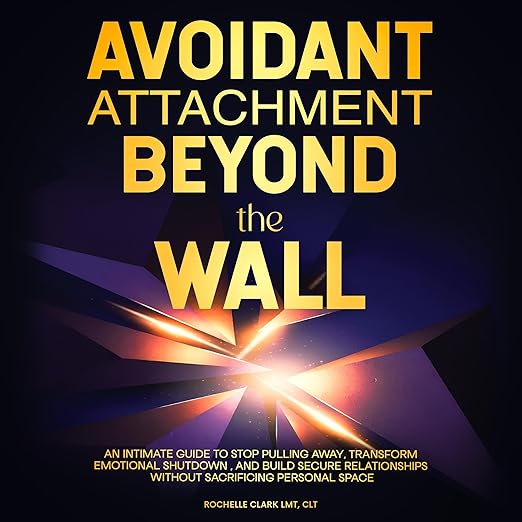
The self-help genre is saturated with books that explain attachment theory at considerable length and offer very little that is actually useful to do with the knowledge. Avoidant Attachment: Beyond the Wall, book three in Rochelle Clark’s Secure Self Series, is rather more practical than most. It begins from the correct premise – that avoidant behaviour is a nervous system adaptation, not a character flaw or a failure of will – and proceeds to offer tools that are specific enough to actually use in the actual situations where avoidant patterns typically show up.
At just under six hours it is a manageable and well-paced listen. Narrator Sallybeth delivers the material with the kind of grounded warmth that genuinely matters for a subject this personal and this close to the bone for many listeners. Some self-help books you can skim; this one rewards attentive listening and pausing to actually attempt the exercises it describes.
About the Audiobook
Clark’s distinguishing move is somatic as well as cognitive. Most attachment books work from the inside out: understand the pattern, adjust the thought, change the behaviour. Clark’s argument is that avoidant patterns are held in the body – in the threat response that fires when emotional intimacy gets too close – and that genuine change requires body-based work alongside the cognitive tools. This dual approach gives the book more texture and more practical reach than a straightforward guide to communication scripts, though those scripts are here too, and they are usefully specific.
The book addresses several interlocking challenges that avoidant individuals typically encounter. The tendency to ghost after promising dates. The compulsive fault-finding that activates when relationships deepen past a certain threshold. The emotional vocabulary that stalls at “fine.” The pride in self-sufficiency that coexists with a persistent, unacknowledged loneliness. Clark addresses each pattern with specific techniques: somatic exercises for tolerating closeness without triggering the flight response, word-for-word scripts for requesting space without activating the partner’s abandonment anxiety, and strategies for interrupting the protest-withdraw cycle that characterises the anxious-avoidant pairing, which is perhaps the most common and most painful attachment combination.
The breadth is notable: the tools are explicitly designed to apply across romantic relationships, family dynamics, friendships, and professional contexts. Each chapter includes Action Steps, Communication Scripts, Reflection Prompts, and case studies drawn from real experience – a practical scaffold that makes the material immediately applicable rather than merely interesting to contemplate. A PDF companion document is included with the Audible version, which extends the value of the listening experience into ongoing practice.
Clark is careful to distinguish between what avoidant attachment looks like from the inside – where independence feels like strength and distance feels like safety – and how it appears from the outside, where partners and friends experience it as withdrawal, dismissal, or indifference. That dual perspective is one of the book’s genuine strengths: it is useful both for people who identify as avoidant and for those in relationships with someone who does. This is book three in The Secure Self Series; the previous volumes are available as companion reading.
The Narration
Sallybeth narrates with a calm, grounded quality that is well-chosen for the content. A clipped or anxious delivery would be actively counterproductive for a book about nervous system regulation; instead, she creates a sense of space in the material that subtly mirrors what the book is trying to teach. The scripts and reflection prompts are delivered at a pace that allows listeners to actually absorb and process them rather than simply moving through them. For a book where the exercises are as important as the explanations, narrator choice matters more than usual, and this is a good one.
What Readers Say
The audiobook holds a perfect 5.0 from its early reviews. Massimiliano Salerno described the experience as finally having someone “translate patterns I couldn’t explain,” noting particularly the shift in framing – avoidance as a protective strategy that once served a purpose rather than simply selfishness or emotional immaturity – as genuinely transformative. Angela Gutierrez found it clarified the dynamics between her own attachment style and her partner’s, specifically the pattern of mutual triggering. Both reviews suggest the book is landing precisely where it is aimed, with readers who recognise themselves in the description and are ready to do something about it.
Who Should Listen?
For anyone who recognises themselves in the phrase “I want connection but intimacy feels suffocating” – whether they identify as avoidant themselves, are in a relationship with someone avoidant, or are trying to understand a pattern they’ve noticed recurring across different relationships and different contexts. Also genuinely useful for therapists and coaches working in the attachment space who want practical, body-based tools to recommend to clients alongside more traditional cognitive approaches. Part of The Secure Self Series – books one and two are available as companion volumes.
Available on Audible UK, Kobo, Scribd, and Storytel. Listen to Avoidant Attachment on Audible UK.