Clara’s Verdict
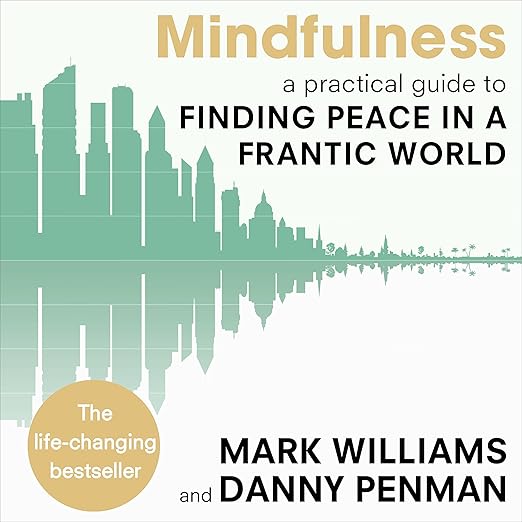
There are mindfulness books, and then there is Mindfulness: A Practical Guide to Finding Peace in a Frantic World by Professor Mark Williams and Dr Danny Penman. This is not a wellness trend packaged between covers. Williams co-developed Mindfulness-Based Cognitive Therapy at Oxford University, and MBCT is formally recommended by NICE as being as clinically effective as antidepressants for preventing depression relapse. That credentialing matters. It changes what you’re listening to. Available now for the first time as an unabridged audio download – and at over ten hours, this is a proper, substantive course rather than a gentle introduction. With over one and a half million copies sold in print, it is one of the most impactful books in its field.
I’ve reviewed a great many wellbeing audiobooks in my career. This one has a weight and rigour to it that most of its competitors simply cannot match, and I come back to it regularly both for professional reasons and personal ones.
About the Audiobook
Published by Little, Brown Audio in August 2021, this unabridged edition runs to 10 hours and 31 minutes and is structured as an eight-week programme. Eight guided meditations are included – and crucially, repeated at the end of the recording for easy access, so you can practise them without hunting through chapters. The meditations range from body scans to mindful movement to breathing exercises, each introduced within a theoretical context that explains not just how to do it but why it works and how it connects to the broader MBCT model.
Williams and Penman write with rare clarity about depression, anxiety, and the grinding daily stress that even those of us who aren’t clinically unwell will recognise. The book’s central argument – that most human suffering is not caused by events themselves but by our habitual, often entirely unconscious responses to those events – is not new in philosophical terms. But the evidence base it rests on is substantial and rigorously presented, and the practical tools it derives from that evidence are both accessible and effective. The concept of “being mode” versus “doing mode,” and the way the book teaches you to shift between them, is one of the clearest explanations of a fundamentally important mental distinction I’ve encountered anywhere.
It is worth noting that this is also a beautifully written book. Williams and Penman are stylists as well as scientists, and the prose has a quality that keeps you reading even in sections that might otherwise feel like course material.
The Narration
Professor Williams reads his own work, and the effect is considerable. His voice carries an academic precision softened by genuine warmth – you hear a clinician who has spent decades sitting with people in real distress and who has built practical tools to help them. The guided meditations are particularly well delivered: unhurried, specific, and free from the slightly performative spirituality that can make lesser practitioners sound like they’re auditioning for a spa weekend. At over ten hours, this is not light listening, but Williams’s voice makes the investment feel consistently worthwhile.
What Readers Say
With a 4.6 out of 5 from eight Audible UK listeners, the response has been deeply positive. One reviewer described it as having “life changing potential” and wished she’d found it years earlier: “the writing is warm, empathic and compassionate which rubs off – I started to feel a bit nicer towards myself just by reading it.” Another, who had spent years trying antidepressants, CBT, dietary changes, and exercise without reaching the root of their depression, found in this book something none of the others had offered: it “has gone to the heart of it and shown me WHY I am depressed.” A US listener who had been a committed sceptic about meditation changed their position entirely after engaging with the neuroscience of brain plasticity that Williams and Penman present – a reminder that this book converts sceptics, which is the hardest thing any book in this space can do.
Who Should Listen?
This is for anyone experiencing anxiety, low mood, chronic stress, or the exhausting sense of never quite keeping pace with life. It’s particularly valuable for those who’ve tried mindfulness apps and found them thin, or who want to understand the science underpinning the practice rather than simply following instructions. It is strongly recommended for those recovering from depression who want clinically validated tools for preventing relapse. The eight-week structure means it rewards repeated listening – most practitioners return to it annually. This is the rare self-help audiobook that functions as both a course and a companion.
Begin the programme that’s changed millions of lives – listen to Mindfulness on Audible UK.