
Clara’s Verdict
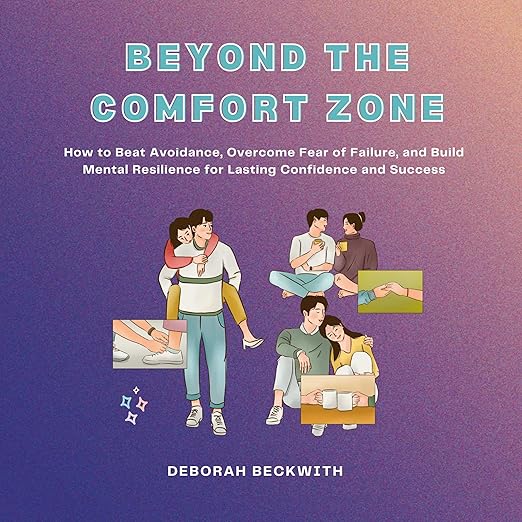
Deborah Beckwith’s Beyond the Comfort Zone is a personal development audiobook with a clear sense of its own purpose and audience. It does not promise transformation through dramatic disruption or overnight reinvention. It is, instead, a sober, psychologically informed guide to a specific problem: the way that comfort – the routines, the avoidances, the familiar patterns that feel like safety – can quietly close down possibility without any single moment of catastrophic failure. At just 1 hour and 6 minutes, narrated by Jake Andrews, it is deliberately short, which feels appropriate for a book whose central argument is that meaningful change begins with small, manageable actions.
About the audiobook
Beckwith draws on psychology and behavioural research to map what she calls the “comfort zone trap” – the suite of interrelated behaviours that keep people in stagnation despite their awareness that something needs to change. These include procrastination, perfectionism, emotional avoidance, distraction, and the particular way that fear of failure can be rationalised into what appears to be reasonable caution. The trap is that these behaviours are often invisible from the inside. They feel like prudence; they present themselves as logic. The discomfort of growth, meanwhile, feels like a warning signal rather than an indicator of progress.
The antidote Beckwith proposes is micro-stretching: small, incremental actions that expand the boundary of what feels manageable, without requiring the kind of grand gesture that most self-help books demand and that most readers never quite get around to making. The focus is on building sustainable confidence through consistent small actions rather than waiting for motivation or certainty to arrive before moving.
The audiobook covers practical ground across its hour-long runtime: how to identify comfort-based avoidance patterns and the emotional triggers that sustain them; how to reframe the physical experience of discomfort as evidence of growth rather than danger; how to develop daily routines and environmental conditions that support resilience; and how to use accountability – including social accountability – to sustain momentum beyond the initial enthusiasm of starting something new.
There is also a chapter on the relationship between mindfulness, self-compassion, and the willingness to tolerate discomfort. Beckwith argues that the harsh self-criticism that often accompanies avoidance is itself a form of avoidance – a way of explaining failure that makes it feel inevitable and therefore forgivable. The more constructive alternative is the patient, self-aware observation of one’s own patterns without the punitive response that tends to deepen them.
The tone throughout is grounded and encouraging without tipping into the feverish positivity that makes so much personal development content exhausting. Beckwith does not claim that the process is easy or that results will be immediate. She claims only that the process works – and that the work begins with noticing, honestly, where you have been hiding.
The narration
Jake Andrews narrates with an even, engaged quality that serves the material well. There is no artificial urgency here – the book’s argument is about sustainable, patient change, and the narration mirrors that steadiness appropriately. A high-energy narrator would inadvertently undermine the message by making “growth” feel like an adrenaline sport. Andrews keeps the pace measured and the tone warm without being soporific. For a short audiobook, consistent engagement throughout is more challenging than it sounds, and Andrews achieves it.
What readers say
At the time of writing, no customer reviews have been posted for this title on Audible UK. The audiobook was released in January 2026 and is still building its readership. Given the specificity and brevity of the content, it is likely to resonate most with listeners seeking a concise conceptual orientation rather than an exhaustive treatment of the subject.
Who should listen?
This audiobook is well suited to listeners who feel stuck in the particular way that doesn’t involve crisis – not the dramatic stuck of a life in collapse, but the quieter, more insidious stuck of having made peace with a life that is smaller than they know they could be living. It will resonate especially with those who recognise the comfort zone patterns Beckwith describes: the project that never quite gets started, the conversation that keeps being deferred, the year that looks, from December, remarkably similar to the one before it.
At just over an hour, it is worth the listening time for the conceptual clarity alone. Think of it as a beginning: the framework for a longer project of personal development, rather than the project itself. It may well be the nudge that makes that project feel possible rather than merely aspirational.
For listeners who want to go further after this introduction, Beckwith’s framework pairs well with longer treatments of the subject – behavioural psychology texts, CBT-informed self-help, or structured coaching programmes. The value of this audiobook is in the clarity of its diagnosis and the reasonableness of its first suggested steps. It does not try to do more than one hour allows, and that restraint is, in its own way, a model of the approach it advocates.
Listen to Beyond the Comfort Zone on Audible UK – just over one hour that might make the next year look rather different from this one.