Clara’s Verdict
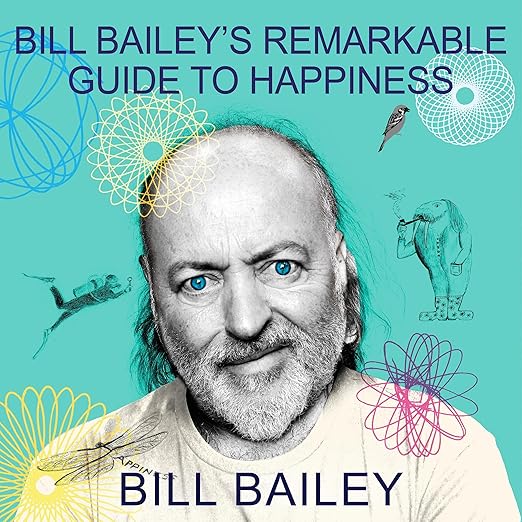
The happiness genre is, on its better days, an honest attempt to think carefully about what makes a life feel worthwhile. On its worse days it is a procession of counterintuitive productivity hacks dressed in wellness language. Bill Bailey’s Remarkable Guide to Happiness, which runs just under four hours, sits happily outside both categories. This is a comedian’s meditation on joy, structured around Bailey’s genuine enthusiasms: outdoor swimming, golf in the absurdist register, letter-writing, campfire cooking, walking, and the kind of pleasures that cost very little and resist easy description. It is more philosophy than self-help, and considerably funnier than most of either.
The absence of a listed narrator is, in this case, almost certainly the presence of Bailey himself. One reviewer specifically references his distinctive delivery, noting that they could hear his voice in their head as they read the book. For an audiobook of this kind, that is not merely a bonus but the entire point: Bailey’s comedy has always depended on the voice as much as the material.
About the Audiobook
Published by Quercus and released in May 2022, the book runs three hours and fifty-one minutes, which is short for a non-fiction title but appropriate for a work that is structured around a series of vignettes and reflections rather than sustained argument. Bailey does not build a thesis so much as accumulate evidence from his own experience: paddle-boarding down the Thames in a Santa hat, wild swimming in a glacial river, simple reflection. The science appears, but lightly; this is not a neuroscience textbook on positive affect. It is closer to a companionable conversation about what Bailey has found genuinely pleasant in the world.
One reviewer notes that the Kindle version contains drawings by Bailey that are difficult to see at faint pencil weight. As an audiobook, this visual element is absent, which may actually sharpen the listening experience by removing distraction.
The Narration
With no narrator credited separately, Bailey almost certainly performs the text himself, which given his background in live performance and his experience with podcasts and audio work, makes the production a direct extension of his public persona. His stage presence has always been built on the unexpected: the sudden shift from gentle reflection to absurdism, the mock-scholarly aside, the warm return to something earnest. These qualities translate well to the intimacy of headphones. A reviewer describes his personality as shining through and notes that the combination of humour, common sense, and scientific fact works more effectively than either element alone.
What Readers Say
The three Audible ratings are small in number but positive in character, averaging 4.4. The written responses vary in tone. One enthusiastic five-star reviewer finds the book full of golden nuggets of information and scientific theory alongside the humour, and appreciates that Bailey avoids the meditation route in favour of lived experience. A four-star reader summarises it with pleasant accuracy: Bill’s thoughts on happiness, reminding us that the real pleasures are day-to-day rather than expensive. A three-star response, from someone who enjoys Bailey on panel shows, finds the book slightly lacking in spark, attributing this possibly to the lockdown context in which some sections were written. At four hours, the risk of disappointment is relatively low.
Who Should Listen?
Fans of Bill Bailey’s comedy who want an extended piece of his thinking rather than a stand-up performance. Those who find the happiness and wellbeing genre either preachy or overly clinical will likely find Bailey’s approach a welcome alternative. The short runtime makes it an easy afternoon listen. Those looking for a systematic, evidence-heavy guide to improving their wellbeing should look elsewhere; this is a comedian being thoughtful, not a researcher being accessible, and that distinction is worth making before you press play.