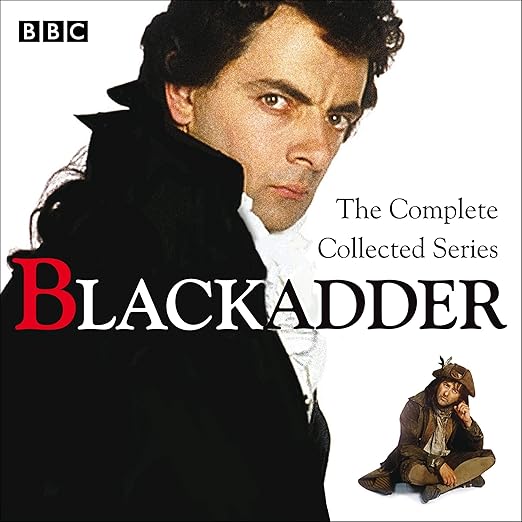
Clara’s Verdict
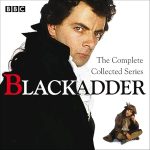
There is a particular kind of joy that comes from hearing Rowan Atkinson deliver a withering put-down in real time. No subtitles, no pause button, no rewinding to catch the expression on his face – just the voice, and the exquisite timing that wraps an insult in such silken condescension that the victim barely notices until it’s too late. I put this collection on during a long train journey from Euston to Edinburgh and didn’t look up once. Fifteen hours of Blackadder, all four series, eight specials, and a generous pile of extras – and I arrived at Waverley feeling obscurely cheered by the whole of British comic history.
What’s remarkable is how well the material translates without the visuals. Blackadder was always, at its core, a dialogue-driven show – the comedy lived in the words and the vocal performances rather than in physical gags or carefully composed sight lines. Hearing it stripped of the screen clarifies this beautifully. You notice the architecture of a Curtis and Elton joke more acutely when there’s no performance to distract you, and the architecture is often extraordinary: a setup buried two scenes earlier, a callback that only lands if you were paying attention, a Baldrick plan that takes thirty seconds to become obviously disastrous but which Tony Robinson delivers with such absolute conviction that it takes longer than it should for the logic to collapse.
About the Audiobook
This collection covers the full sweep of the Blackadder dynasty: from the bumbling medieval Prince Edmund in The Black Adder, through the sharp-tongued Elizabethan schemer of Blackadder II, to the Regency-era butler serving the magnificently dim Prince George in Blackadder the Third, and finally to the mud and barely suppressed despair of Blackadder Goes Forth, set in the trenches of the First World War. The tonal shift across the four series is dramatic and deliberate – the writing sharpens considerably from Series One onward once Ben Elton joined Richard Curtis and Rowan Atkinson on the scripts, and the comedy becomes increasingly pointed, political, and on occasion genuinely moving. The final episode of Goes Forth remains one of the most quietly devastating conclusions in British television history, and it lands entirely through voice alone.
The extras are a genuine bonus. Blackadder’s Christmas Carol reverses the Dickens premise to delightful effect – here it is the good-natured man who sees the light, and the light is not inspiring. Back and Forth, the millennium special, holds up surprisingly well. The inclusion of the Britain’s Best Sitcom segment adds a fascinating layer of cultural context to the whole enterprise. This is not a highlights package – it is the complete record of one of British television’s greatest comic achievements, rendered in audio with the full original cast intact.
The Narration
The full cast performance here is as good as it gets. Rowan Atkinson, Tony Robinson, Stephen Fry, Hugh Laurie, Tim McInnerny, and Miranda Richardson are all present in their original roles, and the ensemble chemistry is exactly what you’d hope for after four decades. Tony Robinson’s Baldrick – perpetually optimistic, perpetually filthy, perpetually possessed of a cunning plan that isn’t – lands every punchline. Stephen Fry’s Melchett booms and blusters with magnificent self-satisfaction across the Elizabethan and Regency series before becoming, in Goes Forth, the kind of senior military incompetence that is genuinely frightening when you think about the history it parodies. Hugh Laurie, playing the earnest and catastrophically stupid George, brings a sweetness that gives the final scenes their sting.
These are audio recordings of the original television soundtracks rather than purpose-built audio dramas, so there is audience laughter throughout – which may take some adjustment if you’re used to listening alone, but which quickly becomes part of the pleasure. One reviewer noted the absence of visuals but found the brilliant tongue-lashing dialogue more than compensated. The voices do all the work, and they do it gloriously.
What Readers Say
Listeners on Audible UK have given this collection 4.4 stars from 52 ratings, which is a solid tally for a comedy recording that depends entirely on whether you’re already a Blackadder devotee. Most reviewers are. P. Tempest kept it simple – great comedy – and sometimes brevity is its own endorsement. Graham Bland was more expansive, calling it better than reading scripts and noting that while Series One predates Ben Elton’s full involvement, the later series remain very funny even without the visual element.
There is one outlier review, from Rod Collier, who found it quite difficult to relax and enjoy and ultimately deleted the files. This is a useful data point: audio comedy of this vintage isn’t for everyone, and the absence of visuals genuinely does create a different listening experience. Some jokes are built on facial expressions that simply don’t survive the transition. But for those who come to it already fond of the original, the verdict is consistent across the remaining reviews: it’s funny, it holds up, and at fifteen hours it’s exceptional value for money.
Who Should Listen?
This collection is essential for anyone who grew up with Blackadder on the BBC and wants to revisit it in a portable format, or for younger listeners discovering the series for the first time through audio. It suits long commutes, overnight drives, and any situation where you want reliable, sophisticated comedy that rewards attention rather than demanding it. It is less suited to those approaching British sitcom cold, or to anyone who finds audience laughter in audio recordings distracting. If you’ve ever quoted Blackadder in conversation without prompting and expected the other person to finish the line, this is for you.