Clara’s Verdict
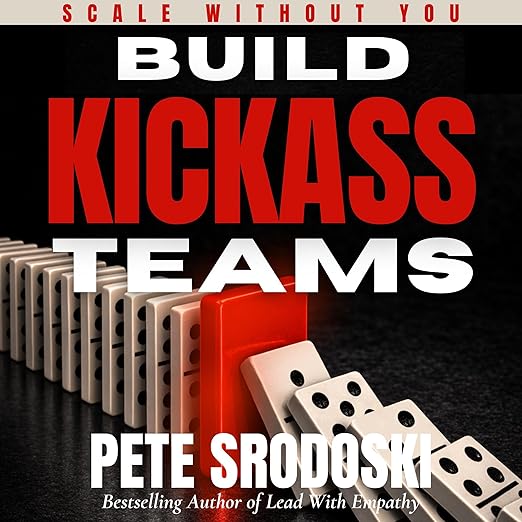
Here’s a book that does exactly what it says on the tin – and then some. Pete Srodoski’s Build Kickass Teams is the third instalment in the Build a Business That Runs Without You series, and it may be the most practically useful entry yet. I’ve read my share of management books with grand frameworks and precious little substance; this is emphatically not one of them. In under six hours of listening, Srodoski dismantles the single biggest illusion that keeps business owners exhausted: that constant involvement equals leadership. It doesn’t. It’s a trap. The book’s opening argument is almost uncomfortably direct – if your business falls apart when you step away, you don’t have a team, you have a bottleneck, and that bottleneck is you. Most founders don’t want to hear that. Srodoski says it anyway, which immediately earns my respect. What strikes me most throughout is the refusal to make leadership sound noble. It’s presented as a discipline, not a personality trait. That’s a more useful framing than most management books manage.
About the Audiobook
The central argument is disarmingly simple: most leadership failures are clarity failures. When decisions keep flowing back to the founder – when approvals require your sign-off, when fixes demand your attention, when the team grinds to a halt the moment you take a holiday – that’s not a people problem. It’s a structural one you built yourself. Srodoski walks through the full arc of team-building from scratch: hiring with intention (and learning to identify assets versus liabilities quickly, before significant investment of time or money), onboarding with 30/60/90-day plans that establish clear expectations from day one, and building genuine accountability through priorities, feedback loops, and scorecards rather than vibes and hope. Later chapters tackle the harder conversations that most management books dance around: how to coach underperformers in real time rather than waiting for a formal review, how to address toxicity with what he calls “fairness and backbone,” and – crucially – the distinction between delegating tasks and delegating outcomes. The latter is where most managers fall down, and Srodoski is unusually precise about why: delegating a task means you still own the problem; delegating an outcome means someone else owns it and has the authority to solve it their way. That insight alone is worth the listen. Each chapter closes with a Monday Morning Playbook – concrete, actionable steps you could begin implementing the following week. Not vague injunctions to “communicate more effectively.” Specific moves. At just under six hours, this is a focused and intentional piece of work.
The Narration
Jeff Cecil narrates, and he’s a solid choice for material of this kind. His delivery is direct without being harsh, measured without being slow – which suits a book that prizes plain speaking above all else. He handles the instructional passages with good pacing, never rushing through the playbook sections where a thoughtful listener might want a moment to absorb each point before moving on. Some audiobooks in the business and leadership space suffer from a narrator who sounds as though they’ve never actually run anything; Cecil brings enough authority and composure to the text that the advice lands with appropriate weight. The production is clean throughout. Worth noting: the publisher confirms a PDF companion is available in your Audible Library alongside the audio, which is a genuinely useful addition for a book with structured frameworks you might want to return to.
What Readers Say
The thirty Audible ratings average out at an impressive 4.6 stars, and the written responses are notably enthusiastic for a business title. Reviewer Alessandra Di Lorenzo calls it “a bold, no-fluff guide for leaders who want to create teams that perform with passion and purpose,” singling out Srodoski’s raw honesty about what leadership actually demands day to day – “presented as a daily responsibility requiring clarity, co-ownership, and constant growth rather than a title you earn once.” W. Sawyer, a reader who describes corporate jargon as giving them “the ick,” appreciated the total absence of management-speak: “just clear advice on leading yourself, hiring right, and setting a culture that lasts.” Page Turner YA calls it “a direct, actionable punch to the status quo of team building,” highlighting the Monday Morning Playbook format as what made the difference between theory and practice. Katie Swingler, a small business owner, put it simply: “it will certainly help me when it comes to growing my team.” J. Coronado makes the observation that most people end up in management without any formal training and are simply told to make things happen. “This book helps with that a bunch,” they write – which is perhaps the most honest endorsement a leadership book can receive.
Who Should Listen?
This is squarely aimed at founders, small business owners, and anyone who has recently stepped into a management role without being given any preparation for it – which, in my experience, is the vast majority of managers. If you recognise yourself in the bottleneck dynamic – if you check in on everything, approve everything, and are quietly afraid that the whole thing would collapse without you – this is the book you need to hear. It’s also a genuinely useful refresh for more experienced managers who have accumulated good instincts over the years but want a structured framework to work within. The series format means there’s more where this came from if it resonates. Listen to Build Kickass Teams on Audible UK and give yourself the blueprint you should have had on day one.