Clara’s Verdict
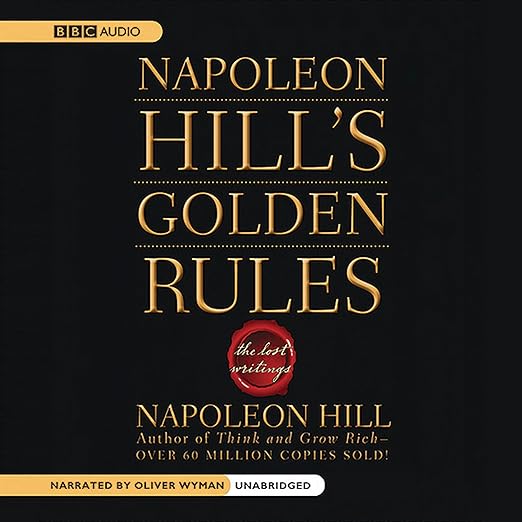
Napoleon Hill’s reputation is complicated, and I shan’t pretend otherwise. His claimed interviews with Andrew Carnegie and other industrialists have been disputed, his research methods have been questioned, and the prosperity-gospel strain running through his work has not aged particularly well in an era of inherited advantage and structural inequality. All of that said, Napoleon Hill’s Golden Rules is a more interesting document than the famous later books. These are Hill’s articles in their raw state, before they became a self-help franchise polished for mass consumption. There is a directness here, and occasionally a genuine sharpness of observation, that Think and Grow Rich has largely ironed out in the service of palatability. Oliver Wyman narrates across nearly seven hours, and the result is a substantial and somewhat unusual listen.
About the Audiobook
Between 1919 and 1923, Hill wrote prolifically for Success Magazine, drawing on years of reported interviews with self-made millionaires and industrialists of the Gilded Age – the Carnegies, Rockefellers, and Edisons of the era. These articles, compiled as ‘lost writings’ long after Hill’s death, cover the Law of Attraction, the power of a pleasing personality, the Law of Retaliation, auto-suggestion, and the philosophy of definiteness of purpose. The ideas that would eventually crystallise into Think and Grow Rich (1937) are present here in embryonic form, still being tested, still working out their contradictions.
For readers already familiar with the later work, the interest lies in watching Hill develop and refine his system in public. These are not finished arguments – they are arguments in process, which makes them more revealing. Each article stands alone, which suits the audiobook format well: you can absorb them individually and return to the collection without losing your place in a larger narrative.
What is perhaps most striking, reading these articles now, is how much of Hill’s framework anticipates ideas that would later find academic grounding in cognitive psychology and behavioural economics – the role of expectation in shaping outcome, the power of social environment, the dangers of scattered focus. He gets there via rags-to-riches mythology rather than laboratory research, and the supporting logic is sometimes shaky, but the intuitions are sharper than his critics tend to allow.
The Narration
Oliver Wyman brings a measured, authoritative quality to the material that suits it appropriately. He does not oversell the more grandiose claims – and there are several – which is exactly the right choice. The early-twentieth-century rhetorical style Hill employed could easily tip into unintentional parody in less careful hands; Wyman keeps it grounded and treats the content with the seriousness it requires to function. The pacing across nearly seven hours is steady without becoming soporific, though some listeners may find the episodic structure repetitive towards the later portions as Hill returns to familiar themes from different angles.
One dimension of the collection that rewards attention is the period rhetoric Hill employs – the direct address, the confident imperatives, the appeals to universal principles. It is the rhetoric of the Gilded Age, and hearing it in Wyman’s measured reading gives it a useful distance. You can appreciate the underlying ideas while also hearing the ideological assumptions baked into the form – assumptions about who success was available to, and what kind of success counted. That critical distance is, I think, a feature rather than a flaw when approaching Hill in 2025.
What Readers Say
With a rating of 4.7 from 229 reviews, Hill’s loyal readership has embraced this collection warmly. “Another chapter of wisdom and insight from the master of self-help – download it today and see the difference,” wrote one long-time admirer. Another praised the exploration of the Law of Retaliation as particularly intriguing – one of the more unusual concepts in Hill’s framework, and one that rarely features in the secondary literature. The reviews are enthusiastic rather than analytical, which is characteristic of Hill’s audience; the consistency of positive response suggests the material lands as intended for listeners already sympathetic to his broader worldview.
Who Should Listen?
This is primarily for people already operating within the Napoleon Hill universe – those who have read or listened to Think and Grow Rich or The Law of Success and are curious about where those ideas originated. It is also genuinely useful for anyone studying the history of American self-help and prosperity thinking as a cultural phenomenon; these articles are primary documents in that tradition. I would not recommend starting here if you are new to Hill; there are better entry points in the more developed later work. But as a historical document of early-twentieth-century success philosophy, unvarnished and still being argued out, it has value that goes beyond its self-help surface.
Also worth noting: at nearly seven hours, this is a more sustained engagement with Hill’s ideas than most short summaries or audiobook digests of the well-known works. For the listener who wants to go beyond the famous aphorisms and understand where the philosophy actually came from, this is the most direct route available.
Listen to Napoleon Hill’s Golden Rules on Audible UK – also available on Kobo, Scribd, and Storytel.