Clara’s Verdict
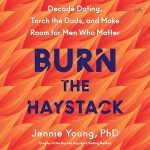
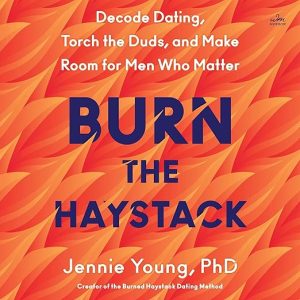
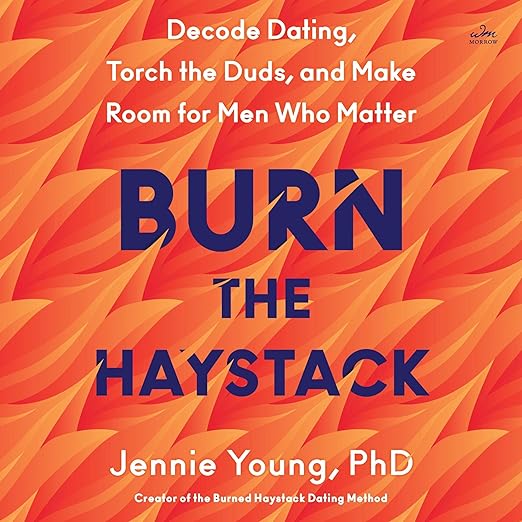
Dr Jennie Young is a professor of feminist rhetoric, which means she has spent her career teaching people how language shapes power, how communication encodes expectations, and how to read beneath what is said to what is meant. When she encountered online dating, she applied her professional toolkit and found, predictably, that the results were illuminating and fairly grim. Burn the Haystack is the book that emerged from that encounter: part academic analysis, part feminist manifesto, part genuinely funny guide to refusing the terms on which the dating market typically operates. At nine and a half hours, narrated by Kiiri Sandy with Young herself providing the framing, this is a substantial listen that earns its runtime through the quality of its thinking and the pleasures of its delivery.
About the Audiobook
Young’s central argument is a direct challenge to the conventional wisdom about online dating, which typically advises women to “give people a chance,” extend generous benefit of the doubt, and approach the whole enterprise with patient optimism. Young’s counter-argument: for most of the men on most of the apps, extending that benefit of the doubt is a waste of time and a quiet form of self-erasure. The “haystack” is the available pool of potential partners; the “needle” is a long-term, committed, non-toxic match. Her method for finding the needle is not to sort through the haystack carefully – it is to burn it down to the people who can pass basic rhetorical scrutiny.
The rhetorical patterns she identifies are drawn from real profiles and real messages: “Test and Apologize” – an early sexual boundary-push followed by an apology designed to gauge whether you will overlook it; “Disciplinary/Directive” – profile language that establishes rules and hierarchies before any conversation has begun; “Blue Ribbon for Bare Minimum” – men who open their profiles by noting that they won’t hit you, or that they shower regularly, as distinguishing characteristics. Young’s descriptions of these patterns are simultaneously forensic and funny, which is the book’s great skill: it makes you laugh at something that is also genuinely alarming.
The broader application – using rhetorical analysis to decode power dynamics in professional settings, classrooms, and everyday communication – gives the book a scope beyond dating advice. Young is teaching a skill, not just providing a filter. The supplemental PDF accompanying the audiobook suggests it is designed as an actively used resource rather than a passive listen. Published by William Morrow, this has serious trade backing.
The Narration
The dual-narration structure – Kiiri Sandy handling the main text, Young delivering her own introduction and closing love letter – is well-judged and well-executed. Sandy captures the professor-meets-friend register that Young describes: confident and clear, with genuine wit in the comic passages. Young’s own sections carry obvious personal conviction; her voice in the closing letter shifts into something more private and direct, giving the book a warmth that purely academic feminist writing sometimes lacks. William Morrow’s production quality is excellent throughout the nine-and-a-half-hour runtime.
What Readers Say
There is also a cultural timing element worth noting. Burn the Haystack is published into a moment when online dating has become the dominant way that people in most Western countries meet long-term partners – and into a growing conversation about the specific costs of that shift for women navigating platforms built around patterns of male behaviour that Young documents in the book. The methodology she offers is not nostalgic for a pre-app era; it is designed for the world that exists.
Released in April 2026, Burn the Haystack has not yet accumulated listener reviews on Audible at the time of writing. Young already has a substantial online community through her Burned Haystack platform, suggesting a pre-existing audience with strong engagement and genuine investment in the methodology she is teaching. The publisher’s confidence in the material – William Morrow is not a vanity press – and the specificity of the rhetorical framework described indicate a text with genuine intellectual substance behind its accessible surface.
Who Should Listen?
Women navigating online dating who are exhausted by the cognitive labour of endless optimistic filtering and would welcome a framework for sorting more efficiently and with greater self-respect. Anyone with an interest in feminist rhetoric and how ordinary communication encodes power dynamics – this works as an introduction to rhetorical analysis as much as a dating guide. Readers who enjoyed books like Untamed by Glennon Doyle or The Beauty Myth by Naomi Wolf will find Young’s voice and politics congenial. This is not for everyone – it takes a specific and unapologetic stance – but for the audience it speaks to, it is likely to feel like the book they have been waiting for. It also works as a standalone introduction to rhetorical analysis for anyone who has not studied the discipline formally and finds themselves curious about how language actually functions in everyday power dynamics beyond the dating context. Listen to Burn the Haystack on Audible UK.