Clara’s Verdict
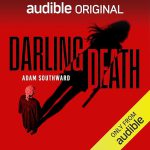
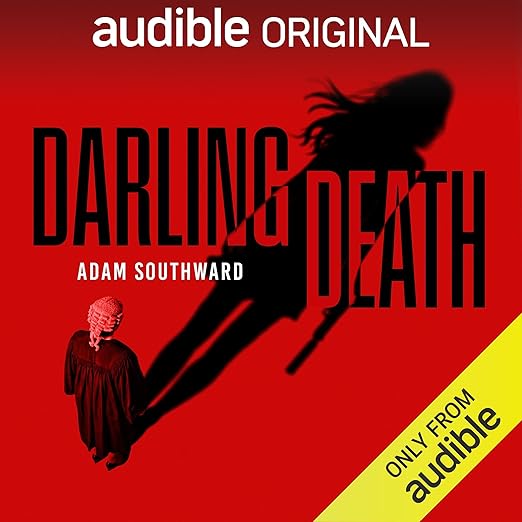
Every so often an Audible Original arrives that feels less like a book and more like a pilot episode somebody has already storyboarded, and Darling Death is one of those. Adam Southward has built a vigilante thriller around a top London barrister who defends the innocent by day and kills predators by night, and he has written it with the gloss turned all the way up: Chelsea townhouse, wardrobe full of Dior, silk and sophistication over something considerably colder. It is nine hours and twenty-one minutes of pure premise, and it knows it.
I enjoyed it a great deal more than I expected to, and the reason is worth stating. This is not a novel making a serious argument about the failures of the justice system, whatever its setup suggests. It is a stylish, fast, faintly camp revenge fantasy that happens to be very well made. Judge it as that and it is excellent company. Judge it as legal fiction and you will be annoyed within the hour. It is currently in the upper reaches of the Audible UK charts, and given the release only landed in May 2026, that is a fast climb.
About the Audiobook
Mae Darling has, on the surface, everything. A glittering career at the London bar, the house, the clothes, the reputation. Underneath it she is a killer, working through the predators who have slipped through the fingers of lady justice, as the listing rather nicely puts it. The book does not tease this out slowly or ask you to guess. You know what Mae is almost immediately, and the tension comes from watching her manage two lives that were never designed to be compatible.
The plot turns when her professional work brings her face to face with the man responsible for her father’s death. That is the moment the novel stops being a series of self-contained hunts and becomes a single pursuit, and Southward uses it to open the story outwards into a spiralling conspiracy running up into the higher levels of British power. The structural interest, such as it is, lies in Mae balancing her intellect against her impulses, and in how close she comes to becoming the thing she hunts. That last idea is signposted heavily rather than explored, which is my main reservation about the book.
The listing offers Killing Eve and Dexter as reference points, and both are fair. From Killing Eve it takes the glamour, the wit, and the pleasure of watching a woman be very good at something appalling. From Dexter it takes the moral bookkeeping, the code that permits the killing. What it adds is a particular strand of London luxury detail, brand by brand, that reviewers have taken to with real enthusiasm. This is a standalone story with nothing to be read beforehand, though the ending leaves plenty of room for Mae to return.
The Narration
Pippa Bennett-Warner reads it, and the casting is the smartest decision in the production. Known to television audiences from Gangs of London and Moonflower Murders, she brings exactly the quality this book needs, which is control. Mae is a barrister, and Bennett-Warner reads her the way a good advocate speaks: precise, unhurried, never raising the volume when lowering it would work better.
What impressed me most is her handling of the two Maes. There is no theatrical switch between the professional and the predator, no drop into a growl when the knives come out. The voice stays broadly the same and the temperature changes underneath it, which is far more unsettling than a performed transformation would be and is a genuinely difficult effect to sustain across nine hours. The courtroom material benefits enormously, since she can deliver legal argument without either flattening it or making it sound like a costume.
Her one mild limitation is the same as her strength. The register is cool by design, and in the more heightened sequences, of which there are several, I occasionally wanted a touch more heat to match the writing. Reviewers who mentioned the narration were unreserved in their praise for it, and I would agree with the direction of that verdict even if I would stop a little short of the superlative.
What Readers Say
This is a very recent release with only a handful of ratings posted so far, so I would not read too much into the headline figure yet. What is there is uniformly enthusiastic, and the comments are consistent enough to be useful. Andrea Walsh’s entire review runs to seven words: “I didn’t want it to end. Simply brilliant”.
You do need to suspend disbelief, but if you do, you’ll be taken on a thrilling ride as Darling Death, a vigilante lawyer, serves up her own brand of justice.
SandraL’s review is the one I would point a prospective listener towards, because it states the terms clearly before selling the book. She calls it “packed with fashion designer name-drops” and warns that “It’s dark and not for the faint-hearted, with a few sex scenes that might not be for everyone”, while still adoring it. Bevlaaa hit on the same appeal from the other direction, enjoying “the sophistication mixed with the thrill” and the fact that Mae name-drops designers even while in jeopardy. That detail is either delicious or maddening depending entirely on your temperament, and it is worth knowing which you are before you begin.
Who Should Listen?
The running time is nicely proportioned for what this is, which is a high-gloss revenge thriller with a magnetic lead and no interest whatever in being worthy. If Villanelle’s wardrobe was as much of a draw as her body count, if you like your antiheroines articulate and unapologetic, and if a conspiracy climbing towards the establishment sounds like a good use of a week of commutes, this will suit you very well indeed.
The obvious caution is the content. There is real darkness here, the violence is not decorative, and the sexual content is more explicit than the elegant packaging implies. The other caution is credibility. You are asked to accept a working barrister conducting a parallel career as a killer without the practical difficulties that would arise, and the novel would rather you did not ask. Suspending disbelief is not optional here, it is the condition of entry.
Anyone who wants procedural rigour, courtroom accuracy, or a serious interrogation of vigilante ethics should look elsewhere, because this book will feel frivolous to them and they will not be wrong. For everyone else, Bennett-Warner’s performance alone justifies the time, and I would happily spend another nine hours with Mae Darling if Southward writes them.