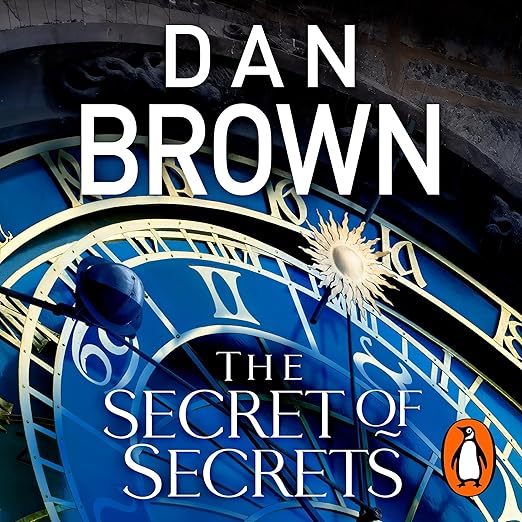
Clara’s Verdict
Twenty-two hours and fifty minutes is the number to weigh before anything else, and I say that as someone who read the reviews after listening and found my own reservation waiting for me in almost every one of them. Dan Brown returns with his first novel in more than eight years, the sixth outing for Robert Langdon, and the ambition of the thing is not in question. Neither, in the end, is the length.
What is genuinely good here is Prague. Brown has always used cities as puzzle boxes, and Prague, a place steeped in folklore and layered with centuries of accumulated secrecy, suits his method better than almost anywhere he has taken Langdon before. Paul Michael narrates, and across a runtime this substantial his particular virtues become considerably more valuable than they would be over eight hours. It has taken up residence high in the Audible UK charts.
About the Audiobook
Langdon accompanies Katherine Solomon to Prague, where she is due to give a lecture, and she vanishes without trace from their hotel room. He is far from home and, in the publisher’s phrasing, out of his comfort zone, which is a meaningful shift for a character whose usual advantage is knowing more than everyone in the room. The woman he loves is gone and the city is not going to help him.
What follows is the familiar architecture: arcane knowledge deployed against a deadline, a shadow city hiding in plain sight, and a conspiracy that scales up alarmingly. What is different is the emotional stake. Langdon has generally been a man with a professional interest in the outcome. Here he has a personal one, and the relationship between him and Katherine is the thing reviewers keep returning to with real warmth.
Two honest observations. First, the subject matter is heavier going than the earlier books, involving theoretical material that genuinely requires attention rather than merely providing colour. Second, the publisher’s copy carries several enthusiastic lines with no attribution at all, including “Left me speechless” and “Completely addictive”. I mention it not to be sniffy but because unattributed praise tells you less than a rating does. The plot stands alone, but the emotional weight of Langdon and Katherine depends on a history the earlier novels supply.
The Narration
Paul Michael is a specialist in exactly this kind of assignment: long, plot-driven, information-dense fiction that needs momentum above all else. His approach is to serve the text rather than to interpret it, and I mean that as a compliment. There is no interpretive invention here, no attempt to make the prose more interesting than it is, and on a book of this length that restraint is worth a great deal.
The specific problem a Brown novel poses in audio is the transition between chase and lecture. Every few chapters the narrative stops so that somebody can explain something, and a narrator who lets the energy drain out of those passages will lose the listener permanently. Michael’s solution is to keep the tempo identical across both modes, treating an explanation as though it were an action beat. It should not work as well as it does.
His real achievement is stamina. That runtime represents an enormous quantity of sustained delivery, and the voice at hour twenty is recognisably the same as the voice at hour two, with the same pressure behind it. Listeners who found the theoretical passages demanding will be grateful that the performance never asks them to work harder than the material already does.
What Readers Say
The figure that tells the story is 4.2 across 68,744 ratings, the most divided response of any major title I have looked at recently, and the reviews explain the split with unusual precision. Enthusiasts and sceptics agree on the facts and disagree only on whether the facts are a problem.
A five-star reader captured the double quality exactly, describing it as “both a thrilling read, and a challenging one” and noting that the theories were interesting but hard at times to comprehend, “requiring total concentration”. She had never been to Prague and finished wanting to go, which is Brown at his most effective. Another five-star reader, three visits to Prague behind her, called the research astounding and welcomed the return to Langdon’s world.
The four-star dissent does the most work here:
I would imagine most people know what they will be getting from a Brown/Langdon book by now, and this one does not disappoint in that regard.
That same reviewer, who enjoyed it and paced through it happily, still landed on the obvious conclusion: “But I think it is too long”. I agree with him. There is a superb and considerably shorter thriller inside this recording.
Who Should Listen?
Committed Langdon readers should not hesitate, particularly those who care about the Katherine Solomon thread, which pays off more here than anywhere previously. The Prague material is the strongest sense of place Brown has managed in years, and for anyone who enjoys a novel that sends them looking up buildings afterwards, that alone justifies the time. Long-haul travel and extended commutes suit it well, since the length stops being a liability when you have nowhere else to be.
Weigh it carefully if you dislike exposition, if a formula announcing itself as a formula irritates you, or if the runtime is beyond what you realistically finish. The theoretical passages are demanding and cannot be half-listened to, which makes this a poor choice for background listening while doing anything that requires thought. Newcomers to Brown would do better starting where Langdon started.