Clara’s Verdict
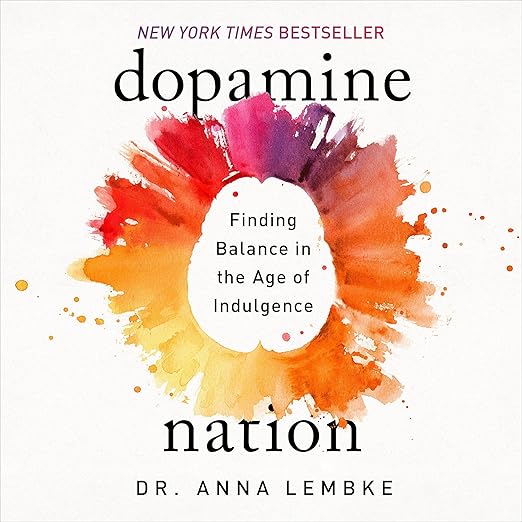
I have reviewed a great many books about addiction, compulsion, and the psychology of pleasure, and very few of them manage to be simultaneously rigorous and readable. Dopamine Nation by Dr. Anna Lembke does both, and the fact that she narrates it herself transforms a compelling book into something close to essential listening. Lembke is a professor of psychiatry at Stanford who has spent her career treating patients with addictive disorders of every variety, and her authority is earned in the most direct way possible – through decades of clinical practice confronting the full spectrum of human compulsion. This is not a pop-science book dressed up in borrowed neuroscience. It is the real thing, written and delivered by someone who has sat with these questions professionally for years.
The book was endorsed by the Guardian, which described Lembke as “a whiz on why we get hooked on things.” That is putting it mildly. What Lembke offers is a coherent framework for understanding why a world of unprecedented pleasure is producing unprecedented rates of misery, and what to do about it that does not amount to simply trying harder to resist.
About the Audiobook
The central argument is deceptively simple: we live in a world of unprecedented hedonic possibility, and that excess is making us miserable. Dopamine – the neurotransmitter associated with anticipation and reward – responds to a world of abundant stimulation by recalibrating downward, meaning we need more and more of the same stimulus to feel equivalent pleasure. The smartphone, Lembke argues, is the modern hypodermic needle: delivering dopamine hits around the clock for a generation that has never known scarcity of entertainment, information, connection, or distraction.
What distinguishes this book from its peers is the way Lembke grounds these arguments in individual patient histories. The clinical cases are presented with both rigour and compassion – addictions to opioids, gambling, pornography, shopping, gaming, and yes, the more banal compulsions most of us prefer not to examine too closely. The lived experiences of these patients give concrete weight to the neuroscience, and the neuroscience gives context to the human stories. The balance is rare and valuable in a field where popular science books often sacrifice one for the other.
The practical prescription that emerges – the concept of a dopamine fast, of voluntarily introducing pain to reset the pleasure-pain balance – is counterintuitive and, if you follow the logic, persuasive. Lembke is not preaching abstinence or minimalism. She is asking for self-awareness and honest accounting of what we are actually doing to ourselves in the pursuit of relief. That feels appropriately modest and appropriately difficult.
The neuroscience is condensed into accessible metaphors without being dumbed down. The pleasure-pain balance, the dopamine see-saw, the concept of hedonic set-point – these are explained clearly enough for non-specialists while retaining their intellectual substance. At six hours and eleven minutes, this is a manageable commitment for material of this intellectual density.
The Narration
Lembke narrating her own work is the ideal arrangement for this particular book. Her voice carries clinical precision and genuine warmth in equal measure. When she discusses her own patients, the intimacy is not performed – she has earned the right to these stories through years of relationship. When she discusses her own compulsions – there is a section about her relationship with a particular series of romance novels that some listeners found misplaced given the severity of her patients’ addictions – the candour feels deliberate rather than naive. She is implicating herself in the same spectrum of behaviour she is analysing. That requires intellectual honesty of a kind that makes the book more trustworthy rather than less.
What Readers Say
Dopamine Nation holds a 4.4 out of 5 rating from eleven UK listeners. Reviewers praised it as a book that helps people understand the mechanics of their own behaviour – one listener described it as offering new perspectives and a new sense of individual agency. Another wrote that it deepened their understanding of addiction in ways that felt genuinely applicable to their own life. A third reviewer, who works in a medical context, found the clinical case studies compelling and the neuroscience well-explained for a lay reader. A thoughtful critical voice noted that Lembke’s disclosed addiction to the Twilight novels feels jarring set against the backdrop of more severe addictions among her patients – a fair point, though one the author herself seems aware of. The Guardian’s endorsement remains the most efficient summary available.
Who Should Listen?
Anyone who suspects that their relationship with their phone, their eating habits, their scrolling behaviour, or their consumption of any kind is not entirely within their conscious control will find this audiobook illuminating and, at moments, confronting. It is also valuable for those working in mental health, education, or any field where understanding compulsive behaviour matters practically. The science is rigorous but never inaccessible, and the clinical stories are presented with the kind of compassion that makes them readable rather than merely instructive.
Find Dopamine Nation on Audible UK, or via Kobo, Scribd, and Storytel.