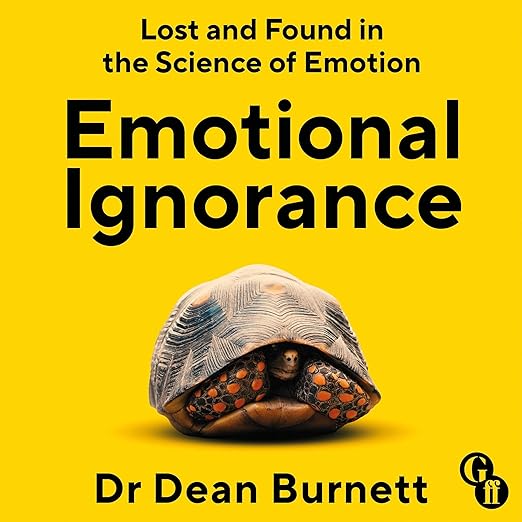
Clara’s Verdict
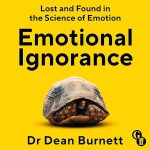
Dean Burnett is the rare science communicator who is actually funny – not “science communicator funny,” which means the odd well-placed analogy, but genuinely, structurally funny in ways that make the serious material land harder. Emotional Ignorance is his most personal book, written in the aftermath of losing his father to Covid-19, and it is considerably richer for the autobiographical strand running through it. Matt Addis’s fourteen-hour narration is excellent: he matches Burnett’s voice in tone without losing himself in impression, and handles the shifts between comedy and grief with real intelligence. Recommended by New Scientist, endorsed by neuroscientist Gina Rippon – and for good reason.
About the Audiobook
Burnett begins with a deceptively simple question: what would life be like without emotions? Prompted by his father’s death and his own experience of grief, he sets out to examine what we actually know about how emotions function, what they are for, and why they so often seem to work against us. The resulting investigation is wide-ranging and genuinely surprising, stretching from evolutionary biology to contemporary neuroscience to the specific question of why doomscrolling is so extraordinarily difficult to stop.
The book’s particular strengths are its honesty about uncertainty – Burnett is meticulous about distinguishing between what the science has established and what remains contested – and its use of personal experience as an analytical tool rather than simply an emotional frame. The chapters on grief are among the most affecting writing on the subject I have encountered in popular science: not because they are sentimental, but because Burnett applies the same rigorous curiosity to his own pain that he applies to every other aspect of his subject matter.
Topics include: why “gut feelings” are neurologically credible; nostalgia and the brain’s relationship to the past; the emotional mechanics of sadness, and why sad music can improve mood. Each is handled with the combination of intellectual precision and self-deprecating wit that characterises Burnett’s best work. At fourteen hours, this is a substantial listen, but the material rewards full attention.
The Narration
Matt Addis handles Burnett’s prose with impressive skill. The tonal range required is considerable – from comic riffs to careful scientific exposition to moments of unguarded personal reflection – and Addis navigates each without apparent effort. He has clearly understood the book’s architecture: the jokes land because the surrounding material is treated seriously, and the more vulnerable passages are given space without becoming overwrought. A fine performance of demanding material.
What Readers Say
Emotional Ignorance holds 4.4 stars from 57 UK listeners, with the majority of reviews expressing genuine enthusiasm. One reader called it “a well thought out, meticulously researched investigation into how much is known about our emotions” – high praise from someone who describes approaching the subject with scientific scepticism. Another described it as “an insightful and fascinating exploration of our emotions” and noted the value of Burnett’s willingness to engage honestly with his own limitations. A reader who bought the book as a present for an emotionally avoidant family member reported finding it unexpectedly “thought provoking” for themselves. The sole critical review – questioning Burnett’s casual style – was the minority position. The book is also available in print and has been praised by neuroscientists and general readers alike.
Who Should Listen?
For fans of popular neuroscience with a human dimension – readers of Oliver Sacks, Annie Murphy Paul, or Burnett’s own previous books. Equally suited to anyone who has lost someone and found the experience intellectually as well as emotionally confusing. The book works particularly well for listeners who want to understand their own emotional responses rather than simply feel validated by them. Genuinely illuminating.