Clara’s Verdict
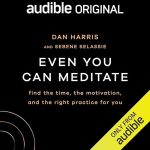
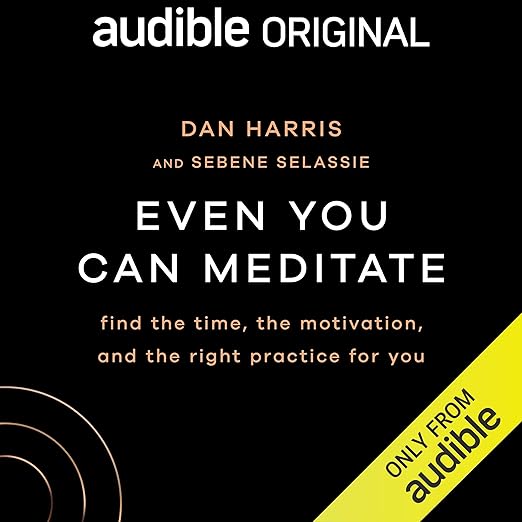
I’ll confess something: I spent years telling myself I wasn’t the sort of person who could meditate. Too restless, too London-brained, too prone to composing shopping lists the moment I closed my eyes. Then Dan Harris – a man who had a panic attack live on air in front of five million viewers – convinced me otherwise. Even You Can Meditate is the audiobook I wish had existed a decade ago. Co-created with meditation teacher Sebene Selassie and released as an Audible Original in March 2026, it is practical, secular, and mercifully free of incense-and-crystals mysticism. Harris narrates it himself, which matters enormously here: his wry, self-deprecating voice is the whole point. This is not a guru talking at you from a place of achieved serenity. This is a fellow sceptic showing you the door and admitting he still sometimes walks into the frame on the wrong side of it.
What distinguishes this from the crowded field of meditation guides is honesty about the specific obstacles that stop most people before they start. Harris doesn’t pretend the practice is easy or that the benefits arrive immediately. He spent years on the reluctant side of this argument himself, which means he knows exactly what internal objections you are lining up, and he addresses each one with the precision of someone who held the same position not long ago. At four hours and two minutes, this is a genuinely achievable listen – the length of a long journey from London to Edinburgh, or a lazy Sunday morning with the curtains still drawn.
About the Audiobook
Harris and Selassie structure the content around the most common obstacles people face: insomnia, resentment, an over-active inner critic, and the general background hum of modern stress that never quite resolves into a specific problem you can solve. Each section introduces a distinct meditation tradition – mindfulness, loving-kindness, body-scan techniques, open awareness – explains its origins and the scientific evidence base in accessible terms, and then guides the listener through a short practice they can do immediately. The approach is explicitly evidence-led: Harris draws on neuroscience and psychology rather than metaphysics, which makes the whole enterprise considerably easier to take seriously for those of us who find wellness culture’s mystical vocabulary alienating.
Selassie brings a different register – warmer, more expansive, with a quality of settled ease in her own skin that Harris openly admits he is still working towards – and together they cover a range of styles without the whole thing becoming an overwhelming sampler platter. The book is genuinely useful rather than merely comprehensive: by the end, you will have a clear sense of which approach is likely to work for your particular mind and your particular difficulties. The section on using meditation for insomnia is alone worth the listening time for anyone who has ever lain awake at 3am cataloguing tomorrow’s anxieties. The guidance on working with resentment is more sophisticated than I expected, drawing on loving-kindness practices in a way that sidesteps the usual cloying sentimentality.
The Narration
Harris narrating his own material is both an obvious choice and the correct one. He has spent years hosting the 10% Happier podcast, and the ease and authority of a practised broadcaster are evident throughout. The pacing is podcast-crisp – information-dense without being overwhelming, with asides that are genuinely funny and self-exposure that never tips into performance. The vulnerability he brings – about his on-air panic attack, about professional failure, about the ego’s stubborn resistance to sitting still – never becomes mawkish because Harris has the journalist’s instinct for keeping his own story in service of the larger point rather than indulging it for its own sake.
Selassie’s narration is smooth and unhurried, with exactly the quality of voice you want guiding you through a breathing exercise: present without being performatively calm. The guided practice segments are well-produced and – crucially – contain actual silence, built into the recording itself. This sounds like a small thing but it is not. Most guided meditation recordings are so anxious about dead air that the silence exists only in theory. Here, it exists in practice, which means the practices actually work as practices rather than as descriptions of what practices could theoretically be like.
What Readers Say
As an Audible Original released in early 2026, formal review counts are still building. The listener feedback that has accumulated is strongly positive across the board. Those who have worked through the full audio describe it as the first meditation resource that felt genuinely achievable – not a challenge to their self-discipline, but a conversation with someone who understands precisely why self-discipline so often fails at this particular task. Several listeners note that the variety of techniques, rather than overwhelming them, actually helped them identify a style that suited their particular anxieties. The production quality is consistently praised, with the guided practice segments described as genuinely usable rather than awkwardly tokenistic additions to what is really just a self-help book with a few breathing exercises bolted on at the end.
Listeners who came to the book already familiar with Harris’s podcast describe it as a natural extension of that work – more structured, more actionable, but with the same underlying quality of honest self-examination. Those coming to Harris for the first time are consistently struck by how different this feels from the usual wellness register.
Who Should Listen?
If you have ever picked up a meditation app, managed three sessions, and then quietly deleted it – this is your second chance done properly, by someone who has made the same deletion several times. It is equally valuable for those who already have a sporadic practice and want to understand why different techniques work, rather than simply following instructions and hoping something shifts. The secular, scientifically-framed approach makes it accessible to the naturally sceptical. Parents who are running on empty, professionals burning through their reserves, or anyone whose inner critic has become a near-constant companion will find specific, practical guidance here. At four hours, it is a realistic single-day commitment. Listen to it on Audible UK and actually use the guided practice sections – do not skip them, even if you feel slightly self-conscious. That feeling passes.