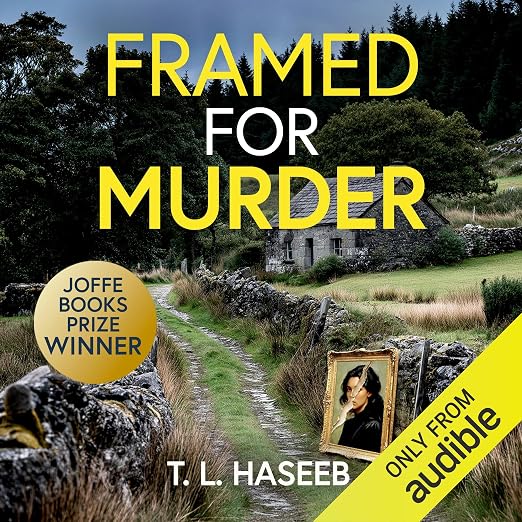
Clara’s Verdict
Debut crime novels arrive in numbers every month and most of them do one thing well. Framed for Murder does several, and it manages the hardest one first: it makes you believe that a detective with twelve years behind her genuinely intends to resign, and then gives her a reason to stay that is worth the delay.
Amber Kash is drafting her resignation letter when she is called to an interview room at Summerfield Police Station. Waiting inside is Joanna Merrick, a celebrity psychologist known from a true crime documentary called The Portrait Maker, and Merrick is nothing like her screen self. She is dirty, she is terrified, and she is making a claim that cannot possibly be true: three nights ago she watched a murder committed by a woman who is herself dead, a woman whose own killing was the subject of that documentary. A couple of hours after telling Kash this, Merrick is dead too.
That is an outstanding first act. The book won the Joffe Books Prize in 2025, the audiobook runs ten hours and twelve minutes with Aizah Khan narrating, and it is climbing the Audible UK charts with an average of 4.5 from a small but growing set of ratings. This is the opening of the Detective Inspector Amber Kash Mysteries, and it is a properly promising start.
About the Audiobook
What T L Haseeb has understood is that an impossible claim is only half of a good hook. The other half is what it costs the person who hears it. Kash is not a fresh recruit with everything to prove. The publisher describes her as sharp and stubborn, twelve years into the job and running out of reasons to stay on the force, which puts her in the most interesting possible position: experienced enough to know the claim is nonsense, tired enough not to care about protecting her record.
The book then complicates that with a secret from her own past, which the copy describes as ticking like an unexploded bomb underneath both the investigation and everything else she holds dear. I am generally wary of the detective with a buried past, because the device so often exists to give a procedural an emotional dimension it has not earned. Here it appears to be load-bearing, judging by how consistently the early reviewers mention being kept guessing about where the book was actually going.
The setting matters too. This is a firmly English crime novel built around a provincial station rather than a metropolitan force, and the publisher positions it for readers of Ann Cleeves, Elly Griffiths and L J Ross. That is the right neighbourhood: character-led, regionally rooted, more interested in people than in forensics. It is book one of a planned series, so you can begin here with no homework whatsoever, which is a real advantage over most of the procedurals currently in the charts.
The Narration
This is a substantial assignment for any narrator: ten hours, a lead who is exhausted and sardonic, a supporting cast of officers, and a victim who has to be credible as both a polished television personality and a woman in genuine terror.
The Merrick interview is the test the whole recording turns on. It arrives early, it is the listener’s introduction to the central mystery, and it requires a performance within a performance. Merrick is a woman the audience knows only from a screen, presented here in a state of collapse. A narrator who plays that too broadly turns her into hysteria and loses the credibility the plot depends on. Khan keeps it low, frightened and coherent, which is the version that makes Kash’s decision to stay on the case make sense.
For Kash herself, the useful quality is dryness. This is a woman who has already decided the job is not worth it, and she has to sound like it without becoming tiresome company across ten hours. Khan finds the balance. The early reviewers all describe the book taking hold immediately, though in fairness they are describing the experience of reading it rather than this recording. What I can say about the recording is that the voice settles who Kash is inside the first few minutes.
What Readers Say
Ninety one ratings at 4.5 is a good early signal, though I would note how recent the feedback is. Most of the reviews were posted in the second half of July 2026, inside a fortnight of release, which means this is the response of the author’s earliest and most engaged readers rather than a settled consensus.
“Several plot threads handled with skill, believable and interesting characters, and just the right degree of uncertainty about what genre this actually is.”
That is Mrs R M Summers, and the final clause is the most interesting observation anybody has made about this book. A debut that leaves readers pleasantly unsure whether they are in a police procedural, a psychological thriller or something stranger is doing something deliberate. Another reviewer, Dr S. Mann, files a piece headed “Gripping British mystery with a detective worth following” and praises how densely the twists are plotted, describing being made to second guess their own deductions throughout.
There is one point of transparency here, and the reviewer offers it herself. June, who gives it five stars and calls it a brilliant first book, discloses having received an advance copy from the publisher as well as having bought it. That does not invalidate the review, and I would much rather flag it here than have you discover it later.
Who Should Listen?
Procedural readers looking for a series to commit to at book one should start here. The Cleeves and Griffiths comparison is accurate enough to be useful, and the appeal of getting in on the ground floor of a series that looks likely to run for years is not a small thing. It also suits listeners who prefer their crime fiction character forward, since Amber Kash is plainly the reason to come back rather than the puzzle.
I would hesitate in two cases. If you insist on a large body of listener feedback before committing, ninety odd ratings collected inside a fortnight is thinner ground than the number makes it look. And if you want a tightly conventional whodunnit, be aware that one reviewer singles out never quite settling on the genre as a point in the book’s favour. Not every reader will agree. Treat it as a caution if you like your crime fiction to stay where it started.